

A Divorce Decree Doesn't Remove Your Ex From Your Home Loan. Here's What It Actually Does.
You and your co-applicant combined your incomes, passed the lender’s assessment, and got sanctioned for a loan neither of you could have managed alone. The EMI went out on schedule. For a while, everything worked exactly as planned.
Now the relationship has changed. A divorce. A sibling fallout. A parent who moved cities and wants the liability off their name. Someone wants out — and the question nobody thought to ask at signing has become the only one that matters: can one of you actually leave?
The short answer is yes. But “wanting out” and “actually being out” are two entirely different things, and the gap between them is where most exit situations go wrong.
This post covers the three legal routes, the math that determines whether an exit is even possible, the one misunderstanding that leaves people’s credit scores exposed for years — and what to sort out before you sign, not after.
Want to know whether the remaining borrower can qualify on their own before you invest in legal paperwork? ++Run a free eligibility check with Butter Money++ — takes 2 minutes, no branch visit, no CIBIL impact for either applicant.
The One Fact That Catches Everyone Off Guard: You’re Both Liable for the Full Loan
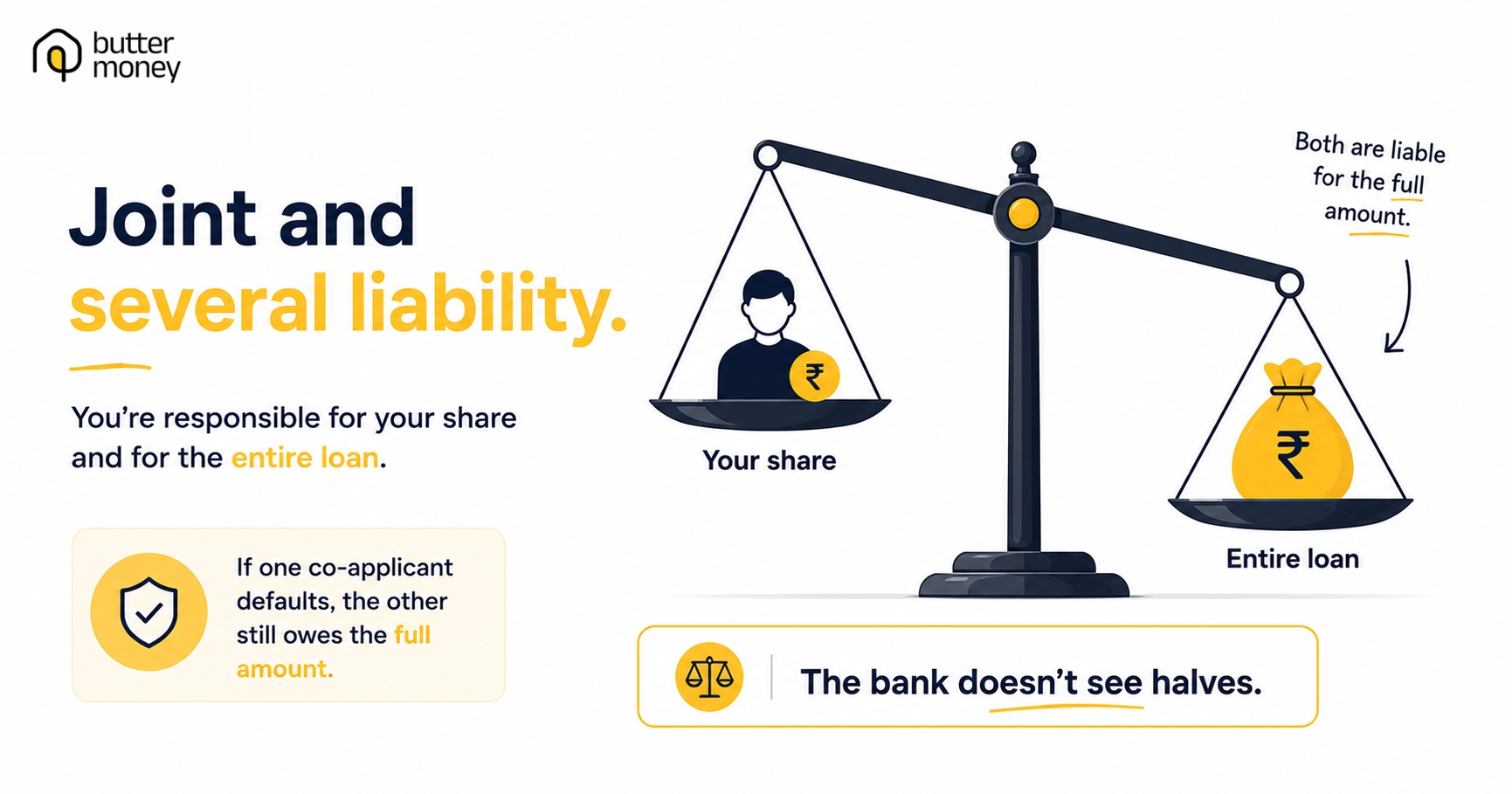
Most co-applicants assume a joint loan works like a 50-50 split — each person is responsible for their share, their half of the EMI, and their portion of the outstanding balance.
The law says otherwise. Every joint home loan is structured on joint and several liability. In plain English, that means:
- The lender can recover the entire outstanding amount from either borrower
- It doesn’t matter who earns more, who lives in the property, or what any private agreement between the two of you says
- If your co-applicant stops paying, disappears, or simply wants out, you are not on the hook for “your share” — you’re on the hook for the whole loan
- A written understanding between the two of you doesn’t bind the lender. Only a formal change to the loan account does
This is the structural fact that turns every “I just want out” request into a multi-step bank process — because removing one borrower changes the repayment guarantee the lender depends on.
What Triggers an Exit Request
In practice, the situations that bring this to a head are predictable:
- Divorce or separation — the most common trigger for spouse co-applicants by a significant margin
- Family disputes — siblings or a parent-child pair who bought together and can no longer maintain the arrangement
- Relocation abroad — one co-applicant moving and wanting an EMI obligation tied to a property they no longer live near off their credit profile
- New borrowing needs — one person taking on additional loans who needs the outstanding joint liability removed to qualify elsewhere
Whatever the reason, the lender’s process is the same.
The Three Real Paths Out
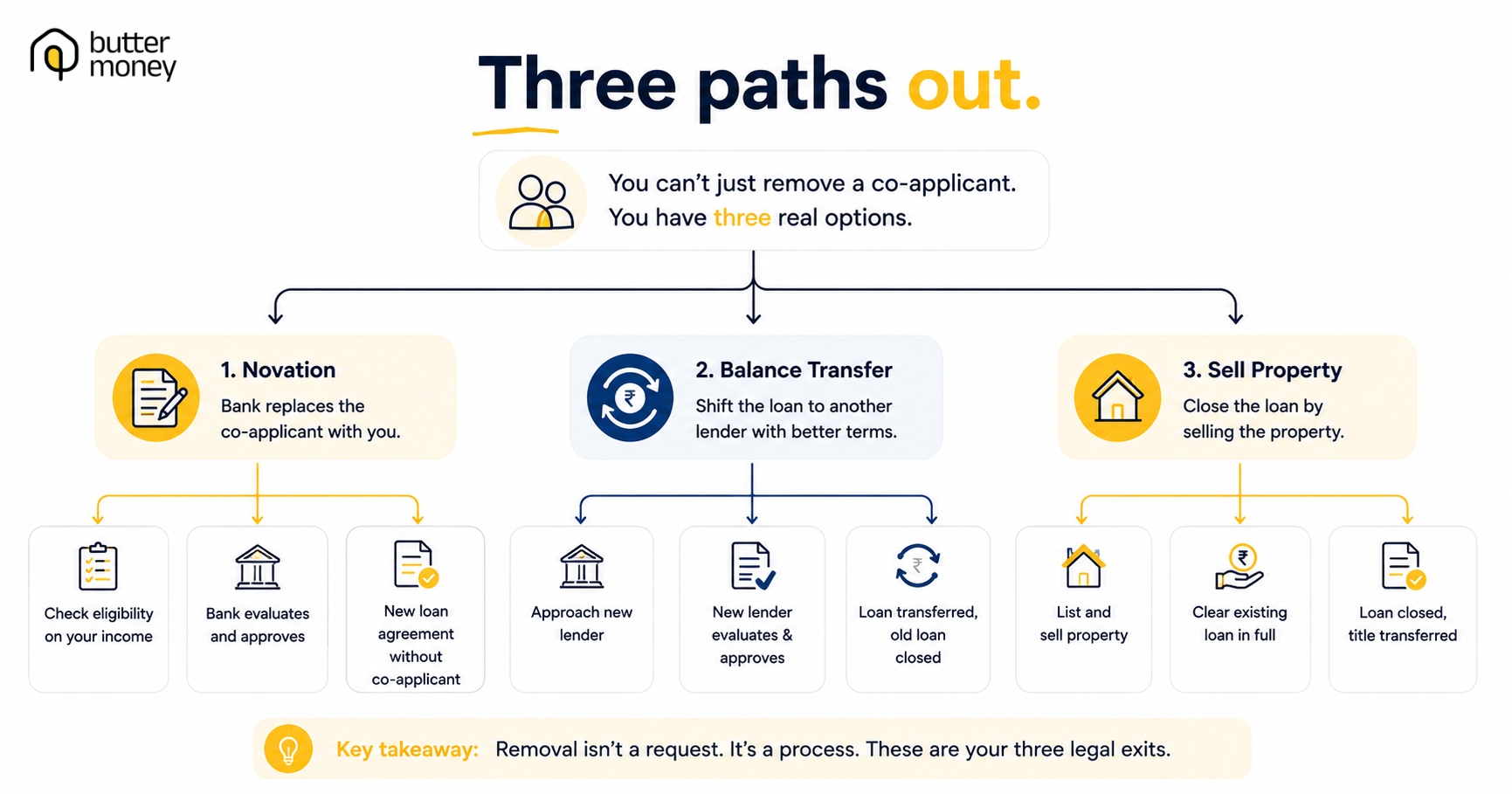
There is no “remove me” button. Every route goes through the bank — because removing a co-applicant changes who the lender is relying on for repayment, and they need to reassess that risk.
Path 1: Novation — the remaining borrower takes over solo
Novation is a formal agreement shifting full repayment responsibility from both borrowers to one. It’s the cleanest option when the current lender offers it.
What the process looks like:
- The remaining borrower submits a novation request to the lender
- The bank runs a fresh standalone assessment — FOIR check, credit pull, income verification, the same gatekeeping as a new application
- If approved, the exiting co-applicant is formally released from the loan
- If the property is also jointly owned, this is paired with a release deed or gift deed (depending on how the ownership is being transferred) that the exiting party signs to relinquish their stake
- That deed must then be registered at the sub-registrar’s office — attracting its own stamp duty and registration cost that most people don’t budget for
The novation only works if the remaining borrower can independently clear the eligibility bar. If they can’t, no lender will approve it regardless of how cooperative both parties are.
Path 2: Balance transfer under one name
If the current lender doesn’t offer novation — some don’t — the remaining borrower applies to a new lender to refinance the loan entirely in their own name:
- The new lender assesses the remaining borrower’s standalone eligibility
- If approved, the new loan closes the original joint loan completely
- Fresh processing fees, documentation, and paperwork apply
This costs more upfront than a novation, but it opens the door when the original lender won’t cooperate. It also gives the remaining borrower a chance to shop for a better rate in the same move.
Path 3: Sell the property and close the loan
The simplest exit on paper:
- Sell the property
- Use the proceeds to prepay and close the loan
- Split what remains per the ownership agreement
No credit reassessment, no release deed, no lender approval process for removal. The catch: both parties need to agree on sale price, timing, and how the remaining proceeds are divided — which is often the hardest part when the relationship has already broken down.
Can the Remaining Borrower Actually Qualify Alone? Run the Math Before Anything Else
This is the step most people skip, and it’s the one that decides whether an exit is even possible.
A worked example with conservative numbers:
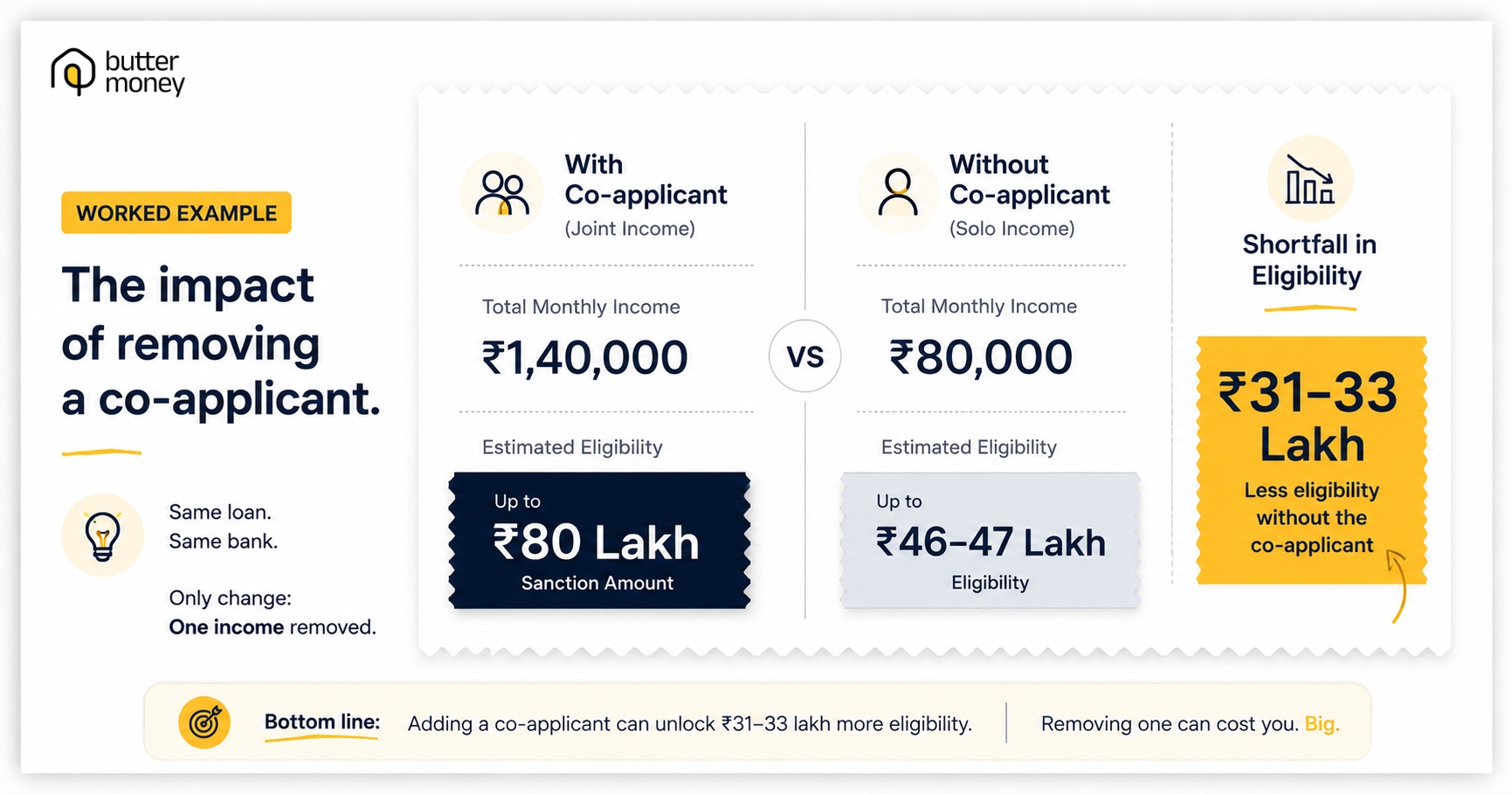
A couple qualifies together on a combined income of ₹1,40,000/month and takes a loan of ₹80 lakhs at 8.5% over 20 years. The joint EMI runs to approximately ₹69,600/month — well within their combined FOIR limit.
Now one partner, earning ₹80,000/month, wants to take over solo. The math:
| Joint (both) | Solo (remaining borrower) | |
| Monthly income | ₹1,40,000 | ₹80,000 |
| Max EMI at 50% FOIR | ₹70,000 | ₹40,000 |
| Loan eligibility (8.5%, 20yr) | ₹81–82 lakhs | ₹46–47 lakhs |
| Outstanding (if early in tenure) | ~₹78 lakhs | ₹78 lakhs |
| Shortfall | — | ~₹31–33 lakhs |
No lender will approve a novation with a ₹31–33 lakh gap between what the remaining borrower can independently support and what the loan actually owes.
What the remaining borrower can actually do when the gap is this large:
- Bring in a new co-applicant (a new partner, a sibling, a parent) to restore the combined income picture
- Make a lump-sum prepayment to shrink the outstanding to within solo eligibility range
- Wait — if the loan has been running long enough, the outstanding will have reduced and income may have grown
++Check your standalone eligibility numbers before you start the legal process++ — if the math doesn’t work, no amount of paperwork will.
Your CIBIL Score Doesn’t Know Your Relationship Status
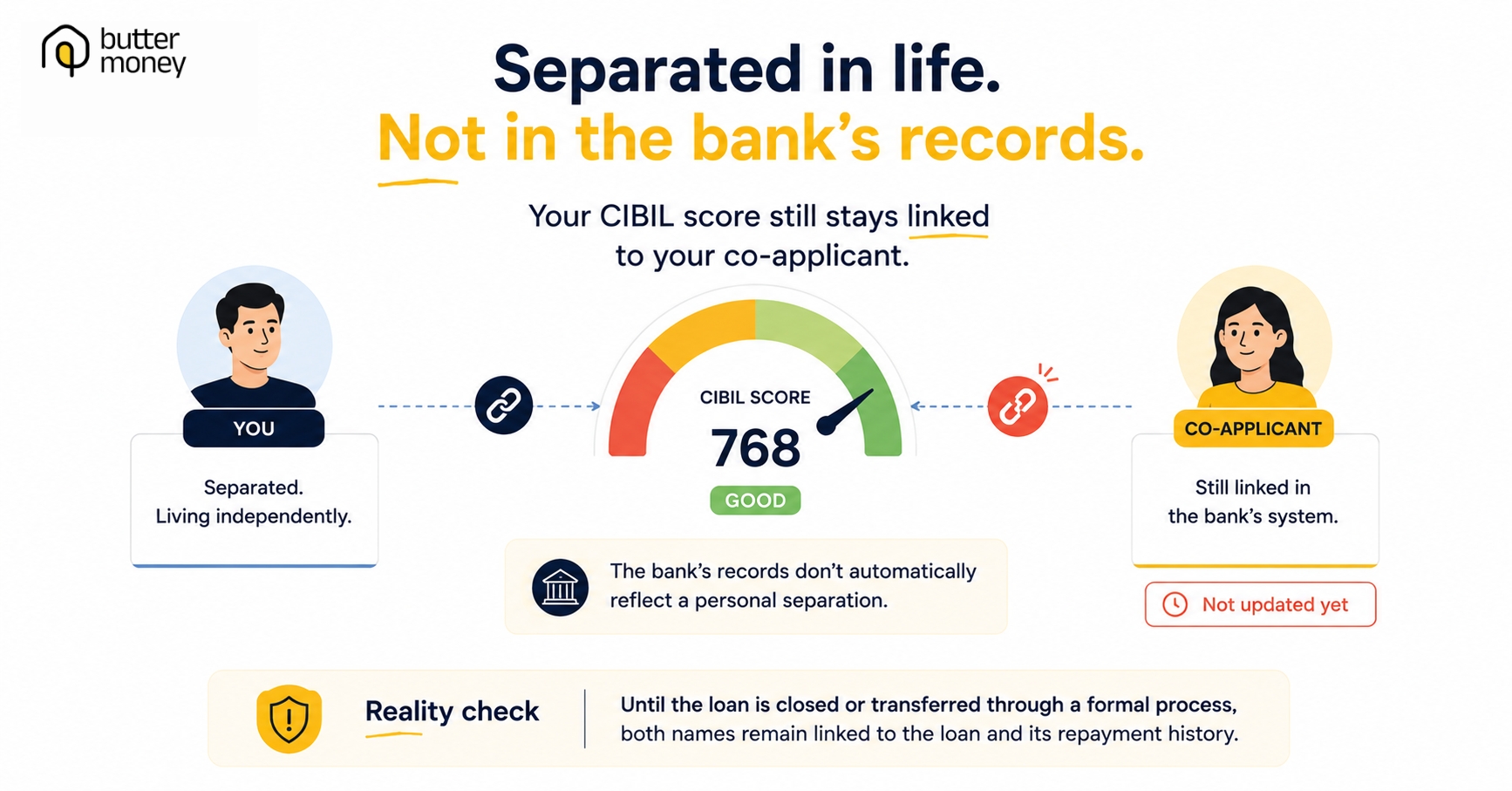
Until the loan is formally novated or refinanced, both names stay attached to it on both credit reports. Every EMI — paid or missed — continues to hit both scores equally.
It doesn’t matter that:
- You’ve separated
- A court case is in progress
- You personally haven’t managed the account in months
- A private agreement between the two of you says one person is responsible
The lender’s records are what the bureau reads. If the person still servicing the loan misses a payment six months after you’ve informally stepped back, your CIBIL score drops too.
This is where people get damaged without realising it — sometimes for years. If you are the one stepping back, treat getting formally removed from the loan as urgent, not a formality to handle eventually.
Seeing a dip in your score you can’t explain? ++Run a free check with Butter Money++ — we’ll help you figure out whether a joint loan is the source and what to do about it.
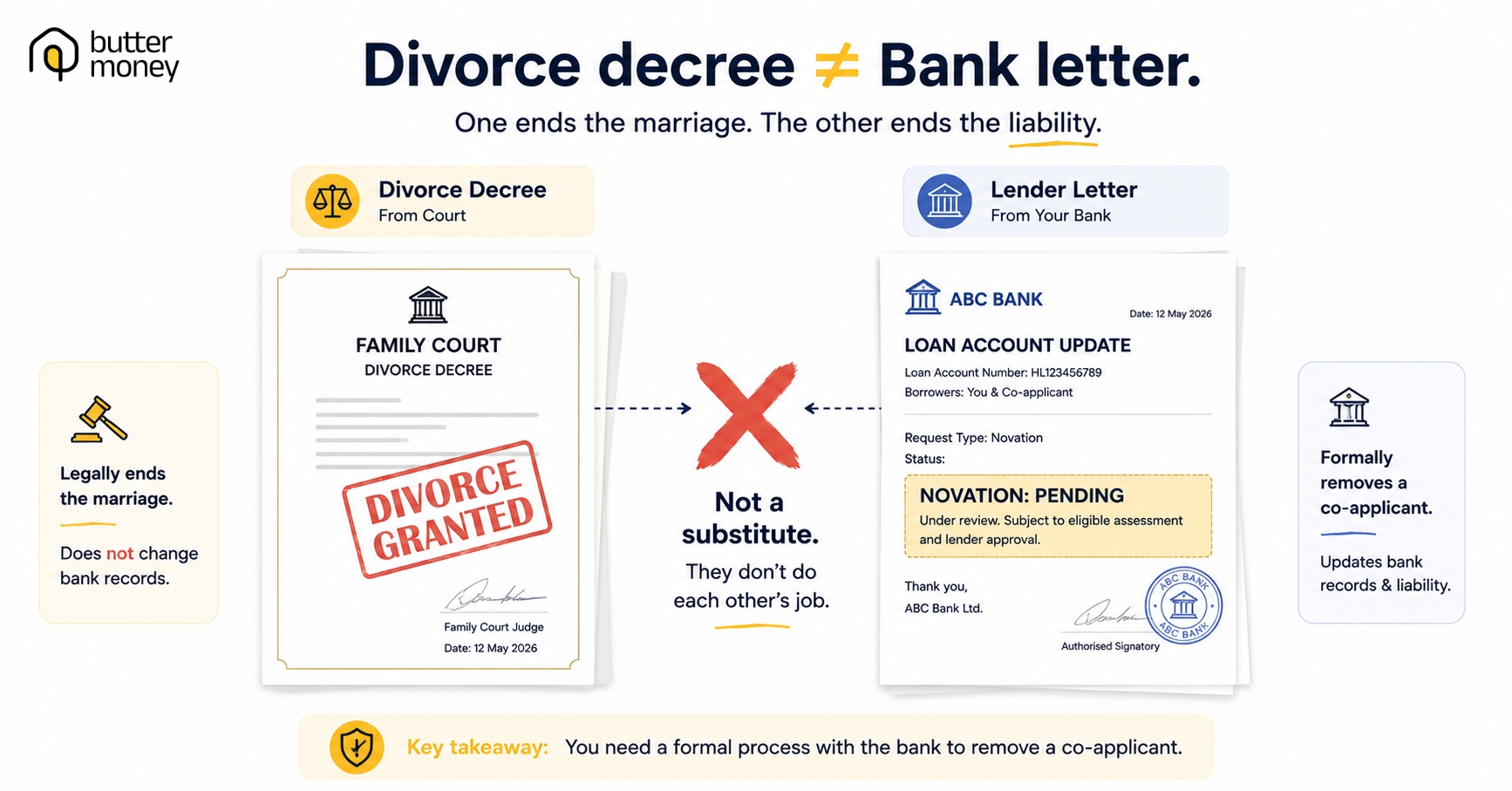
A Divorce Decree Doesn’t Update Your Loan Account
This is the most common misunderstanding we see in exit situations, and it’s the one that causes the most damage.
A mutual consent divorce, a settlement agreement, and a court order dividing assets all settle things between you and your former spouse. None of them instruct your bank to do anything.
Courts and lenders are completely separate systems that do not communicate:
- Your lender will still need a novation request
- They’ll still run a standalone credit reassessment on the remaining borrower
- If ownership is also changing, they’ll still need a registered release deed
- None of this is triggered by the divorce decree — you have to initiate it separately
The most common pattern: a couple treats the court order as the finish line, only to discover months later that both names and both credit profiles are still fully attached to the loan. The bank was never informed. Nothing changed on the loan account.
Don’t let the legal settlement and the loan process run in parallel and assume they’ll connect. They won’t.
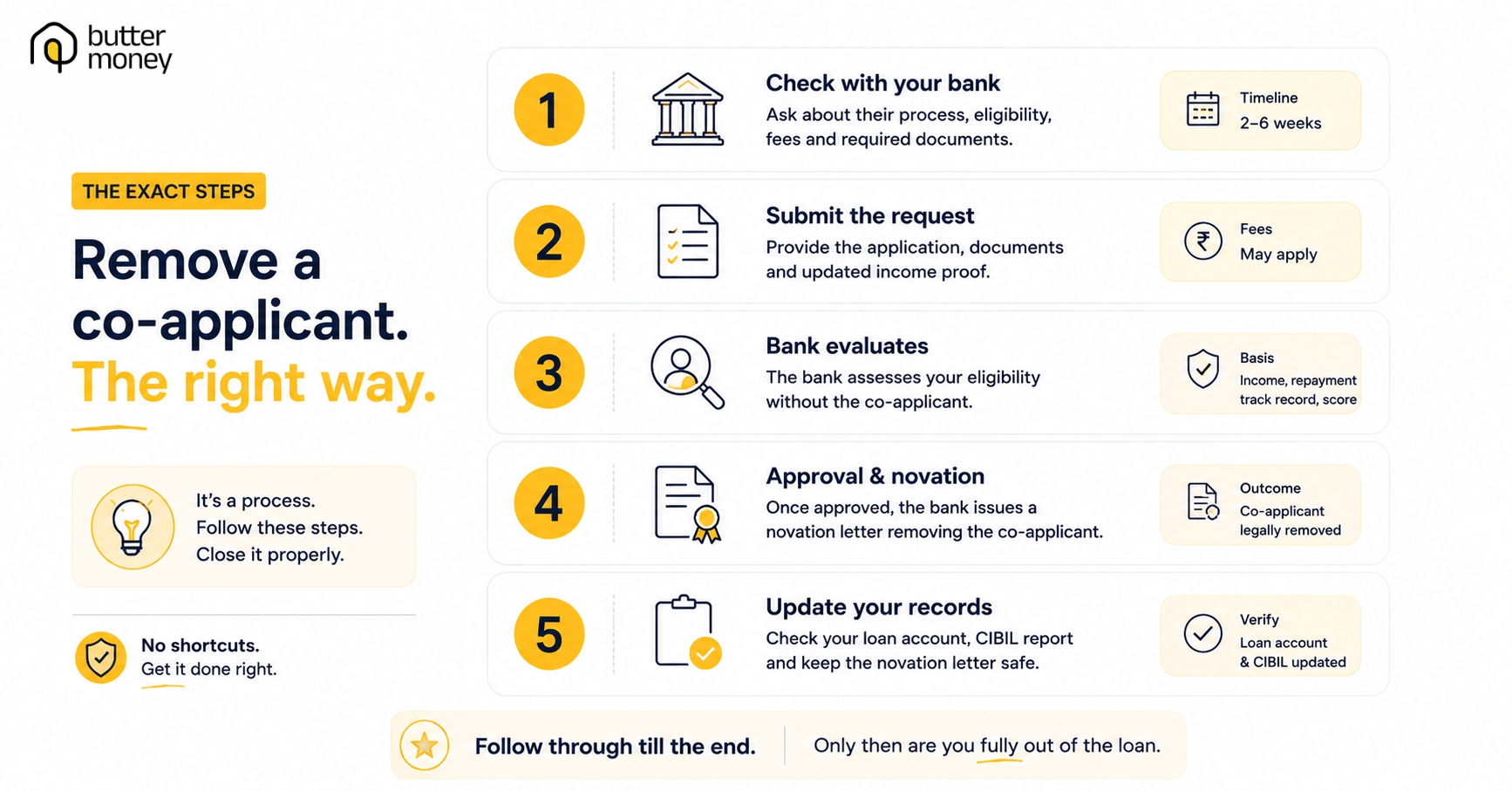
If You’re the One Who Wants Out: The Exact Steps
When This Is Actually More Manageable
To be honest about this: not every exit situation is equally difficult. A few scenarios where the process is genuinely more straightforward:
- The exiting co-applicant was never a co-owner. If they were added purely for income support and hold no ownership stake, you skip the release deed and property registration entirely. The novation still needs lender approval and a standalone credit check — but it’s fewer steps.
- The remaining borrower’s income has grown significantly since the original sanction. A big salary increase, a promotion, or a years-in-service income jump can close the eligibility gap without any prepayment. Run the updated numbers first.
- The loan has been running for 8–10 years and the outstanding has reduced substantially. As the principal is paid down over time, the remaining borrower’s standalone eligibility may already cover what’s left. Worth checking the current outstanding against current income before assuming a shortfall exists.
- Both parties are cooperative. The process has a clear, if slow, path when everyone agrees and documentation is in order. It’s uncooperative exits — one party refusing to sign the release deed, or disputes over sale price — that get genuinely difficult.
If any of these apply to you, the exit is still a formal process, but probably a less painful one than the general case suggests.
++See what your options look like with Butter Money++ — free eligibility check, no CIBIL impact, and we can give you an honest read on whether a solo takeover is viable before you start.
What to Settle Before You Sign, Not After
If you’re reading this before taking a joint home loan, this is simpler than it looks in hindsight. Have one conversation upfront:
- Will both co-applicants also be co-owners, or just co-applicants? (This matters for how complex an exit becomes.)
- How would an exit be handled if the arrangement needs to change?
- Are you sizing the loan on the assumption that both incomes will always be available? If yes, what’s the contingency if they’re not?
Documenting those answers — even informally — doesn’t create legal certainty, but it does remove the ambiguity that turns cooperative separations into disputes.
And before you decide how large a joint loan to take, check what you’d each qualify for independently. Not because you’re planning to split — but because knowing that number sets a floor you can both feel steady about.
The Bottom Line
A joint home loan is useful on the way in — it gets both people to a bigger sanction than either could reach alone. On the way out, that same interdependence is exactly what makes the process slow and conditional.
The exit is possible. It’s rarely fast. And whether it works at all comes down to one number: can the remaining borrower independently service what’s left? If the answer is yes, the process is inconvenient but manageable. If the answer is no, the options narrow fast.
The best time to have this conversation is before signing. The second-best time is now — before a delay on the formal process costs someone’s credit score.
++Talk to Butter Money about your situation++ — free, no branch visit, and we’ll give you an honest read on what’s actually possible.
FAQs
Q1.Can a co-applicant be removed from a home loan without the other person’s consent? No. Removing a co-applicant requires the lender’s approval and, in almost all cases, cooperation from both parties — one to exit, one to formally take over. If the other co-applicant refuses to cooperate, the process typically requires legal intervention and can take significantly longer.
Q2.Does a divorce decree automatically remove my ex from our joint home loan? No. A divorce decree settles matters between you legally, but the bank requires a completely separate process — a novation request, a fresh standalone credit assessment, and (if ownership is also changing) a registered release or gift deed. Courts and lenders don’t share information. You have to initiate the bank process independently.
Q3.What happens to my CIBIL score while the exit is being processed? Both credit reports remain linked to the loan until the lender formally processes the removal. Every payment — on time or missed — continues to affect both scores equally, regardless of any personal arrangement between the parties.
Q4.Can the remaining borrower take over without switching lenders? Sometimes — through a novation with the existing lender, if the lender offers it and the remaining borrower clears a fresh standalone eligibility check. If the lender doesn’t offer novation, or the remaining borrower doesn’t clear the standalone check, a balance transfer to a new lender under one name is the next option.
Q5.If the exiting co-applicant was never a co-owner, is the process simpler? Yes, moderately. You skip the release deed and sub-registrar registration step, since there’s no ownership stake to transfer. The lender’s novation approval and standalone credit reassessment still apply — those don’t change regardless of ownership status.
Q6.What if the remaining borrower can’t qualify solo right now? Three options: bring in a new co-applicant, make a lump-sum prepayment to shrink the outstanding to within standalone eligibility, or wait until income has grown or the outstanding has reduced enough. The bank won’t approve a novation with a gap — the math has to work first.
Q7.How long does the novation process typically take? It varies by lender. The credit reassessment alone can take 2–4 weeks, and if a release deed needs to be drafted and registered, add more time for that. 6–18 weeks end-to-end is a reasonable range; faster if documentation is clean and both parties cooperate.


