

NRI Home Loans in India: Complete Eligibility & Process Guide
You’re living abroad, the rupee looks attractive against your salary, and the family WhatsApp group keeps sending you listings in your home city. The pull to buy in India is real. The confusion is also real: Do you even qualify for a home loan as an NRI? Is the process different from what your cousin in Bengaluru went through? Which account does the money move through, and what happens if you can’t fly down to sign papers?
This guide answers all of it, in order. You’ll get the exact eligibility criteria lenders use, the documents to keep ready, the FEMA rules that govern every rupee, the step-by-step process, and one cost difference that catches most first-time NRI borrowers off guard. No jargon without a plain explanation, and an honest section on when an NRI home loan is not your best move.
Not sure where you stand? You can check your eligibility on butter.money in about 2 minutes — free, fully online, and with no impact on your credit score.
Can NRIs actually get a home loan in India?
Yes. NRIs, OCIs (Overseas Citizens of India), and PIOs (Persons of Indian Origin) can take a home loan from Indian banks and housing finance companies to buy residential or commercial property, with no special RBI permission needed. SBI, HDFC Bank, ICICI Bank, Axis Bank, Bank of Baroda, and LIC Housing Finance all run dedicated NRI desks. The catch is that an NRI loan is structured a little differently from a resident loan, and the differences are where the money is.
The loan itself works the same way a resident loan does: you borrow a percentage of the property value, repay in equated monthly instalments (EMIs), and the property is mortgaged to the lender until you’ve cleared the balance. What changes is the eligibility screening, the tenure on offer, the rate, and the rule that every payment must flow through specific Indian bank accounts. We’ll cover each below.
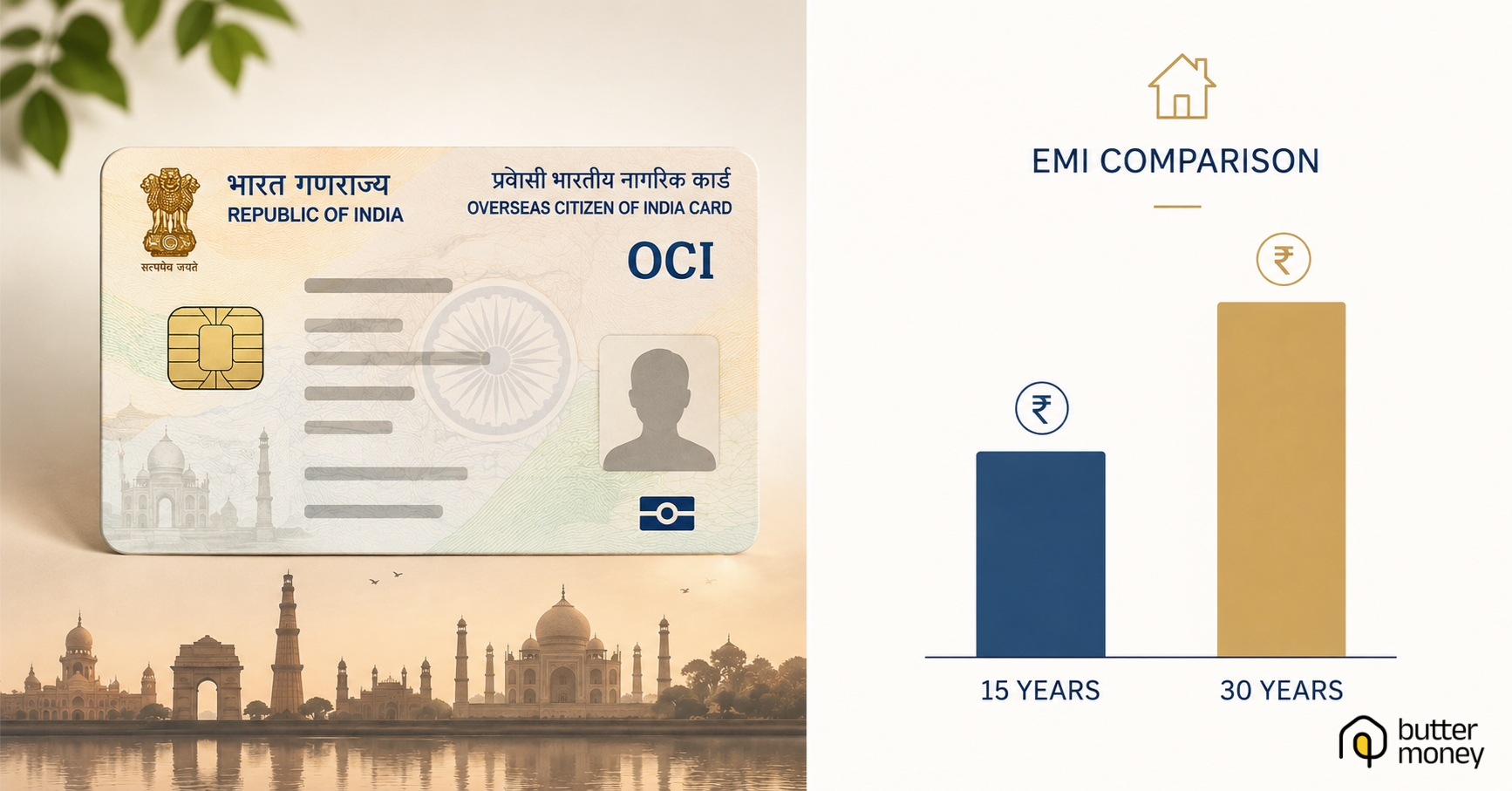
Who counts as an NRI, OCI, or PIO?
An NRI is an Indian citizen who lives outside India for work, business, or other reasons that suggest staying abroad for an uncertain period. For loan purposes, lenders generally expect you to hold a valid Indian passport and to have been employed or running a business abroad for a minimum stretch (more on that next).
An OCI (Overseas Citizen of India) holds a foreign passport but has Indian roots and a lifelong OCI card. For home loans, most lenders treat OCIs the same as NRIs. A PIO (Person of Indian Origin) is broadly similar in eligibility, though the PIO card itself has been merged into the OCI scheme. If you hold an Indian passport or an OCI card, you’re almost certainly eligible to apply.

NRI home loan eligibility: the exact checklist
Eligibility comes down to your professional stability, income, age, and credit profile. While the fine print varies by lender, the common requirements as of mid-2026 are:
- Age: Usually 21 years minimum at application, and the loan must typically be fully repaid by around 60 years (or your retirement age abroad).
- Employment — salaried: At least 2 years of overseas work experience, often with a minimum of 1 year at your current employer.
- Employment — self-employed: At least 3 years of business continuity abroad.
- Income: Varies by country of residence, since cost of living differs. Many lenders look for the equivalent of roughly USD 2,500–3,000 a month, or an annual income near USD 42,000, with higher thresholds for the US, UK, and UAE.
- Credit profile: Your Indian credit history still matters. A clean CIBIL record (CIBIL is India’s main credit bureau; your score runs 300–900) on any old Indian card or loan strengthens your case.
- Identity: A valid Indian passport or OCI card.
A resident Indian co-applicant — usually a close relative — isn’t mandatory, but it can lift your eligibility and is often recommended.
Want to know the loan amount your profile actually supports before you fall in love with a property? Run a free eligibility check on Butter Money — it takes about 2 minutes and won’t touch your CIBIL score.
The one thing most NRIs get wrong: your tenure is shorter
A floating-rate NRI home loan is usually offered at a shorter maximum tenure and a slightly higher interest rate than the same loan would carry for a resident — and that combination raises your monthly EMI more than most people expect.
Here’s the honest picture. A resident borrower can often stretch a home loan to 30 years. Many lenders cap NRI tenure lower — frequently around 15 years, and up to 20 years at some banks, depending on your age and profile. On top of that, NRI interest rates typically run about 0.2% to 0.7% higher than resident rates. The shorter tenure is the bigger lever, so let’s put real numbers on it.
Worked example: the EMI gap from tenure alone
Take an ₹80 lakh property with an 80% loan-to-value (loan-to-value is simply how much the bank lends against the property’s value), so a loan of ₹64 lakh at 8.6% per year — close to where SBI’s NRI rate sits in mid-2026. Holding the rate constant to isolate the tenure effect:
| Borrower structure | Tenure | Approx. EMI | Approx. total interest |
| Resident-style | 30 years | ₹49,700/month | ₹1.15 crore |
| Typical NRI cap | 15 years | ₹63,400/month | ₹50 lakh |
The 15-year NRI structure costs about ₹13,700 more every month — roughly 28% higher — than the 30-year structure, on the same loan at the same rate. That single line item reshapes your monthly budget abroad.
But notice the right-hand column, because this is the part competitor guides never show you: the shorter tenure means you pay around ₹65 lakh less in total interest over the life of the loan. The higher EMI isn’t a penalty so much as a faster, cheaper payoff. Whether that’s good or bad depends entirely on your monthly cash flow. If the EMI is comfortable, the shorter tenure is quietly working in your favour. (Figures are approximate, as of mid-2026, and move with the RBI repo rate.)
See your real EMI before you commit. Run your numbers through the Butter Money EMI calculator — adjust the tenure and rate to see exactly what fits your monthly income abroad.

What property you can — and can’t — buy
NRIs and OCIs can buy any number of residential and commercial properties in India without RBI approval. You cannot buy agricultural land, plantation property, or a farmhouse. As per FEMA (the Foreign Exchange Management Act, 1999, which governs all cross-border money movement), these categories can only come to you through inheritance, with no exceptions regardless of intent.
This is one of the most common and costly mistakes NRIs make. Buying a restricted property type is a FEMA violation that can attract serious penalties, so confirm the land classification before you pay a single rupee of token money.
How the money has to move: NRE, NRO, and FCNR accounts
Every rupee connected to the purchase — booking amount, down payment, and EMIs — must flow through your NRE, NRO, or FCNR account, or via direct inward remittance from abroad. Cash payments and direct transfers from a foreign bank account to the seller are FEMA violations.
Here’s the plain-English version of the three accounts:
- NRE (Non-Resident External): Holds your foreign income converted to rupees. Funds here are freely repatriable — you can send them back abroad without limit.
- NRO (Non-Resident Ordinary): Holds your India-sourced income such as rent or dividends. Repatriation from an NRO account is capped at USD 1 million per financial year, subject to tax compliance.
- FCNR (Foreign Currency Non-Resident): A deposit account that holds foreign currency, fully repatriable.
The single rule underneath all of this: your money trail must be clean and traceable through Indian banking channels. Keep every bank record, allotment letter, and agreement.

Documents you’ll need
NRI applications get more scrutiny than resident ones, so document readiness is what separates a smooth approval from weeks of back-and-forth. Keep these ready:
- Valid Indian passport (or OCI card)
- Visa or work permit / residence permit of your country of residence
- PAN card (mandatory for any property transaction in India)
- Overseas address proof (bank statement, utility bill, or driver’s licence)
- Salary slips for the last 3–6 months (salaried) or income tax returns and profit-and-loss statements (self-employed)
- NRE/NRO bank statements for 6–12 months
- Employment contract or appointment letter
- Property papers: allotment letter, buyer agreement, draft sale deed, title documents
- Power of Attorney, if you can’t be present in India (see below)
Power of Attorney: why you’ll probably need one
Because you live abroad, you’ll usually need a trusted person in India to handle signing and registration on your behalf, and that’s done through a Power of Attorney (PoA). Grant a Specific PoA, not a General PoA, so the authority is limited strictly to the tasks at hand. Before it’s registered in India, the PoA must be notarised in your country of residence or attested at the Indian Embassy or Consulate. A poorly drafted or unregistered PoA is a frequent cause of registration delays, so get this right early.

The step-by-step process
- Confirm your status and the property type. Verify you qualify as an NRI or OCI, and confirm the property isn’t on the restricted list (no agricultural land, plantation, or farmhouse).
- Arrange your funding route. Decide how much you’ll fund from NRE/NRO savings versus the loan, and ensure your accounts are in place.
- Check eligibility and get a sanction. Submit income and KYC documents; the lender assesses your profile and issues a loan approval letter (the amount it’s willing to lend).
- Complete property and legal due diligence. Verify the title is clear and the project is RERA-registered (RERA is the Real Estate Regulatory Authority that protects buyers).
- Set up your Power of Attorney if you can’t be present, properly notarised or embassy-attested.
- Sign, register, and have funds released. The agreement is registered, stamp duty (a state tax, typically 3%–8% of value) and registration fees are paid, and the lender releases funds.
- Repay via NRE/NRO. EMIs are debited from your NRE or NRO account, or paid through inward remittance. Rental income from the property can also service the EMI.
Repatriation: getting your money back out when you sell
You can repatriate the sale proceeds of up to two residential properties, provided you originally bought them through your NRE account or via inward remittance. Beyond that, repatriation from an NRO account is capped at USD 1 million per financial year, subject to tax clearance.
This is worth planning before you buy, not after you sell. If sending money back abroad later matters to you, funding the purchase through your NRE account from the start keeps that door open.
A note on tax deductions
NRIs can claim the same home loan tax deductions as residents — under Section 80C for principal repayment and Section 24(b) for interest paid — but only against income that is taxable in India. If you earn rent on the property or have other Indian-source income, the deductions reduce your Indian tax. If you have no taxable income in India, there’s nothing for the deduction to offset, so the benefit may not apply to you. This is exactly the kind of detail that’s easy to assume and expensive to get wrong, so confirm your position with a tax advisor.
When an NRI home loan might not be your best move
An honest guide tells you when to pause. A loan isn’t automatically the right call. Reconsider, or at least run the math carefully, if:
- You have enough NRE savings to fund the purchase outright and no other use for that capital. If your foreign deposits earn less than 8.6%, borrowing makes sense; if they earn more, or you’d rather stay liquid, paying down is a real alternative.
- You have no taxable income in India. Without Indian income to offset, you lose the tax deductions that make borrowing more efficient for residents.
- You’re planning to return to India soon. Your status, income source, and the account rules all change when you become a resident again, which can complicate an existing NRI loan.
- The rupee’s direction worries you. You earn abroad and repay in rupees. If your home currency weakens against the rupee over the loan’s life, your effective cost rises. This is a genuine risk, not a reason to avoid buying — just one to size honestly.
If any of these apply, talk it through before signing. Butter Money’s advisors can help you compare lender offers and pressure-test whether a loan or a self-funded purchase serves you better.
In summary
Buying a home in India as an NRI is well within reach, and the path is more navigable than the paperwork first suggests. The fundamentals are simple: confirm you qualify, keep your documents clean, route every rupee through the right account, and budget for the shorter tenure that quietly raises your EMI — while remembering it also cuts your total interest. Get those four right and the rest is process. Your home in India isn’t a someday. With the numbers in front of you and the rules understood, it’s a decision you’re now equipped to make.
Frequently asked questions
Q1.Can an NRI get a home loan in India without visiting? Yes. Most major lenders allow NRIs to apply online and complete much of the process remotely. For signing and registration, you can appoint a trusted person in India through a Specific Power of Attorney, notarised in your country or attested at the Indian Embassy. Physical presence is helpful but not essential if your PoA is in order.
Q2.How much home loan can an NRI get? Lenders typically finance 75%–85% of the property value, and up to 90% in some cases, with the rest paid as your down payment. The final amount depends on your income, age, credit profile, and the lender’s policy. The actual loan you qualify for is best confirmed with an eligibility check.
Q3.What is the maximum tenure for an NRI home loan? NRI tenure is usually shorter than for residents. Many lenders cap it around 15 years, with some extending to 20 years depending on your age and profile, against the 30 years a resident can often get. The shorter tenure raises your monthly EMI but reduces total interest paid.
Q4.Which account can an NRI use to repay the home loan? EMIs must be paid from your NRE or NRO account, or through inward remittance from abroad. Rental income earned on the property can also be used to service the EMI. Direct payment from a foreign bank account to the lender is not permitted under FEMA.
Q5.Can an NRI buy any property in India with a home loan? You can buy residential and commercial property freely, but not agricultural land, plantation property, or farmhouses, which are restricted under FEMA and can only be acquired by inheritance. Always confirm the land classification before paying any token amount.
Q6.Are NRI home loan interest rates higher than for residents? Typically yes, by roughly 0.2% to 0.7%, though the gap varies by lender and profile. As of mid-2026, NRI home loan rates broadly sit in the 8.5%–9.5% range. Because rates are floating and linked to the RBI repo rate, they move when the RBI changes the rate.
Q7.Can an NRI claim tax benefits on a home loan? Yes, under Section 80C for principal and Section 24(b) for interest, but only against income that is taxable in India, such as rental income from the property. If you have no taxable Indian income, the deductions may not benefit you. Confirm your specific position with a tax advisor.


