

Property Registration Delays: Why They're Holding Up Your Home Loan Disbursement in 2026

Your home loan is sanctioned. The seller has agreed on a date. Your EMI calculator has been open on your phone for a week. And then — nothing moves, because a sub-registrar’s portal won’t accept your Khata number.
Buyers spend weeks comparing interest rates and processing fees. But one of the reasons disbursement gets delayed usually has nothing to do with the bank — it’s the registration. Nowhere is this more visible right now than in Karnataka, where a string of overlapping reforms has made 2026 a genuinely tricky year to time a registration and a disbursement together.
Quick answer: Banks withhold final disbursement on resale and ready properties until the sale deed is registered, because an unregistered property can’t legally be mortgaged. In Karnataka, e-Khata verification, guidance value revisions, and SRO slot scarcity are the three most common reasons registration — and therefore disbursement — slips past your sanction letter’s validity window.
Not sure where your file stands against a lender’s timeline? ++Check your eligibility with Butter Money++ — free, 2 minutes, no CIBIL impact, and we’ll flag anything in your documentation that could slow registration down before it becomes a disbursement problem.
Why Registration and Disbursement Are Joined at the Hip
A sanction letter tells you what a lender is willing to lend. Disbursement is the lender actually releasing that money. For a resale or ready property, banks almost always withhold the final tranche until the sale deed is registered.
This isn’t bureaucratic caution — it’s structural:
- Until the deed is registered, the property isn’t legally transferred
- Without legal transfer, the bank cannot create an enforceable mortgage on it
- A registered deed is what lets a lender file its charge with CERSAI and treat the property as valid collateral
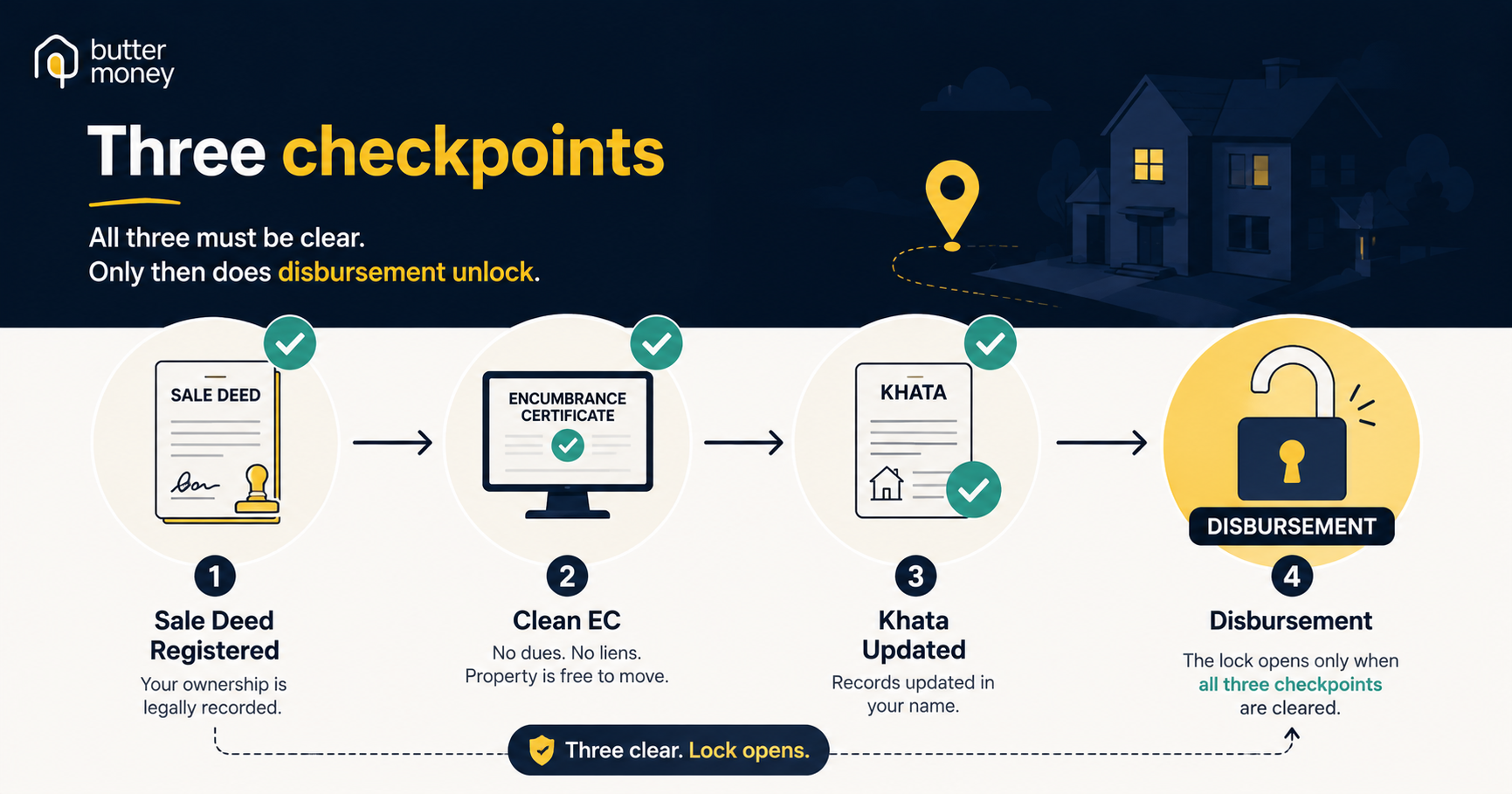
So while your sanction letter might arrive in days, your money doesn’t move until three things are in place:
- The sale deed is registered at the jurisdictional Sub-Registrar Office (SRO)
- The property carries a clean, updated Encumbrance Certificate (EC)
- Ownership records (Khata, in Karnataka’s case) reflect the buyer’s name, or are at least in the process of transfer
A delay at any one of these three checkpoints holds up the fourth thing everyone actually cares about: your money reaching the seller.
The Karnataka Picture Right Now
Karnataka has been mid-overhaul of its land records and registration stack for two years, and 2026 is the year several of those changes are colliding at once.
e-Khata is a hard gate, not a formality
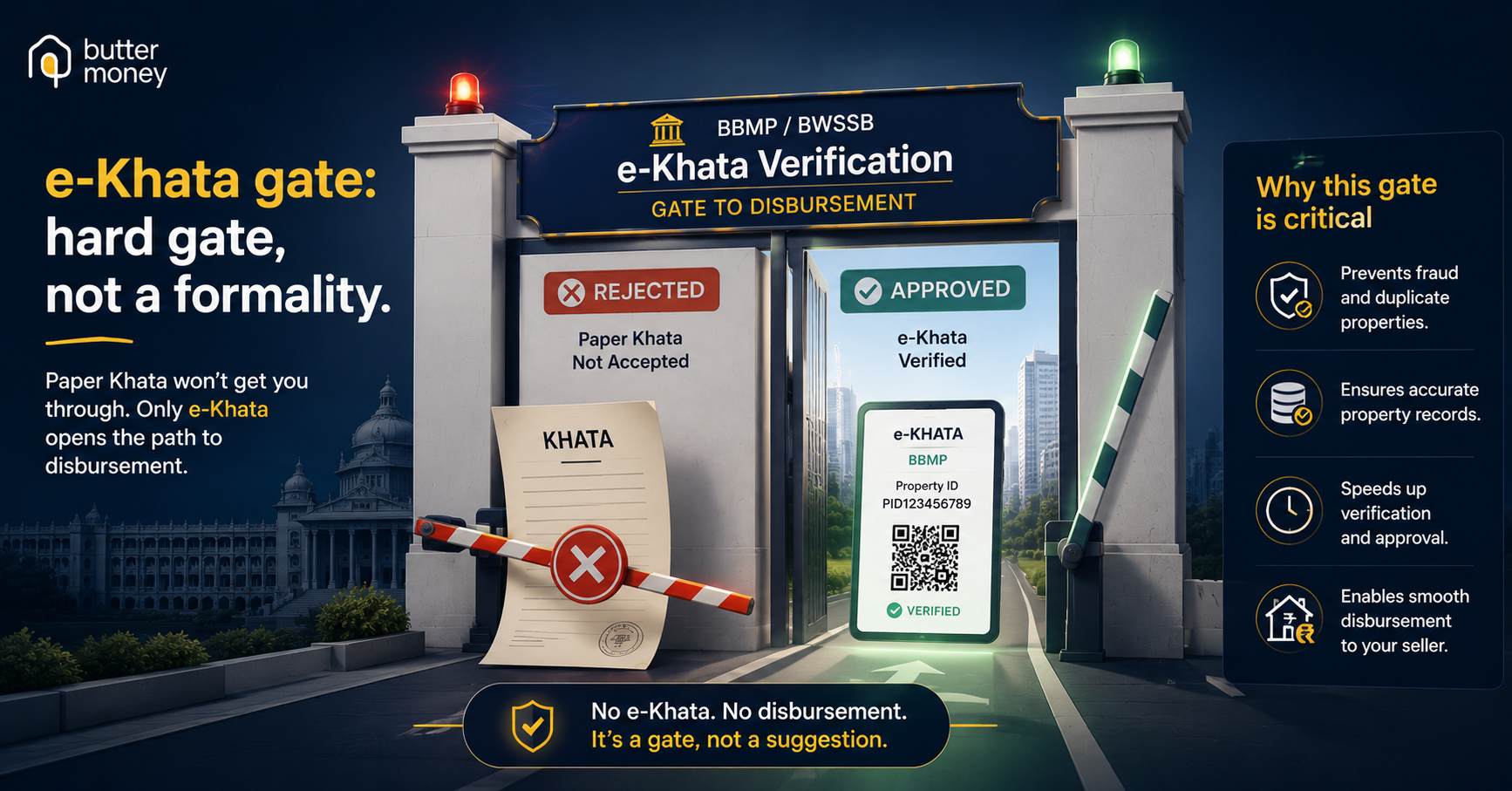
Since e-Khata became mandatory for registration on 1 July 2025, the Kaveri 2.0 portal will not generate a sale deed unless a verified e-Khata reference is linked to the property — and the sub-registrar has no discretion to override this. The software blocks the transaction outright.
Two things worth knowing:
- A workaround some SROs used in 2024–25 — accepting court-order exemptions or municipal undertaking letters instead of e-Khata — was curtailed sharply after a late-2025 audit, and is effectively closed now
- Properties near the border zones of the five new city corporations under the Greater Bengaluru Authority (GBA) have been especially prone to delays, as ward-level records migrate
Guidance values have moved twice in quick succession
Two changes have landed within twelve months of each other:
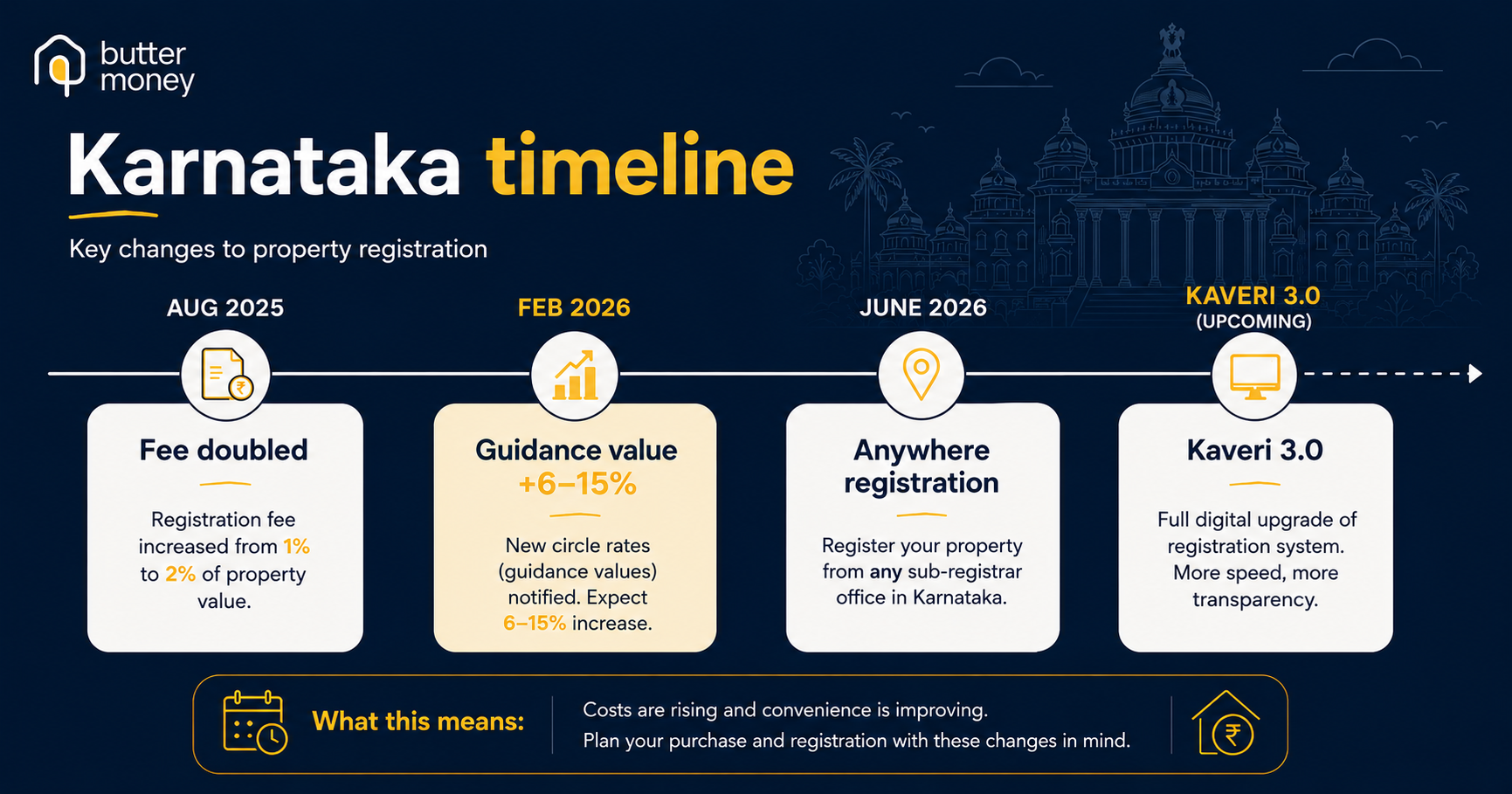
- Registration fee doubled from 1% to 2% of property value, effective 31 August 2025 — the first such increase since 2003
- Guidance values in Bengaluru urban limits were revised up 6–15%, effective February 2026
Together, these push the statutory cost of registering a BBMP-jurisdiction property above ₹45 lakh from roughly 6.6% to about 7.6% of the property’s value. A further 10–15% statewide revision has been under discussion for months, with the formal gazette notification repeatedly delayed — which means SRO appointment slots, already tight in the October–March season, get booked out weeks in advance whenever a revision is rumoured to be imminent.
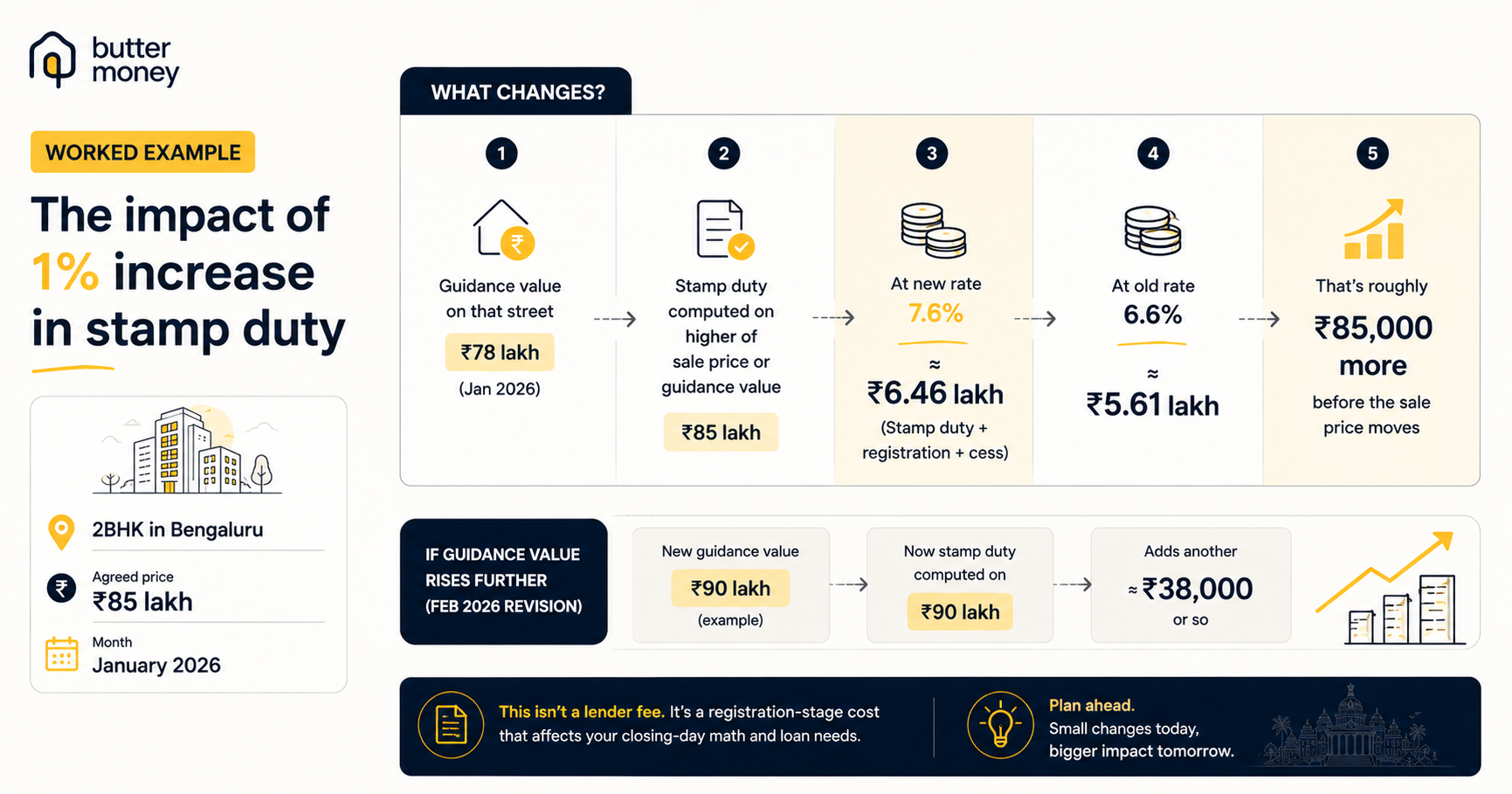
Worked example. Say you agreed to buy a 2BHK in Bengaluru for ₹85 lakh in January 2026, when the guidance value on that street stood at ₹78 lakh.
- Registered value used for stamp duty = higher of sale price or guidance value = ₹85 lakh
- Statutory charges at the new 7.6% (stamp duty + registration fee + cess) ≈ ₹6.46 lakh
- At the pre-August-2025 rate of 6.6%, the same deal would have cost ≈ ₹5.61 lakh
- That’s roughly ₹85,000 more, before the sale price itself moves
- If the February 2026 revision then pushes your specific SRO zone’s guidance value to, say, ₹90 lakh — above your agreed price — stamp duty is now computed on ₹90 lakh, not ₹85 lakh, adding another ₹38,000 or so
None of this is a lender fee. It’s a registration-stage cost that changes your closing-day math and, if you’re stretching your down payment to cover it, can affect how much loan you actually need.
Real reform is underway too
- From June 2026, Karnataka rolled out anywhere registration — buyers can now register a sale deed at any operational SRO within their registration district, instead of being tied to one local office. This directly targets the slot-booking bottlenecks that built up under the old jurisdiction-locked system.
- Kaveri 3.0, an AI-driven upgrade announced in the 2026–27 state budget, promises tighter integration across land record departments and, eventually, remote registration without a mandatory SRO visit. It is not live yet — Kaveri 2.0 remains the system buyers deal with today.
Put together: registration in Karnataka is faster on paper than it was two years ago, but the transition itself is the source of a lot of current friction — and that friction routes straight into disbursement timelines.
Where This Actually Bites Your Loan
Sanction letter validity is a ticking clock. Most sanction letters carry a limited validity window. If registration slips because of an e-Khata correction cycle or a fully booked SRO, you can end up needing a fresh sanction — sometimes on updated terms, since rates or eligibility checks may have moved on in the interim.
Old paper Khatas get rejected outright. This is one of the most common ways deals stall in Karnataka right now:
- The seller has a perfectly valid, older paper Khata
- Kaveri 2.0 requires a verified e-Khata to even generate the deed
- If that migration hasn’t happened, registration — and disbursement — cannot proceed until it does, regardless of how ready your loan is
Resale carries more risk than new-builds. Builder projects often route disbursement through staged, construction-linked tranches with their own tripartite agreements. Resale purchases don’t have that cushion — the bank is typically waiting on one clean registration event, so any single blocker (EC discrepancy, Khata mismatch, a guidance-value shortfall between agreed price and government value) stalls the entire disbursal, not just a part of it.
Buffer time has quietly become a real cost. SRO slots are scarce in peak months, khata migrations sometimes run weeks past their stated turnaround, and the informal “registration will take a couple of weeks” assumption most home loan timelines are still built around is increasingly unreliable in Karnataka specifically.
Worried your registration timeline doesn’t match your sanction validity? ++Run a free eligibility check with Butter Money++ — no branch visit, no impact on your CIBIL score, and it takes about two minutes.
What Borrowers Can Actually Do About It
- Check the property’s e-Khata status before signing anything, not after. A seller’s assurance that “the Khata is fine” isn’t the same as a verified reference number on e-Aasthi.
- Verify the current guidance value on Kaveri rather than relying on what the agreement to sell assumed — a mismatch discovered on registration day can change the stamp duty payable and delay the appointment itself.
- Book your SRO slot as early as your documentation allows, especially in the October–March window or around a rumoured guidance value revision.
- Ask your lender about the sanction letter’s validity window upfront, and build your registration timeline backward from that date rather than forward from when you expect to be ready.
- For older or resale properties, confirm the Khata migration status first — if it’s a paper Khata, factor in the real-time e-Khata conversion time before committing to a closing date.
When This Isn’t Your Problem
To be fair to the process: not every buyer needs to worry about this the same way.
-
Under-construction builder purchases with construction-linked, tranche-based disbursement don’t hinge on a single registration event the way resale does — a delay at one stage usually doesn’t freeze the whole loan.
-
If the property already has a verified e-Khata and a clean, recent EC before you even start house hunting, most of this friction simply doesn’t apply to you — confirm this upfront and it stops being a variable.
-
Outside Karnataka, the specific e-Khata and Kaveri mechanics described here don’t apply — other states run their own registration systems with their own bottlenecks, so don’t assume this exact checklist transfers.If your deal falls into one of these buckets, the bigger risk to your timeline is probably elsewhere — worth a quick check rather than an assumption either way.
The Bottom Line
Karnataka’s registration system is genuinely modernising — anywhere registration and the promised Kaveri 3.0 upgrade are real steps toward a faster SRO experience. But until that transition fully settles, the gap between “loan sanctioned” and “loan disbursed” is wider than most buyers plan for.
Building that buffer into your home-buying timeline isn’t pessimism — it’s just how the process works right now. The buyers who avoid last-minute scrambles aren’t the ones who get lucky with a clean Khata; they’re the ones who checked before they needed to.
++Talk to Butter Money++ about where your registration timeline stands against your sanction — free, and it might save you a fresh sanction letter later.
FAQs
Can my home loan be disbursed before the property is registered? Rarely, for resale or ready properties. Lenders generally require a registered sale deed before releasing the final tranche, since an unregistered property can’t be legally mortgaged. Under-construction builder purchases are the main exception, in which disbursements occur in construction-linked stages.
What is e-Khata and why does it block registration in Karnataka? e-Khata is Karnataka’s digital ownership record, mandatory for sale deed registration since 1 July 2025. The Kaveri 2.0 portal will not generate a deed without a verified e-Khata reference — sub-registrars cannot override this manually.
How long does property registration take in Bengaluru right now? Typically 2–4 weeks end-to-end when documentation is clean, but Khata migration issues, SRO slot scarcity, or a guidance value mismatch can extend this considerably. Build in more buffer than the “typical” figure suggests.
What happens if my sanction letter expires before registration completes? You’ll usually need a fresh sanction, potentially on updated terms if rates or your eligibility profile have changed. Ask your lender about the validity window as soon as you’re sanctioned, not when it’s about to lapse.
Is anywhere registration in Karnataka actually live? Yes, as of June 2026, buyers can register a sale deed at any operational SRO within their registration district, rather than being tied to one jurisdiction-locked office.
Does a guidance value hike affect a loan I’ve already been sanctioned for? Not the sanctioned loan amount itself, but it can affect your out-of-pocket registration cost if the revised guidance value exceeds your agreed sale price — stamp duty gets computed on the higher figure.


