

The Property Valuation Gap: Why Your Bank Values It Lower Than the Seller's Price
You’ve found the flat. You’ve negotiated the price down as far as the seller will go. You’ve worked out the split in your head — this much loan, this much down payment, sorted. Then the bank’s valuer visits the property, and the number that comes back is lower than what you just agreed to pay.
Now the down payment you budgeted for isn’t enough. You’re short by lakhs, with little time to arrange the difference before the deal falls through.
This happens more often than most first-time buyers expect, and almost nobody explains it before it happens. Here’s why your bank’s valuation can land below the seller’s price, how large that gap can realistically get, and what to actually do about it — before it shows up as a shortfall days before registration.
Check your eligibility on Butter Money in about 2 minutes — free, fully digital, no branch visits, and no impact on your CIBIL score. Doing this before you sign the sale agreement means a valuation surprise won’t catch you off guard later.
Two Numbers Your Bank Cares About — Not Just the One You Agreed To
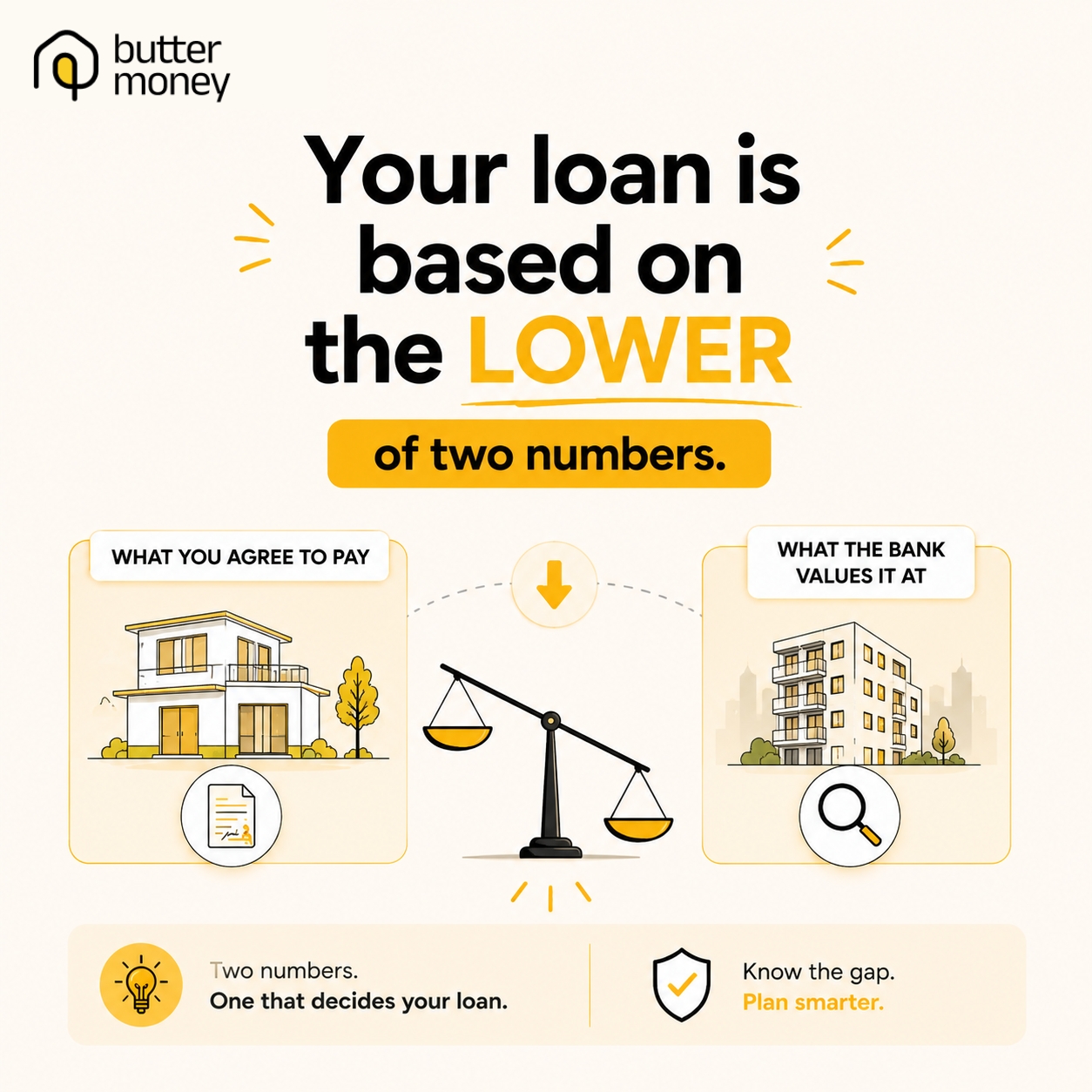
When you negotiate a flat, there’s really only one number in your head: the agreement value — what you and the seller shook hands on. But your bank works with two numbers, and it’s the smaller of the two that decides your loan.
The second number is the bank’s valuation — an independent assessment of the property’s market value, done by a valuer empanelled with the lender, not by you or the seller. Home loans in India are sanctioned as a percentage of the lower of the agreement value and this bank valuation, not the price you negotiated. If the valuer’s number is lower, your loan shrinks to match it — even though the price you owe the seller stays exactly the same.
As per RBI’s loan-to-value (LTV) norms, lenders can typically finance up to 90% of the property value for loans up to ₹30 lakh, up to 80% for loans between ₹30 lakh and ₹75 lakh, and up to 75% for loans above ₹75 lakh. The remaining margin is what you’re expected to bring in as a down payment. The catch: that percentage is applied to the bank’s valuation, not your agreement value, whenever the two don’t match.
Why Bank Valuations Often Come In Lower
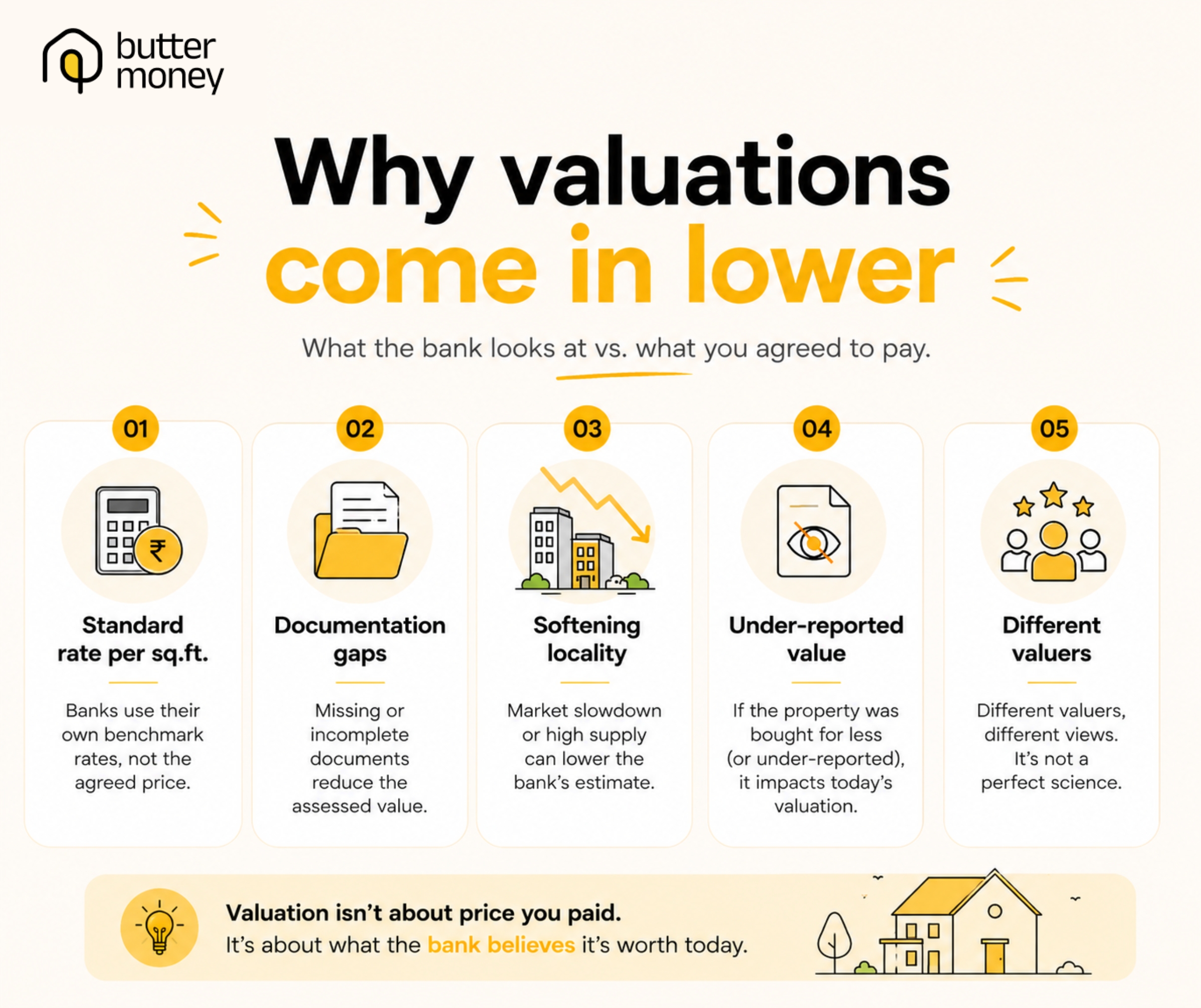
A valuer isn’t pricing your flat the way you and the seller did — through negotiation, urgency, or attachment to a floor with a good view. They’re working off a formulaic, deal-agnostic process, and a few things routinely pull their number below the agreement price:
The valuer prices the building, not the deal. Bank valuers typically apply a standard rate per square foot for the locality, adjusted for floor, age, and approved area, based on recent comparable sales. This method rarely captures what you’re personally paying for — a renovated interior, a corner unit, or a seller who simply wanted a quick sale and priced accordingly.
Documentation gaps and construction deviations. Unapproved extensions, a mismatch between the sanctioned plan and actual construction, a missing occupancy certificate, or an old building nearing the end of its useful life all push a valuer to discount the property, sometimes sharply.
A softening locality. If resale activity in the area has slowed or nearby transactions have come in lower recently, the valuer’s comparable-sales data reflects that correction — even if the seller’s asking price hasn’t caught up yet.
A price that includes value the valuer can’t verify. Sometimes a portion of what a buyer and seller agree to isn’t the figure that ends up in the registered sale deed or the loan application. Where that happens, the bank valuation and the registered value will naturally sit lower than the actual price changing hands — and it’s worth knowing that under-reporting a transaction’s value carries its own tax and stamp duty risk for both sides, quite apart from the loan gap it creates.
Different valuers, different numbers. Valuation isn’t standardised the way a CIBIL score is. Two banks can send two valuers to the same flat and land on two different figures, sometimes a meaningful distance apart.
The Worked Example: How a 10% Valuation Gap Becomes a 30% Bigger Down Payment
Numbers make this concrete. Say you’ve agreed to buy a flat for ₹80,00,000. At this loan size, RBI’s LTV cap is 75%, so you plan for:
- Expected loan: ₹60,00,000 (75% of ₹80 lakh)
- Expected down payment: ₹20,00,000
The bank’s valuer then assesses the property’s market value at ₹72,00,000 — just 10% below your agreement price. Because the loan is based on the lower of the two figures, your sanctioned amount recalculates to:
- Actual loan: ₹54,00,000 (75% of ₹72 lakh)
- Actual down payment needed: ₹80,00,000 − ₹54,00,000 = ₹26,00,000
A 10% gap in valuation just turned your ₹20 lakh down payment into a ₹26 lakh one — a 30% jump, and ₹6 lakh you likely hadn’t set aside. This is precisely why it’s worth checking your numbers on a savings or EMI calculator before you commit funds, so you know exactly how much cushion you’re working with if a valuation comes in lower than expected.
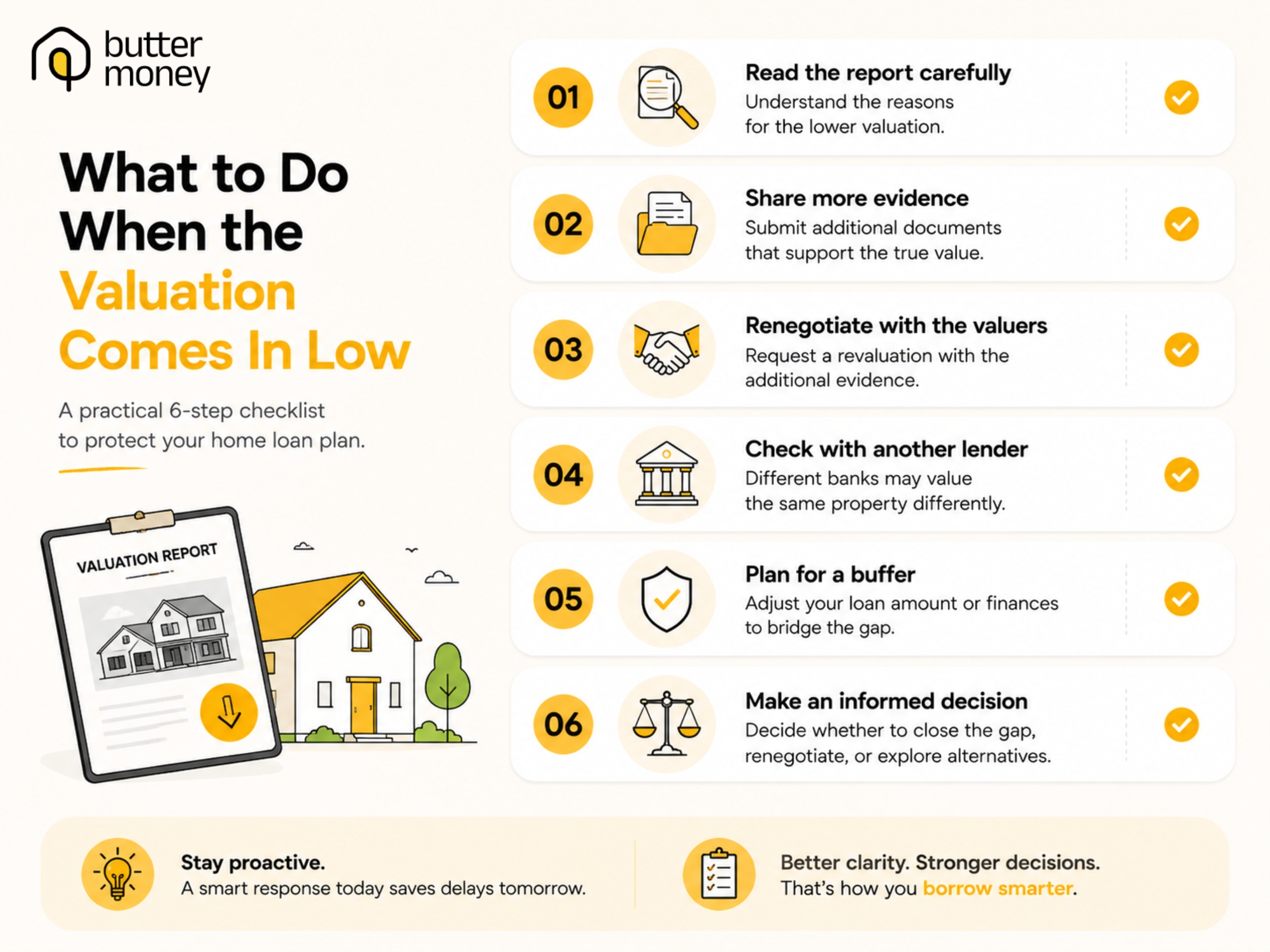
A lower valuation isn’t the end of the deal — it’s a negotiating position, and you have more room to move than it feels like in the moment.
When the Valuation Gap Isn’t Really the Problem
In the interest of giving you the full picture, not every valuation gap is a crisis, and sometimes the bank’s number is doing you a favour.
- New, RERA-registered projects from established developers often carry pre-approved valuations, since multiple lenders have already assessed the project. Surprises here are less common than in resale deals.
- If you’re already putting down well above the minimum margin — say 35-40% instead of 20-25% — a modest valuation gap won’t change how much you need to borrow.
- If your agreement value is already conservative relative to recent sales in the area, the gap risk is low to begin with.
- Occasionally, the bank is right and the seller is not. If the valuation comes in meaningfully below every other listing you’ve seen in the building, it’s worth treating that as information about the deal, not just an obstacle to route around.
- If closing the gap means overextending your finances, that’s a signal to pause, not to force the deal through with a larger loan or a stretched EMI. A property that only works on paper with maximum leverage is a fragile purchase.
Checking your eligibility upfront — before you’re mid-negotiation and under time pressure — gives you a clear-eyed number to plan against either way. It takes about two minutes on Butter Money and doesn’t touch your credit score.
The Gap Is Manageable — If You Know It’s Coming
A valuation gap feels like the ground shifting under a deal you thought was settled, but it’s one of the most predictable surprises in the Indian home-buying process, not one of the least. Once you know that your loan rides on the lower of two numbers, not the one you negotiated, you can budget a buffer, ask the right questions of your valuer and your bank, and walk into registration without a last-minute scramble for extra cash.
Homeownership is still very much within reach — this is simply one more number worth knowing before you sign, not a reason to hold back.
Ready to see where you actually stand? Check your home loan eligibility on Butter Money — free, in about two minutes, with no impact on your credit score.
Frequently Asked Questions
Q1.What is the property valuation gap in a home loan? It’s the difference between the price you’ve agreed to pay for a property (the agreement value) and the market value your bank’s independent valuer assigns to it. Since loans are sanctioned on the lower of the two, a gap here directly increases the down payment you need to arrange.
Q2.Is my home loan sanctioned on the agreement value or the bank’s valuation? Whichever is lower. If your agreement value and the bank’s valuation match, this doesn’t matter. If the bank’s number comes in lower, your loan amount is calculated against that lower figure, not your negotiated price.
Q3.Can I ask my bank for a revaluation if the number seems too low? Yes. Most banks will consider a second look if you provide comparable evidence — recent registered sale deeds for similar properties nearby. A bare objection without supporting data rarely moves the number.
Q4.Does a lower valuation reduce my loan eligibility or just my loan amount? Just your loan amount for this specific property. Your eligibility — based on income, existing obligations, and credit profile — doesn’t change; what changes is the base value the LTV percentage is applied to.
Q5.Can two different banks give different valuations for the same property? Yes. Valuation isn’t standardised across lenders. Different empanelled valuers can arrive at different figures for identical properties, which is why applying with a second lender is a legitimate way to test whether a low valuation is a one-off.
Q6.What evidence helps support a higher valuation? Recent registered sale deeds for comparable units in the same building or locality carry the most weight, along with proof of any renovations, approved additional area, or amenities the valuer’s standard rate might not capture.
Q7.What happens if I can’t arrange the extra down payment? You have three real options: renegotiate the price with the seller using the bank’s valuation as leverage, apply with a second lender for a potentially different valuation, or exit the deal using the cancellation clause in your sale agreement — which is worth checking before you sign, not after a shortfall appears.


