
CIBIL Dispute: How to Raise One and What Happens Next
A CIBIL dispute in plain words
In short: To raise a CIBIL dispute, name the wrong entry, attach proof and file it with the bureau. The lender then has 21 days to correct it and the bureau 30 days in all. Past that, ₹100 a day is owed to you.
A wrong entry on your report is not a judgement on you. The report is built from what lenders send in, and lenders get it wrong: a loan closed years ago that still shows a balance, an EMI marked late that your bank statement says was paid. A dispute is the formal way of saying "this line is wrong, here is the paper that proves it".
If you want to see which lenders would take your profile before you apply anywhere, the eligibility check shows offers from 40+ lenders in about 2 minutes without a hard inquiry. It's a sensible next step once your report is clean. This post is about getting it clean.
Here is something I should say up front. I tried to read CIBIL's own dispute pages for this post and both addresses I tried refused to open for me. So I haven't copied a click-by-click path from CIBIL, and I won't pretend to have one. What I could read and verify is the part that matters most: the RBI rules that put a clock on the whole process, and Experian India's published dispute routes, which show what a bureau's process looks like. Where I'm missing the bureau's own wording, I say so.
The order of the post: what a dispute can fix and what it can't, the proof to gather, how to file online and offline, the clocks, how to track it, what to do if it's rejected, and why you may need to repeat the fix at other bureaus.
What a CIBIL dispute can fix, and what it can't
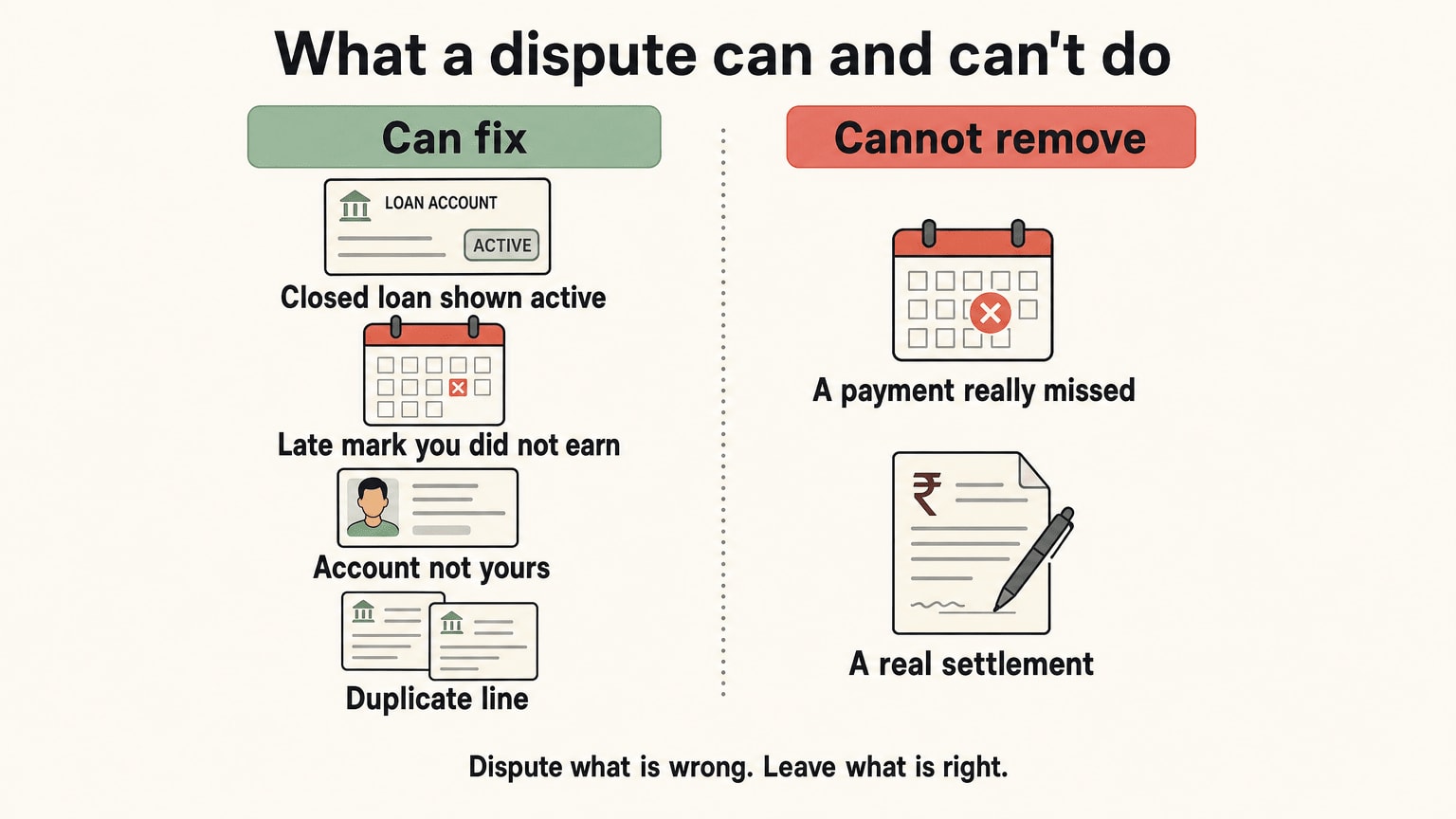
A dispute corrects information that is wrong. It does not remove information that is true but unwelcome. Everything else in this post follows from that one line.
That's the part many guides skip, and it's the part that saves you weeks. If you file a dispute on a late payment you really made late, it comes back confirmed by the lender, and you've spent a month to learn what you already knew. If you file on an entry that is plainly wrong, you're using a right the RBI wrote down.
Entries you can dispute and entries a dispute can't remove
| Entry on your report | Disputable? | Why |
|---|---|---|
| Closed loan shown as active | Yes | The lender's record is out of date |
| Payment marked late that you made on time | Yes | Your bank statement contradicts it |
| Account that is not yours | Yes | The lender or bureau has the wrong person |
| Same loan listed twice | Yes | One entry is a duplicate |
| Wrong name, date of birth, PAN or address | Yes | The identity details are wrong |
| Loan paid in full but shown as settled | Yes | The lender reported the wrong status |
| Payment you really missed | No | It is a correct record |
| Settled entry after a real settlement | No | The report records what happened |
The rows with "No" are not the end of the road. They are where a different job starts: pay what's overdue, keep every payment clean from here, and read the post on how to improve your credit score for the order that works.
Common errors, with cases
These cases are made up to show the shape of a dispute. The amounts are illustrative and belong to no real person or lender.
A closed loan that still looks open. You repaid a loan and got a closure letter and a no-objection certificate, the NOC. A year later your report shows the account as active with ₹10,000 outstanding. To a new lender that reads as a live debt. The proof is the closure letter, the NOC and the last statement showing a zero balance. The lender is the one who has to fix it, because it sent the entry.
A late mark you didn't earn. The payment grid in your report shows a 30 against one month. DPD means days past due, a count of how late the payment was. Your bank statement shows the EMI left your account on the due date. Maybe the lender posted it late, maybe it reported the wrong month. The proof is the bank statement line for that date, plus the lender's own statement for the same month. Our post on reading your CIBIL report explains how to read that grid.
A duplicate. One loan, two lines. Sometimes a lender changes its internal account number and the bureau shows both the old and the new one, each with a balance. Your total debt looks double. The proof is the loan statement with one account number on it, and the line you want removed.
An account that isn't yours. This is the one to act on first. It can be a mix-up between two people with similar details, or it can be someone using your identity. Check the personal information section of the report for a PAN, address or phone you don't recognise. Tell the lender and the bureau in writing, and say plainly that you never took the account. If you think your identity was misused, a lawyer is the right person for what comes after the dispute.
Paid in full, shown as settled. You cleared the whole amount, and the report calls it settled. That word means the lender took less than it was owed, and a future lender reads it differently. This one is disputable, and the proof is your payment receipts and the closure letter.
When the entry is correct
Take the opposite case. You agreed a settlement with a card issuer, paid the agreed amount, and the report shows settled. That is the report doing its job. The lender reported what happened, and a dispute will come back confirmed.
I couldn't find a bureau or regulator page that says how long a settled or written-off entry stays on a file, so I won't quote a number. Sites that do disagree with each other. What I can say is the practical part. Before you ever agree to a settlement, ask the lender in writing what status it will report afterwards. That reply is your only proof of what was agreed.
Proof to gather before you file
A dispute with no proof is a request. A dispute with proof is a correction.
For almost every case the paper is one of these:
- Loan closure letter and no-objection certificate, for a loan that should show as closed
- Bank statement lines for the dates in question, for a wrong late mark or a wrong balance
- The lender's own statement for the month, to show the two records disagree
- Payment receipts, for a paid-in-full account shown as settled
- Your PAN and an ID that shows your date of birth, for a wrong personal detail
Name the account, the lender, the month and what you believe the correct entry is. One dispute per error keeps the trail clean. If five lines are wrong, five separate items, each with its own proof, are easier to follow than one long letter.
Scan everything and keep the original names readable. Save the report you're disputing as a PDF with the date in the file name. When the fix lands, you'll want the before and the after side by side.
One more thing worth doing first. Call or write to the lender that reported the entry, and ask it to correct its records. Under the RBI framework you can raise the complaint with the lender or the bureau, and if more than one lender is involved the bureau coordinates with all of them. Telling both costs a few minutes, and the lender is the only party that can change its own data.
How to raise a CIBIL dispute online
Most guides say online is quicker, and it does leave you a record. Here is the shape of the process. I couldn't open CIBIL's screens, so menus and button names may differ from what you see. Trust your screen over any guide, this one included.
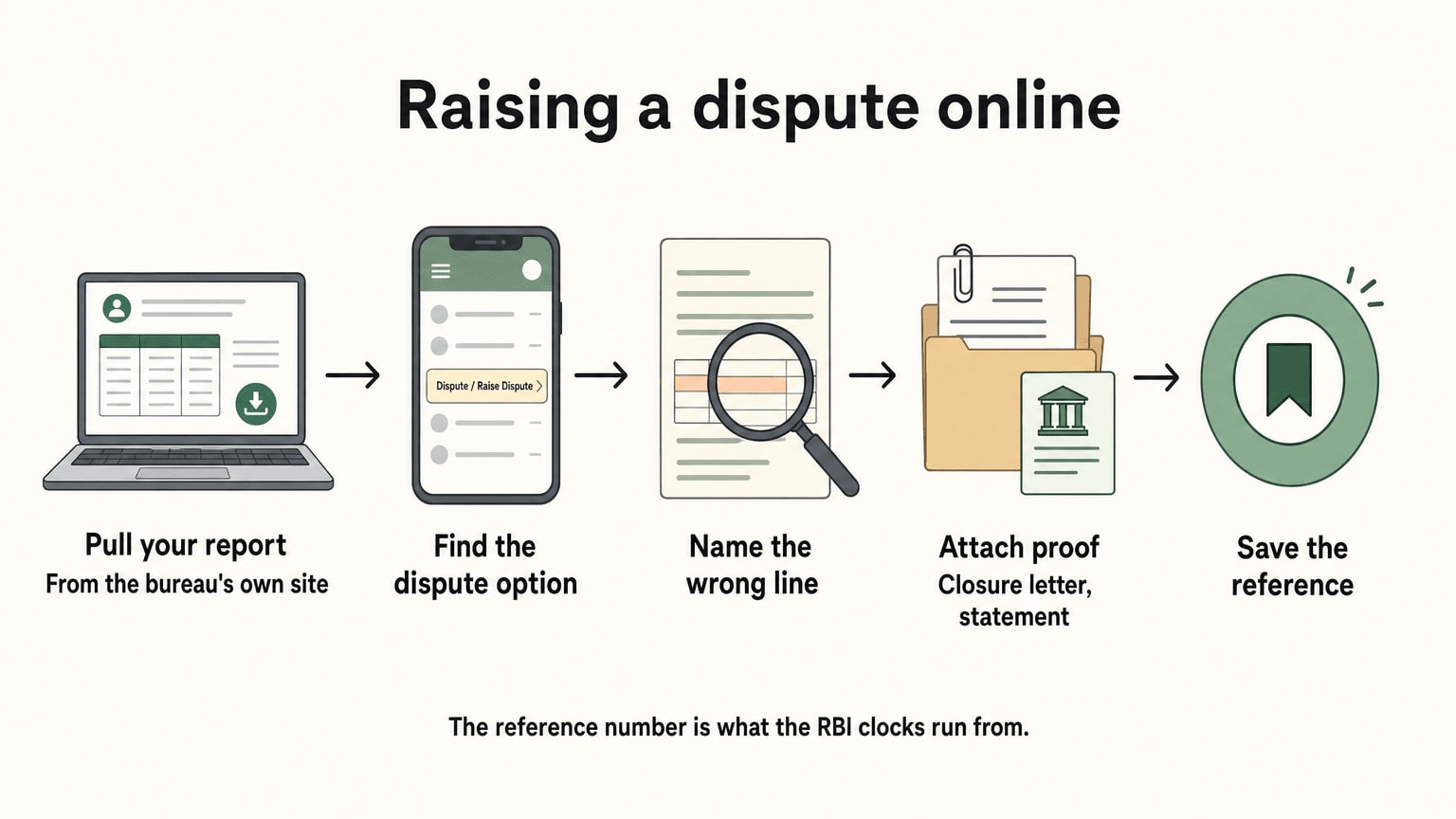
- Get your report from the bureau's own site. Type the address yourself. Don't follow a search result that promises your score in three clicks. Our free CIBIL score check post covers how, and the right to one free full report a year from each bureau.
- Find the dispute option. On a bureau's site it's usually tied to your report or to a separate dispute form. Experian India's page, for example, has a "Raise a dispute" link and a how-to PDF.
- Name the account and the field that's wrong. Say which line and what it should say.
- Attach your proof. Upload the papers from the list above.
- Save the reference number. It proves the date you filed, and the legal clocks run from that date.
- Screenshot the confirmation. A bureau screen can change. Your screenshot won't.
The company route
If the wrong entry sits on a business's credit report and not your personal one, you're in a different lane. Page one calls these company disputes, as against individual ones. I couldn't confirm CIBIL's steps for them, so I won't describe a form I haven't seen. The principle holds anyway: name the account, say what's wrong, attach proof, keep the reference. Look for the company option on the bureau's site, and expect the business, not you, to be the one who files.
A separate form for a rejected application
Experian India has a second route worth knowing about. If a lender turned down an application after a fraud-check flag, Experian's page offers a separate "Help with rejected application" form. It asks for your name as per PAN, your PAN, the lender that flagged the discrepancy, the application ID and date, and a description of up to 300 words. Other bureaus may differ, so check the one your lender used.
How to raise a dispute offline
Not everyone wants to type a dispute into a form. Bureaus list other routes, and Experian India's page is a clear example. It lists a phone line, 022-68165681, an email, Consumer.Support@in.experian.com, and a walk-in office in Mumbai. For CIBIL, check its website for the current postal address and email before you send anything, because sources online disagree on the details and I couldn't confirm them.
If you write, keep it short and put the facts in a short list:
- Your full name, PAN and the report control number you're disputing
- The lender and the account
- What the report says, and what it should say
- A line asking for a reference number
- A list of the attachments
Here is wording you can adapt, using the closed-loan case from earlier. The amount is illustrative.
I am disputing the entry for my [loan type] with [lender], which shows as active with ₹10,000 outstanding. The loan was closed on [date], and I enclose the closure letter, the no-objection certificate and the last statement showing a zero balance. Please correct the entry to closed with no balance, and send me a reference number and the action taken.
It's plain on purpose. A reader at the other end has to see in ten seconds which line is wrong, what it should say and what proves it. Anything past that, like how upset you are, is noise.
Post it by a method that gives you a delivery receipt, and email a copy to yourself. If you walk in, take two copies of everything and ask for the receipt to be stamped. A call is fine to start things off, but ask for the request to be logged in writing, because a call leaves no proof.
The clocks the RBI puts on a dispute
Banks and bureaus can't take forever. The RBI's circular RBI/2023-24/72, dated October 26, 2023, sets a compensation framework for exactly this. Here is how it splits the time.
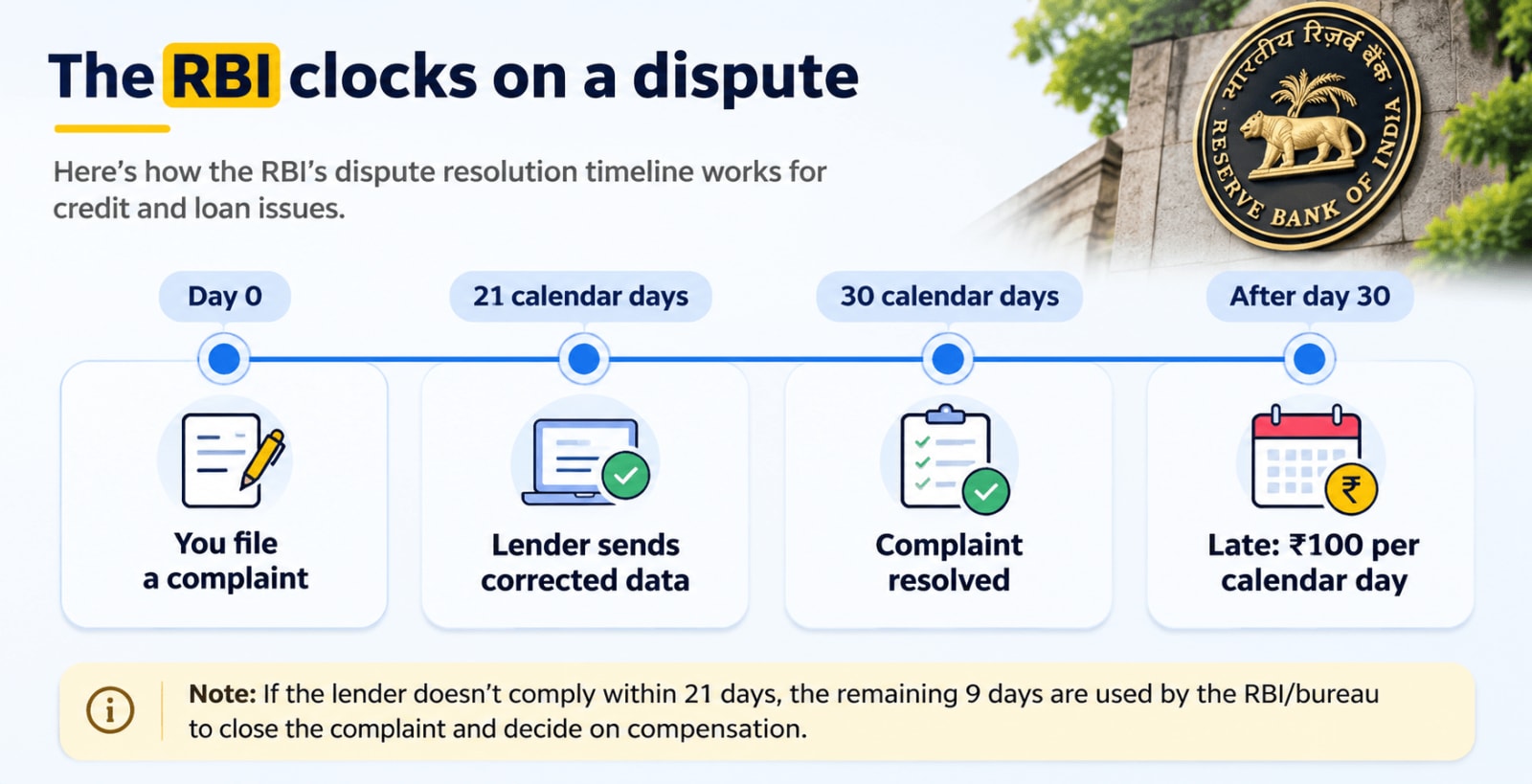
The lender gets 21 calendar days to send the corrected data to the bureau. The bureau gets the remaining 9. Together that's a complaint that should be resolved within 30 calendar days of when you filed it. If it isn't, you're entitled to ₹100 for every calendar day of delay, and the money is to be credited to your bank account within five working days of the resolution.
The clocks, in one place
| Step | Who | Time allowed |
|---|---|---|
| You file the dispute | You | Day 0: the reference number proves it |
| Corrected data sent to the bureau | Lender | 21 calendar days |
| Complaint resolved | Bureau | 30 calendar days from filing |
| Compensation if late | Whoever caused the delay | ₹100 per calendar day |
| Money reaches your account | Lender or bureau | Within five working days of resolution |
Source: RBI/2023-24/72
Who pays depends on who was late. If the lender missed its 21 days, the lender pays. If the lender was on time but the bureau still didn't close the complaint in 30 days, the bureau pays. If both were late, the compensation is split between them.
A simple example, and it's illustrative only. Say the bureau closes your complaint 10 days after the 30-day mark, and the lender was on time. That's 10 days at ₹100, so ₹1,000. It won't change your life. The reason the rule matters is that it makes silence expensive for them, so a complaint with a reference number tends to get answered.
The circular also says you must be told what was done about your complaint, in every case, and that a rejection comes with reasons. Keep those messages.
Why a "resolved" dispute can still look unfixed
A fix has to travel. After the lender corrects its record, the data has to reach the bureau, and the bureau has to put it in your file. Under RBI circular RBI/2024-25/60, dated 8 August 2024, lenders and bureaus update credit information fortnightly, as on the 15th and the last day of each month. Lenders have 7 calendar days after each of those dates to send data and bureaus have 5 to take it in. The rule has applied since 1 January 2025.
So a correct dispute can take a few weeks to show on a fresh report. That's normal. It's also the reason to do this before you apply for a loan, not after.
How to check the status of your dispute
Three places tell you how it's going.
The bureau's dispute reference. Look on the bureau's site for a way to track a dispute with the number you saved. I couldn't confirm what CIBIL's page offers. If there's no tracker, write to the bureau quoting the number and ask for a status in writing.
The messages they owe you. The RBI framework says the bureau or lender must tell you what action was taken, in all cases. If a day count is running and you've heard nothing, write and ask.
A fresh copy of your report. The report is the only proof the fix landed. Pull a new one after the next fortnightly update, and compare it with the PDF you saved before.
When a result comes, it usually falls into one of three kinds.
What a dispute result tends to say, and what to do
| Result | What it means | Your next move |
|---|---|---|
| Corrected | The lender agreed and updated its record | Pull a fresh report after the next update |
| Confirmed as reported | The lender says the entry is right | Check its proof against yours, then escalate |
| No reply by the deadline | The clock has run out | Quote the reference and the dates, ask for compensation |
I'm describing results in general terms, because I couldn't read CIBIL's own wording. Read the reply you get and don't assume it follows this list letter for letter.
If your CIBIL dispute is rejected
A rejection means the lender told the bureau the entry is correct. It does not mean you've lost. It means the lender and you have two different records, and one of them is wrong. Here is the order I'd go in.
First, read the reason. The RBI framework says a rejection must come with reasons. If the reason is "the account was settled" and you paid in full, that's a factual gap you can close with a receipt. If the reason is "the payment was late" and your bank statement says otherwise, you have the proof they didn't.
Second, go to the lender directly. The lender owns the data. Write to its grievance contact, quote the bureau's reference number, attach the same proof, and ask it to review the entry and correct its report to the bureau. Ask for a reply in writing.
Third, escalate inside the bureau. Experian India's page lists three levels: its normal channels, then a nodal officer, then a principal nodal officer. Other bureaus have similar ladders, and you'll find the names on their sites. Use it when the first answer doesn't address your proof.
Fourth, the RBI. The RBI circular says that if compensation you're owed is wrongly denied, you can approach the RBI Ombudsman. Experian's page says that if you're still dissatisfied you may lodge a complaint with the RBI, through its complaint portal, cms.rbi.org.in.
One update to know about. The 2023 circular names the Integrated Ombudsman Scheme of 2021. RBI's complaint portal now names the Integrated Ombudsman Scheme, 2026. A summary by Vinod Kothari says the new scheme came into force on 1 July 2026 and replaced the 2021 one. It also says a complaint must be filed within 90 days from the end of the lender's 30-day response window, or from the last communication, whichever is later. That's one law firm's reading, and I couldn't open the scheme's own text, so check the deadline on the RBI portal before you rely on it. The portal also lets you track a complaint and has a contact centre on 14448.
The practical point is the one about time. Don't sit on a rejection for months. Keep the dates of every reply.
Where to take a dispute that isn't fixed
| Level | Who | What to bring |
|---|---|---|
| 1 | The lender's grievance contact | The bureau reference, your proof, the rejection reason |
| 2 | The bureau's escalation officers | Both of the above, plus the lender's reply |
| 3 | RBI complaint portal | Dates, reference numbers and every reply in writing |
For anything that has become a legal matter, such as a dispute over who owes what, a lawyer is the right person to ask, not a blog.
The same error at other bureaus
Here's something page one rarely says. Fixing CIBIL doesn't fix the others.
CIBIL is one of several credit bureaus in India, and a lender may pull a different one. Experian India and CRIF High Mark are two others. Not every lender reports to every bureau, so your files can differ a little.
So if the error started in a lender's own data, it may be wrong at more than one bureau. Pull your report from each one, using the free yearly report each bureau owes you, and read the same account in all of them. If the wrong entry shows in two, raise a dispute with each. Same proof, same wording, and keep every reference number apart. CRIF High Mark itself tells consumers to regularly check their reports for errors or discrepancies.
If a lender quotes you a score you don't recognise, ask which bureau it came from. Then check that bureau's report, because that is the one it read.
Four things to watch while it runs
Don't pay someone to "fix" your report. I found nothing in the RBI framework that asks you to pay for a dispute. The routes are the bureau, the lender and the RBI. A firm that promises to wipe out a payment you really missed can't honestly deliver it. Ask what it would do that you can't do yourself with a reference number.
A dispute isn't an application. Filing one doesn't ask any lender for credit. I still won't tell you it has no effect on your score at every step, because I couldn't find a bureau page that says so. How a lender reads an item under dispute is the lender's call.
Don't dispute everything. Each correct entry you challenge is a month spent for nothing. Dispute what is wrong. Leave what's right.
Keep a log. Date, bureau, reference number, what you sent, what came back. Four lines per dispute. It's what you'll quote when you escalate.
If a home loan is why you're here
Most people who search this are about to borrow. The order matters here.
Start with your report weeks before you plan to apply. File any dispute that day, because the 21 and 30 day clocks run first and the fortnightly update comes after. Then stop applying for new credit while it plays out, since each application adds a hard inquiry. Bring card balances down and make sure no EMI is missed.
A lender reads your report and also your income, your existing EMIs and the property. A clean report doesn't promise an approval, and a lender may still say no. Our post on SBI home loan CIBIL shows how one large lender treats the score, and what its pages publish and leave out.
Butter Money is not a lender, and it doesn't decide what a lender will do. What it can do is show you what your profile might get before you apply, without a hard inquiry.
Mistakes that slow a dispute down
- Filing without proof. The lender checks its own record, finds it matches, and confirms it.
- Bundling five errors into one letter. One item gets answered and the rest are lost.
- Not saving the reference number. Every clock above starts from the day you filed, and you can't prove it without one.
- Disputing a true entry. It comes back confirmed, and you've lost the weeks.
- Waiting until a bank says no. The clocks and the fortnightly update add up to weeks.
- Stopping at CIBIL. The same wrong line may sit at the other bureaus.
How to avoid report errors in future
You can't stop a lender making a mistake. You can make it easy to catch.
- Keep the closure letter and NOC for every loan you pay off. Put them in one folder, with the date.
- Check your report once a year at each bureau. The free right is per bureau, per calendar year.
- Check again before any big application. A home loan is the one to check for.
- Look at the personal details section. A wrong PAN or address is how files get mixed.
- Watch your first two auto-debits after any change. A changed card or bank quietly turns "automatic" into "missed".
- Keep one note of every dispute. Reference, date, outcome.
None of it is exciting. But a closure letter in a folder is the difference between a short argument and a long one.
Frequently asked questions
How long does a CIBIL dispute take to resolve?
Under RBI circular RBI/2023-24/72, the lender has 21 calendar days to send corrected data and the whole complaint should be resolved within 30 calendar days of filing. After that, the fortnightly update cycle has to carry the fix into your file, so allow a few weeks before a fresh report shows it.
Is there a fee to raise a CIBIL dispute?
I found nothing in the RBI compensation framework that asks you to pay for a dispute, and I couldn't read CIBIL's own page to confirm its terms, because it refused to open for me. Check the bureau's site before you pay anyone, and be wary of firms that charge to "repair" a report.
What documents do I need to raise a CIBIL dispute?
It depends on the error. A closure letter and NOC for a closed loan, bank statement lines for a wrong late mark, payment receipts for a wrong settled status, and PAN and ID for a wrong personal detail. Always name the account, the lender and what the entry should say.
How do I check my CIBIL dispute status?
Use the reference number the bureau gave you on its site, or write to the bureau quoting it. The RBI framework says you must be told what action was taken. Then pull a fresh report after the next fortnightly update to see if the fix landed.
What can I do if my CIBIL dispute is rejected?
Read the reasons, which the RBI framework says must be given. Then write to the lender with the same proof, escalate within the bureau, and finally use the RBI complaint portal. Check the Ombudsman deadline on the portal, because the scheme changed in 2026.
Do I get compensation if the bureau is late?
Yes, if the delay is theirs. The RBI framework entitles you to ₹100 per calendar day once a complaint passes 30 calendar days. It's paid within five working days of resolution. The lender pays if it missed its 21 days, and the bureau pays if it was the one that ran over.
Do I need to raise the dispute at every bureau?
If the same wrong entry shows at more than one bureau, yes. Fixing CIBIL doesn't change Experian India or CRIF High Mark. Check your report at each one and file a separate dispute with the same proof.
Can a dispute remove a negative entry that is correct?
No. A dispute corrects wrong information. A payment you really missed, or a settlement you really agreed, stays as a record. What you can change is what comes after: pay what's overdue and keep every payment on time.


