

CIBIL Report: How to Read It and Fix Errors
What your CIBIL report is, and what it isn't
In short: Your CIBIL report is the full credit history behind the 300 to 900 score. Under an RBI rule you get one free copy a year from each bureau, and you can dispute anything in it that is wrong.
Most people meet the report the day a bank says no. They see a three-digit number, a few red words they don't understand, and a loan officer who says "there's a DPD on one of your cards". Nobody explained what that meant. That is not a failure on your part. The report is written in a bureau's shorthand, and almost nobody hands you the key.
If you want to see which lenders would take your profile before you apply anywhere, the eligibility check shows offers from 40+ lenders in about 2 minutes without a hard inquiry. It's a good second step once you've read your own file, and this post is about the first step.
Here's how I went about it. I tried to read the bureau's own explainer pages for this post, and cibil.com refused to load them for me. So I've leaned on what I could open and read: the RBI's circulars, CRIF High Mark's published sample report and Experian India's consumer pages. Where a point needs the bureau's own wording and I couldn't get it, I say so. You'll see that a few times, and I'd rather you see it than get a confident guess.
The post goes in the order you'd actually use it: the difference between score and report, how to download the report free, what each section holds, how to decode DPD and the status words, how to spot an error, and how to dispute it.
Score versus report: the number and the story
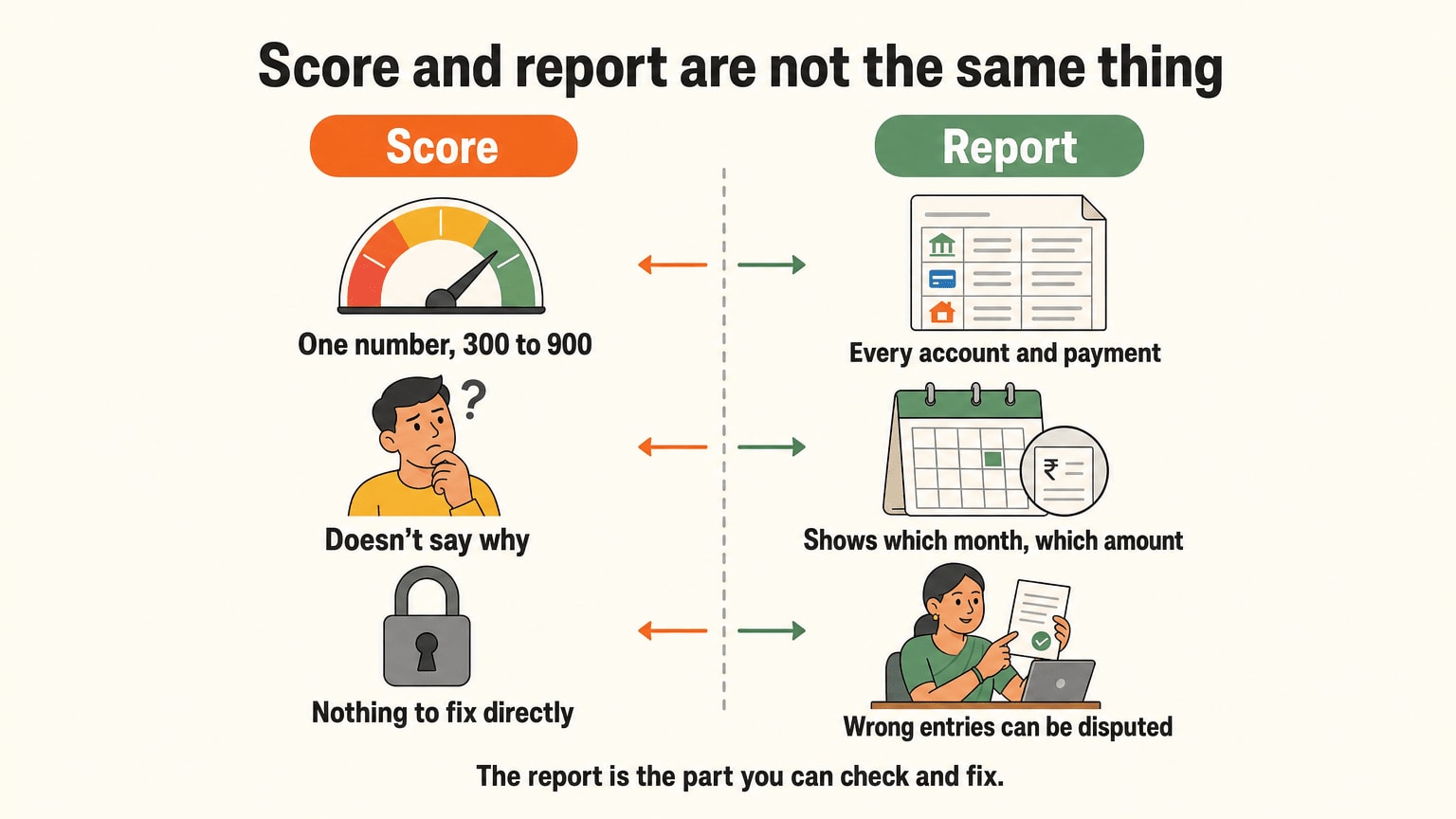
The score is a summary. The report is the evidence. A lender sees both, and the report is where the reasons live.
The same file, two views
| Score | Report | |
|---|---|---|
| What it is | One number from 300 to 900 | The full history behind it |
| What it tells you | Roughly where you stand | Which account, which month, which amount |
| What you can fix | Nothing directly | Entries that are wrong |
| What a lender reads | A quick filter | The detail, when it matters |
Two people can both have a middling score for opposite reasons. One missed a card payment last spring. The other has never missed anything but has cards sitting at their limits. The number looks alike. The reports don't. That is why a fix that works for one does nothing for the other.
The score has bands, and it helps to know them, with one warning. CRIF High Mark is a bureau describing its own score, and it says 750 and above is excellent, 650 to 749 is good, 550 to 649 is fair and below 550 is poor. The same page also says a score above 700 is generally considered good, so the bands overlap a little. Nobody has a single pass mark.
How one bureau labels the score
| Score | CRIF High Mark's label |
|---|---|
| 750 and above | Excellent |
| 650 to 749 | Good |
| 550 to 649 | Fair |
| Below 550 | Poor |
Source: CRIF High Mark
What does a lender do at each band? Lenders don't publish that, and I won't invent it. Our post on the SBI home loan CIBIL score went looking for a published cut-off at one large bank and found none. The honest reading of the bands is: higher is more likely to help, and each lender decides for itself.
How to download your CIBIL report free as a PDF
You have a legal right to this, and it's worth knowing the source. The RBI's circular RBI/2016-17/58, dated 1 September 2016, directs every credit information company to give an individual one free full credit report in each calendar year, after checking who is asking. It has applied since 1 January 2017.
Two things follow from that sentence. It says "report", so you're entitled to the whole file and not only the score. And it says "each credit information company", so the right applies bureau by bureau. You can use it with TransUnion CIBIL and again with the others in the same year.
The practical route:
- Go to the bureau's own site. For CIBIL that's cibil.com, as the free CIBIL score check post walks through. Type the address yourself. Don't click a search result that promises your score in three clicks.
- Have your PAN, a mobile number and an email you still use. The bureau matches you to your file with the PAN and confirms you with an OTP.
- Ask for the full credit report, not just the score. Some paths show a score and a short summary first. The RBI rule covers the whole report, so look for that option.
- Download the PDF and save it with the date in the file name. You'll want to compare it with the next one.
I couldn't open the CIBIL download screens, so I can't describe the buttons. Menus move, so trust your screen over any guide, including this one. Experian India's own page does say plainly that it offers a free credit information report and score, and CRIF High Mark says every individual is eligible for one free report a year.
The other bureaus
CIBIL is the name people use, but it is one of several bureaus, and your lender may pull a different one. Your file can differ a little between them because not every lender reports to every bureau. If a lender gives you a score you don't recognise, ask which bureau it came from. Pull the report from that one as well. It costs nothing but your time, and the free right applies to each bureau in turn.
Does checking your own CIBIL report lower your score?
No, and this is the worry that stops people from looking. Checking your own file is what the industry calls a soft inquiry. CRIF High Mark's explainer separates it from a hard inquiry, the kind a lender runs when you apply for credit. Of the hard kind, it says your score "may get affected, temporarily lowering it by a few points" and that the inquiry may stay on your report for up to two years. It also notes that CRIF's own score isn't affected even by hard inquiries, so how much one costs depends on the bureau and the model.
So pull your own report as often as the free allowance lets you. Don't apply to five banks "to see what happens". That is the move that costs you something.
Reading the report, section by section
Reports look different from bureau to bureau, but the bones are the same. CRIF High Mark publishes a sample personal report with its sections laid out, and I've used it as my map. CIBIL's own layout may name things a little differently, so read your headings against this list and not letter for letter.
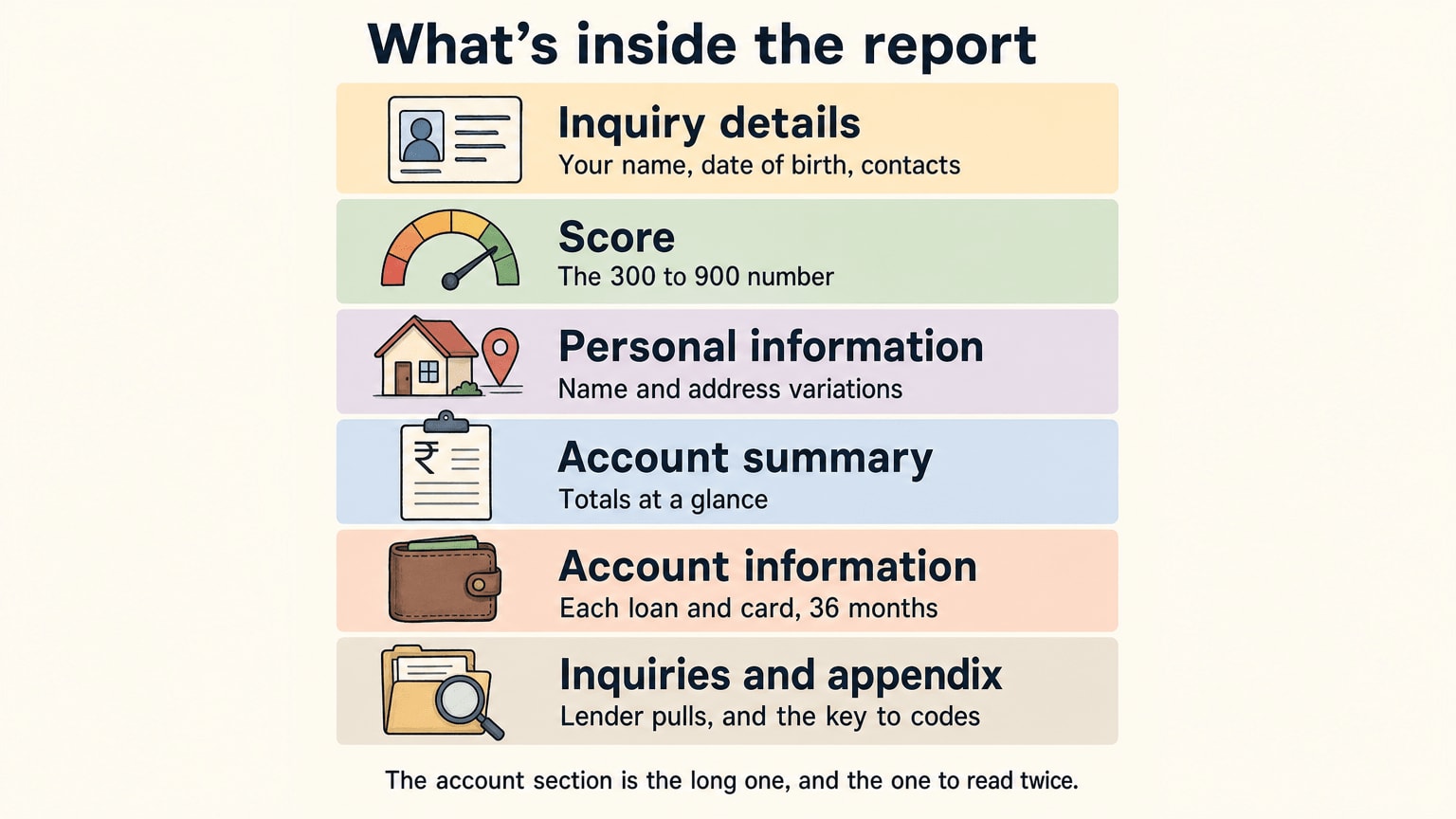
The inquiry details. The top of the report restates what you gave the bureau: your name, date of birth, gender and the identity and contact details you typed in. It looks boring, and it matters because it tells you the bureau found the right person. A wrong date of birth here is the first sign the file may be mixed with someone else's.
The score. Your number, often with a short band or risk label. CRIF High Mark's sample shows a grade from A to M beside the number, with A to D at the low-risk end. This is the part everyone reads. It's also the part that explains least.
Personal information and its variations. The report lists the versions of your name, address, ID and phone number that lenders have sent in, with the date each was last reported. People skip this. Don't. An address you left years ago, a name spelt two ways, or a PAN you don't recognise are all things to check. If two people's details have been merged, this is where it first shows.
The account summary. A short block of totals: how many accounts you have, how many are active or overdue, the current balance, the amount originally disbursed, recent inquiries, and any new accounts or new overdue accounts lately. Read this one for the shape of your file before the detail pulls you in.
The account information. This is the long section, and it's the report. Each loan or card gets its own block: the type, the limit or sanctioned amount, the instalment, the current balance, the last payment, the overdue amount, whether the account is active or closed, and a grid of your repayment month by month for the past 36 months. A home loan is here. So is the card you stopped using, and the phone you bought on EMI.
The inquiries. A list of lenders that pulled your report because you applied for credit, with dates, purposes and amounts. CRIF High Mark's sample covers 24 months. Count them and look at the dates. A cluster in one fortnight reads, to a lender, like someone hunting for credit.
Comments and the appendix. Comments are reserved for special remarks about you. The appendix is the key to every code and abbreviation in the report, and it's the most useful page nobody reads. When you hit a word you don't understand, check there first, because it is the bureau's own definition and beats any blog's, this one included.
A sample entry, line by line
To see how the pieces sit together, here's one made-up card account. Every figure is illustrative and belongs to no real person.
An illustrative account entry
| Field | What it shows | What to ask yourself |
|---|---|---|
| Type | Credit card | Is this a card I actually hold? |
| Limit | ₹10,000 | Does it match my card? |
| Current balance | ₹1,000 | Is it what I owe today? |
| Overdue | ₹500 | Why is anything overdue? |
| Status | Active | Is that right, or did I close it? |
| Payment grid | A row of monthly entries | Any month that isn't zero? |
A limit of ₹10,000 with a balance of ₹1,000 means a tenth of the limit is in use, which reads as room to spare. The same limit with the whole ₹10,000 used is a ratio of 1:1, and that reads as someone at the edge. Our post on how to improve your credit score has the longer version, including why paying a card down before the statement date helps.
The overdue line is the one that deserves a second look. If it shows ₹500 and you paid on time, you've found something worth a dispute. If it shows ₹500 and you forgot, pay it today and make the next payment on time. You can't erase a payment you really missed. You can change what comes after it.
What DPD means, and how to read the grid
DPD stands for days past due. It's a count of how late a payment was, recorded for each month against each account, and it's the single entry that frightens people most.
How to read it, in general terms. Bureau layouts differ, so check the key in your report's appendix.
- A zero means you were not late that month.
- A number means that many days late. A payment missed by 30 days shows as 30. If it's still missing a month later, it shows as 60, and so on.
- A letter or symbol in a cell is a code, not a number of days. It might mean the account wasn't reported that month. I couldn't confirm the codes from the bureau, so look it up in the appendix before you worry.
The grid covers the past 36 months, as CRIF High Mark's sample describes the repayment history. It's a window, not a life sentence. Each new clean month goes in at one end.
Here's the part worth being plain about. DPD is a record of what the lender reported, so you can't remove one by asking nicely. You can have one corrected if it's wrong: a payment you made on time that was posted late, or a month marked late that your bank statement shows was paid. What you cannot honestly do is delete a late payment you really made late. A recent run of clean months is the part of the report you can still shape.
One small point that trips people up. A DPD of a few days doesn't mean the same thing for every lender or every product. A card issuer decides what counts as late on a card. Read your card terms.
Why 90 days is the line that matters
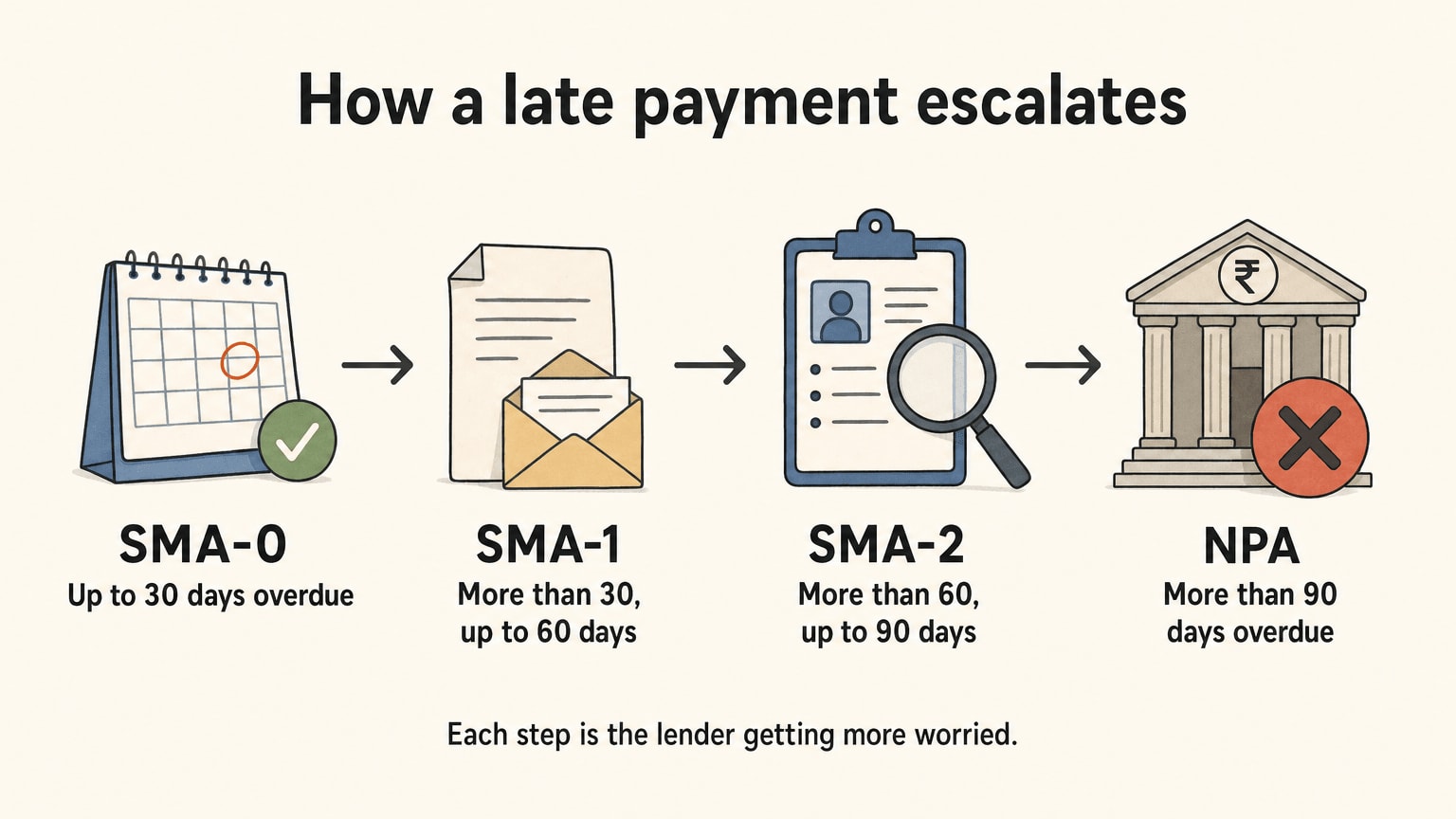
The RBI's master circular on income recognition and asset classification (RBI/2024-25/12, 2 April 2024) sets the rule banks work to. A term loan becomes a non-performing asset, an NPA, when the interest or instalment stays overdue for more than 90 days. A credit card account becomes one if the minimum amount due stays unpaid 90 days after the due date.
Before that line there's a warning stage the circular calls special mention accounts, or SMA. SMA-0 is up to 30 days overdue, SMA-1 is more than 30 and up to 60 days, and SMA-2 is more than 60 and up to 90. Those are labels a lender uses on its own books, and you won't necessarily see them on your report. But they explain why a payment that's 30, then 60, then 90 days late is not a steady slope. Each step is a bank getting more worried, and past 90 days the account is classed as a problem asset.
For you, the lesson is practical. One payment a few days late is a small mark. A payment that rolls from 30 to 60 to 90 is a different file entirely. If you ever see yourself sliding, call the lender before the next month closes. A payment plan you arrange is better than silence.
Account status: what the words mean
Next to each account sits a status. This is where the report gets its scary words. I need to be careful here, because I could not read CIBIL's own key to them, and the lender and bureau blogs I came across disagree. One example: pages online give two different expansions for the code "LSS". So I'll give you the RBI's definitions, which are the ones banks classify by, and the plain meaning of the words you'll meet.
The words you may meet, and what they mean
| Word | Plain meaning | Where it comes from |
|---|---|---|
| Active | The account is open and running | Bureau layout |
| Closed | The account has ended | Bureau layout |
| Substandard | An NPA for up to 12 months | RBI master circular |
| Doubtful | Substandard for 12 months | RBI master circular |
| Loss | A loss the bank has identified | RBI master circular |
| Written off | The lender has taken the balance off its books | RBI master circular, on loss assets |
| Settled | The lender accepted less than you owed | Lender practice |
Source: RBI master circular RBI/2024-25/12, and CRIF High Mark's sample report for the active and closed layout
If you see short codes such as STD, SUB, DBT or LSS, they most likely follow the same ladder: standard (all fine), substandard, doubtful and loss. The ladder is the RBI's, and the shorthand is the bureau's. The exact spelling and meaning of each code on your report is in your report's appendix, so read it there. Don't take it from a stranger's table, including mine.
Settled, closed and written-off, side by side
These three words get mixed up more than any others, and they read very differently to a future lender.
Closed means the account ended. If it ended with the balance paid, that's the best of the three.
Settled means you and the lender agreed that you'd pay less than you owed, and the lender accepted it. It ends the dispute, but the report records that the full amount wasn't paid. Before you agree to a settlement, ask the lender in writing what status it will report afterwards, because "paid in full" and "settled" read differently. Keep that reply. It's your only proof of what was agreed.
Written off is the lender saying it doesn't expect to recover the money and taking it off its books. The RBI circular says a loss asset should be written off. It's not forgiveness. The debt can still be owed, and a written-off entry is a hard mark for a future lender to read. If you owe money on an account marked this way, talk to the lender about what it will report once you pay, and get it in writing.
Which of the three reads best, in a lender's eyes
| Status | What happened | How a lender tends to read it |
|---|---|---|
| Closed, paid in full | Balance cleared, account ended | Neutral to good |
| Settled | Less than the full amount was accepted | A warning, though less severe than written off |
| Written off | Lender gave up on collecting | Among the harshest entries |
I'm giving you an order and not a score impact on purpose. The bureaus don't publish how many points each status costs, and I couldn't find a regulator page that says how long a settled or written-off entry stays on the file. Sites that quote a number of years disagree with each other. If a lender or an agent quotes you one, ask where it's written.
Finding errors: what to check first
The report is built from what each lender sends in. Lenders make mistakes. A card statement that never reached you, a loan a lender forgot to close, a limit cut without a message: these all show up as a lower number and none of them is your fault.
Read the report once for the shape, then again against your own papers. Look for these:
- Accounts you don't recognise. A card or loan that isn't yours is the most serious finding. It can be a data mix-up or a sign someone used your details.
- Closed accounts shown as active. You paid a loan off years ago and it still shows an outstanding balance.
- Payments marked late that you made on time. Hold your bank statement against the month in the grid.
- Wrong overdue amounts or balances. Compare them with the lender's latest statement.
- A written-off or settled mark on an account you paid in full. This one is worth a call to the lender before anything else.
- Wrong personal details. Your name, date of birth, PAN or address.
- Inquiries you didn't make. A lender should appear there only if you applied.
Write each one down with the lender name, the month and what you think the right entry is. Collect the paper that proves it: a loan closure letter, a no-objection certificate, a payment receipt, a bank statement. You'll need it in the next step, and a dispute without proof can sit for weeks.
How to dispute a mistake in your CIBIL report
Don't start by arguing with a call-centre agent. Start with the bureau, in writing, and keep every reference number.
- Raise it with the bureau. CIBIL has an online dispute option on its site. I couldn't open it, so I can't give you the clicks. Experian India's page shows what these usually look like: an online portal, a phone line, an email and a walk-in address, plus a step-by-step guide in PDF. Name the account, say what's wrong and attach your proof.
- Get a reference number and keep it. It's your proof of the date you raised the dispute, and the clock below runs from it.
- Let the bureau go to the lender. The bureau takes it to the lender that sent the entry in. Sometimes it's quicker to tell the lender yourself as well, with the same proof.
- Check the fresh report. After the fix, pull a new copy and confirm the entry changed.
The clock the RBI puts on it
Banks and bureaus don't get to take forever. Under the RBI's circular RBI/2023-24/72, dated 26 October 2023, the lender has 21 calendar days from being told of the error to send corrected data to the bureau. The bureau should resolve the complaint within 30 calendar days of it being filed. If the bureau misses that after the lender has done its part in time, it owes you ₹100 for every calendar day of delay. That compensation is to reach your bank account within five working days of the resolution.
Then comes the update cycle. Under RBI circular RBI/2024-25/60, dated 8 August 2024, credit information is updated as on the 15th and the last day of each month. Lenders have seven calendar days after each of those dates to send data and bureaus have five to take it in. The rule has applied since 1 January 2025.
How the clocks stack up
| Stage | What the rule says |
|---|---|
| You raise the dispute | Keep the reference number |
| Lender sends corrected data | 21 calendar days from being told |
| Complaint closed | 30 calendar days from filing |
| Delay beyond that | ₹100 per calendar day to you |
| Data reaches the bureau | Fortnightly: 7 days for lenders, 5 for bureaus |
Source: RBI/2023-24/72 and RBI/2024-25/60
Add those up and even a clean fix can take several weeks to show on a new report. That's normal, not a sign it failed. It's also the reason to do this before you apply for a loan and not after.
If it isn't fixed
First, check that you're past the deadlines above and that you have your reference number. Go back to the bureau and then to the lender with it. If the bureau or lender wrongly denies you the compensation, the circular says you can approach the RBI Ombudsman under the Reserve Bank Integrated Ombudsman Scheme, 2021. Experian India's page says the same for a dispute you're still unhappy about: you can file a complaint through the RBI's complaint portal, cms.rbi.org.in. That's the escalation route. Use it when the clock has run out and the entry is still wrong, not as the first move.
One more caution. Some entries can't be disputed because they're true. A payment you really missed stays on the report as a record of what happened. If a firm offers to "repair" your report for a fee, ask what it will actually do. The routes are the dispute, the lender and time.
What a lender sees when it reads your report
If a home loan is why you're here, this part matters. A lender pulls your report when you apply, and that pull is a hard inquiry. It reads the score, then the detail: payment grid, overdue amounts, balances against limits, inquiries and any status words that suggest trouble.
It also reads the rest of your file. Your income, the EMIs you already pay against what you take home, your age and the property all count. A good report doesn't cancel a heavy EMI load, and an average one doesn't end the conversation if your income is steady and documented. Our free CIBIL score check post explains that ratio, called FOIR, with an example.
The useful order is simple. Pull the report weeks before you plan to apply. Start any dispute straight away, because of the clocks above. Bring card balances down and make sure no EMI is missed. Then apply once, to the lender you've picked. The sanction is the lender's call. No one else, Butter Money included, controls what a lender decides, and nobody can promise you an approval.
Butter Money is not a lender. It helps you compare offers, and that is all it does here.
Once your report looks right, you can use the eligibility check below to see which of 40+ lenders have offers for your profile, without a hard inquiry.
Keep the report, and keep a short log
Once you've read it, don't just close the tab. Save the PDF and write three lines in a notes file: the date, the score, and the list of things you found. If you raised a dispute, add the reference number and the date. Months later, when a lender asks why a card shows a late mark, you'll have the answer in front of you and not a vague memory.
The same file helps the next time you pull a report. Tick off what's fixed and what hasn't moved. Payment history and the age of your accounts change slowly, so little will change between two reports a few weeks apart. That's not a sign something is broken. Our post on how to improve your credit score covers the habits that do move the number, in the order worth doing them.
Common mistakes with a CIBIL report
- Reading the number and nothing else. The reasons are in the account section.
- Skipping the personal details. A wrong name or PAN can point to a merged file.
- Treating a free-score site as the bureau. Go to the bureau directly. Don't type your PAN into the first site that promises a score.
- Checking it once, years apart. The file changes every month. A score from two years ago says little about today.
- Disputing after you apply. The clocks above add up to weeks. Start before.
- Agreeing to "settled" without asking what gets reported. Get the status in writing first.
- Ignoring a small overdue amount. It's still an overdue account on your file.
- Applying to several lenders to see what sticks. Each is a hard inquiry.
Frequently asked questions
How do I download my CIBIL report for free as a PDF?
Go to the bureau's own site, confirm your identity with your PAN and an OTP, and ask for the full credit report, then save the PDF. Under RBI circular RBI/2016-17/58 each credit information company must give you one free full report per calendar year. I couldn't open CIBIL's download screens, so follow what your screen shows.
What information is in a CIBIL report?
Your personal details and their variations, a score, a summary of your accounts, and a detailed block for each loan or card with limits, balances, overdue amounts, status and a month-by-month payment grid. It also lists the lenders that have pulled your report. CRIF High Mark's sample puts the repayment history at 36 months and the inquiries at 24 months. The appendix explains the codes.
What do DPD, settled and written-off mean on my report?
DPD is days past due: how late a payment was in a given month. Settled means the lender accepted less than you owed. Written off means the lender took the balance off its books because it didn't expect to recover it. Settled and written off are both marks a future lender will notice, and written off is the harsher.
How do I fix a mistake in my CIBIL report?
Raise a dispute with the bureau, name the account, attach proof and keep the reference number. Under RBI/2023-24/72 the lender has 21 calendar days to send corrected data and the complaint should close within 30 calendar days. Then the fortnightly update has to carry the fix, so allow several weeks.
Will checking my own CIBIL report lower my score?
No. CRIF High Mark describes checking your own score as a soft inquiry that doesn't affect your rating. A hard inquiry, run by a lender after you apply, may lower it by a few points for a while.
What is the difference between a CIBIL score and a CIBIL report?
The score is one number from 300 to 900. The report is the history it comes from: every account, payment and inquiry. Lenders read both, and only the report shows you what to fix.
How long does it take to correct an error?
The RBI sets 21 calendar days for the lender and 30 calendar days for the complaint overall, and then the fortnightly update cycle applies. For most people that adds up to several weeks. If the bureau runs past the deadline you may be owed ₹100 per calendar day.
Where do I go if the bureau doesn't fix it?
Go back to the bureau and the lender with your reference number first. If compensation you're owed is wrongly denied, the RBI Ombudsman under the Integrated Ombudsman Scheme, 2021 is the next step. For a legal dispute, a lawyer is the right person to ask.


