
Loan EMI Calculator: 20 vs 25 vs 30 Year Home Loan
Why a lower EMI feels safer
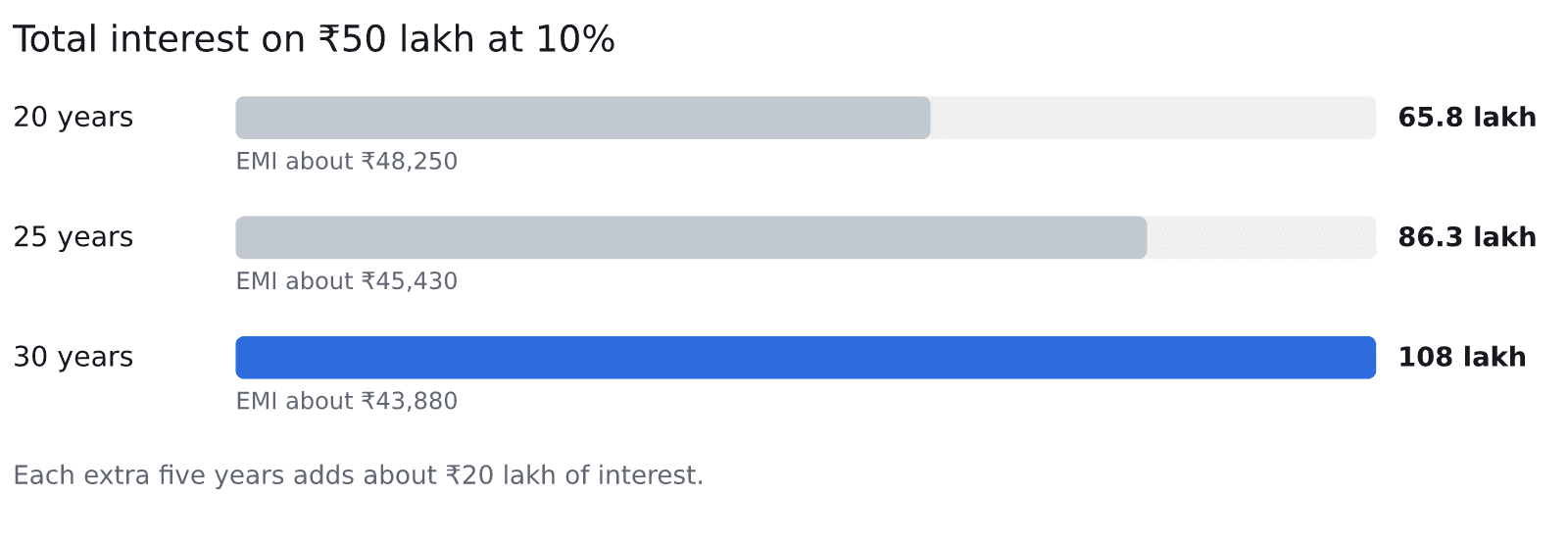
In short: A loan EMI calculator shows that a longer tenure lowers your EMI and raises your interest. On an illustrative ₹50 lakh at 10%, 30 years costs about ₹42 lakh more interest than 20.
You open a calculator, drag the tenure slider from 20 years to 30, and the monthly number drops. It feels like a weight coming off. Nobody has to tell you why: the EMI is the number that lands in your bank statement every month, and it has to fit next to rent, school fees and whatever else is already going out. A lower EMI feels safe, and for some months of some lives it genuinely is.
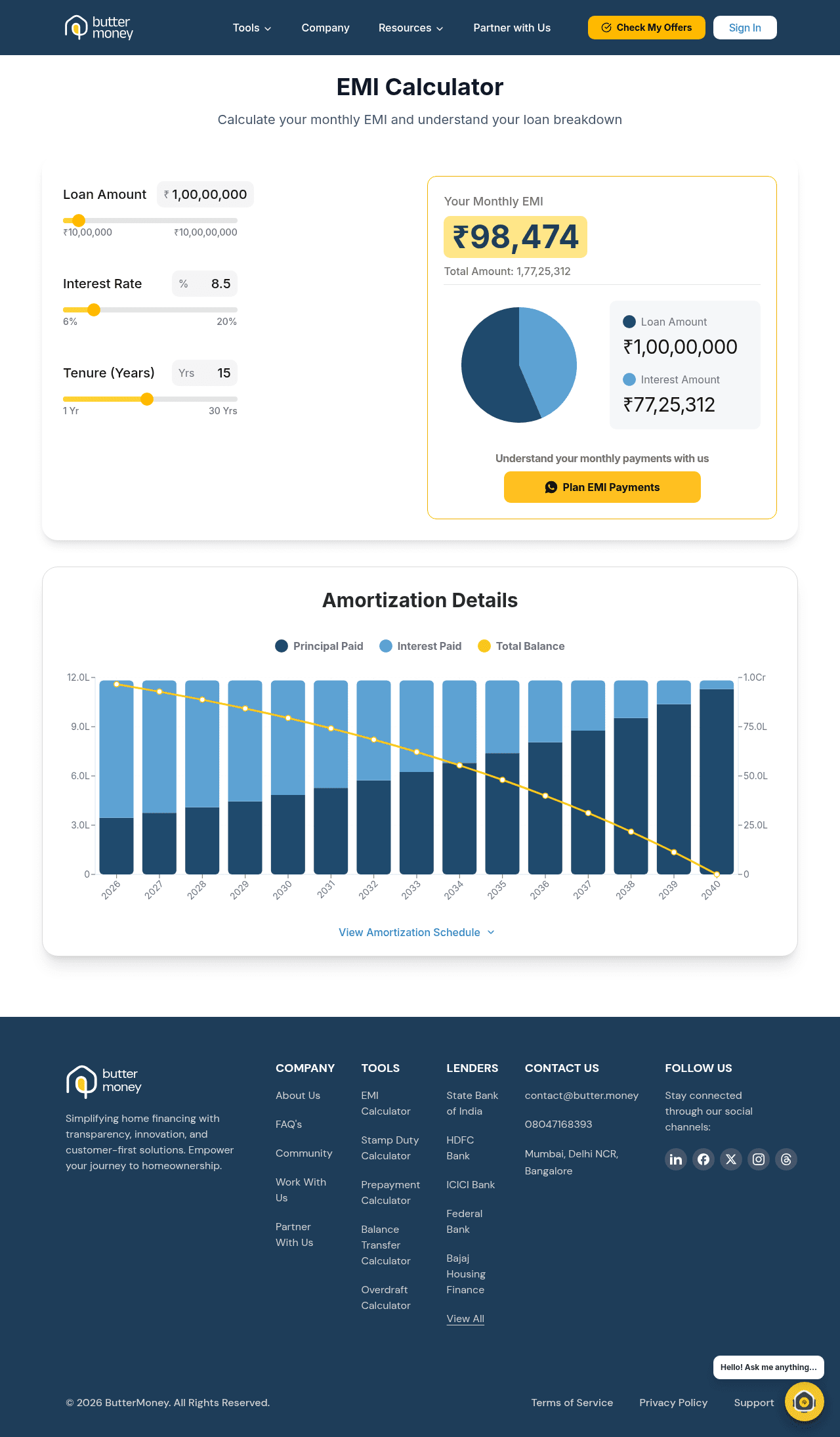
The catch sits in a number the slider doesn't shout about. To see both numbers move together, Butter Money's EMI calculator takes a loan amount, a rate and a tenure from 1 to 30 years, and shows the EMI, the total amount and the interest. Below, I run one loan at three tenures, check what your age and income allow, and look at a middle path that keeps the low EMI without paying for all 30 years.
Talk to a Home Loan expert Want to see how lenders compare for your own profile? Talk to the Butter Money team on 08047168393 (Mon to Sat, 9 AM to 9 PM). Butter Money is not a lender. The lender decides your rate and approval.
How does a loan EMI calculator work?
It runs one formula. With P as the loan, r as the monthly rate (the yearly rate divided by 12, as a decimal) and n as the number of months:
EMI = P × r × (1 + r)^n ÷ ((1 + r)^n − 1)
Three dials go in: loan amount, rate and tenure. One number comes out, plus usually the total interest. A longer tenure shrinks the EMI and swells the interest. A higher rate does the opposite.
Why does the interest swell so much? In the early years most of each EMI is interest, because the interest is charged on a balance that has barely moved. A long tenure keeps that balance high for longer. So the extra years aren't a gentle extension. They are charged at the loan's full rate, on a big balance.
One caution before the numbers. A calculator uses monthly steps, and banks can calculate interest a little differently, so treat its answer as a close estimate. Your sanction letter is the figure that counts.
Same loan, three tenures: EMI and total interest
Here is one loan: ₹50 lakh at 10%, only the tenure changes. The loan and the rate are round numbers I picked to keep the sums clean. They are not a real offer, and 10% is not a rate any lender has quoted you. Change the rate and every figure below changes, though the shape stays.
EMI and interest for ₹50 lakh at 10%, by tenure (illustrative)
| Tenure | Monthly EMI | Interest over the loan | Extra interest vs 20 years |
|---|---|---|---|
| 20 years | About ₹48,250 | About ₹65.8 lakh | None |
| 25 years | About ₹45,430 | About ₹86.3 lakh | About ₹20.5 lakh |
| 30 years | About ₹43,880 | About ₹108 lakh | About ₹42 lakh |
Source: my own working with the standard EMI formula above, on the round numbers in this post.
Read the table by its steps, not its ends.
Going from 20 to 25 years drops the EMI by about ₹2,820 a month. It adds about ₹20.5 lakh of interest. Going from 25 to 30 drops it by only about ₹1,560 more, and adds about ₹21.7 lakh. So the second five years buys you roughly half the relief and costs you the same again in interest.
That's the number I'd keep. Past 25 years, each rupee of monthly relief gets more expensive. Over the whole jump, 20 to 30 years, you save about ₹4,370 a month and pay about ₹42 lakh for it. On this loan the interest at 30 years is more than double the ₹50 lakh you borrowed.
None of this makes 30 years a bad choice. A tight month is real, and a loan you can't pay is worse than a loan that costs more. But it should be a choice you can see, not one the slider made for you. If you'd like to try your own loan, run the three tenures side by side in the EMI calculator and note the interest line each time.
What your age and income allow
Two limits decide how long you can go. One is the lender's, and one is your pay.
Age. The lender's tenure runs out when you hit its age limit. SBI's own FAQ says it offers loans up to 30 years and that repayment should be up to the age of 70. So the sum is simple: 70 minus your age at the start. At 45 the longest tenure is 25 years. At 50 it's 20. A full 30 years is only open if you start at 40 or younger. Butter Money's HDFC calculator post says HDFC's cap is 30 years or retirement age, whichever comes first, so other lenders draw the line in other places. Check the one you plan to use. For SBI's rate, documents and limits in full, Butter Money's SBI home loan calculator guide goes through them.
Income. The lender sets a ceiling on how much of your take-home pay can go to EMIs. SBI's FAQ says its EMI to net monthly income ratio "varies in the range of 20% to 70% for different Net Annual Income slabs". Butter Money's HDFC post says HDFC's own guidance is to keep loan repayments to 30% to 40% of monthly income. These are different yardsticks from different lenders, and your slab is the lender's call.
Take that second yardstick as an illustration. Say your take-home is ₹1 lakh a month and you set aside 40% of it for the home loan, so ₹40,000. At the same 10% rate, here is the loan that ₹40,000 can carry.
Loan size that ₹40,000 a month can carry at 10%, by tenure (illustrative)
| Tenure | Loan a ₹40,000 EMI fits |
|---|---|
| 20 years | About ₹41 lakh |
| 25 years | About ₹44 lakh |
| 30 years | About ₹46 lakh |
Source: my own working with the standard EMI formula.
So does a longer tenure improve your eligibility? Yes, a bit, because the same EMI budget stretches over more months. But look at how much. Going from 20 to 30 years lifts the loan you can service by about ₹4 lakh, roughly a tenth. A smaller down payment gap is a fair reason to take a longer tenure. A much bigger flat is not something the tenure slider can buy you. What the lender actually sanctions also depends on your other EMIs, your credit history and the property valuation, and none of those is in a calculator.
If you want to see what you could get before you apply anywhere, Butter Money's eligibility check takes about 2 minutes and does not touch your credit score. There's no sign-up needed yet. If you're applying to SBI, Butter Money's post on what CIBIL score SBI home loans need shows what to check first.
Long tenure plus prepayments: the middle path
This is the idea I like most. Take the long tenure. Then pay as if it were shorter, for as long as your month allows.
Why does it work? Because the EMI you are required to pay and the amount you actually pay are two different things. On the 30-year loan, the required EMI is about ₹43,880. If you pay about ₹48,250 instead, which is the 20-year EMI, the loan clears in 20 years, with the same interest of about ₹65.8 lakh as the 20-year loan. The difference is that in a lean month you can drop back to ₹43,880 and nobody calls you. A 20-year EMI is due whether the month is lean or not.
That is the whole trade. Same cost, but you hold the choice. Before you rely on it, check your sanction letter for how prepayments are applied, and whether they cut the tenure or the EMI.
Now a bolder version. Same ₹50 lakh at 10% over 30 years, but with ₹10,000 extra on top of the EMI every month, so ₹53,879 in all. I worked it out: the loan clears in about 15 years, and the interest comes to about ₹46 lakh. Compare that with the ₹108 lakh you'd pay by never prepaying. You've halved the term and more than halved the interest, for ₹10,000 a month.
Here is how much of the loan is still owed after 10 years under each plan.
Balance still owed after 10 years on ₹50 lakh at 10% (illustrative)
| Plan | Monthly payment | Still owed after 10 years |
|---|---|---|
| 30 years, EMI only | About ₹43,880 | About ₹45.5 lakh |
| 20 years, EMI only | About ₹48,250 | About ₹36.5 lakh |
| 30 years plus ₹10,000 extra | About ₹53,880 | About ₹25 lakh |
Source: my own working with the standard EMI formula.
Look at the first row. After 10 years of faithful payments on the 30-year loan, you have repaid only about ₹4.5 lakh of the ₹50 lakh. The rest of those payments were interest. That's the shape of a long loan, and it's why the early years of prepaying matter most: an extra rupee paid in year two stops charging interest on itself for decades.

Can you prepay without a penalty?
For most home loans taken today, yes. The RBI's Pre-payment Charges on Loans Directions, 2025 (RBI/2025-26/64, dated 2 July 2025) say a lender shall not levy pre-payment charges on loans to individuals for purposes other than business. They apply to loans sanctioned or renewed on or after 1 January 2026, and they cover prepayment whatever the source of the money. If your loan was sanctioned before that, the older terms in your agreement may still apply, so read yours. SBI's FAQ separately says you can reduce the tenor by prepaying the loan without any penalty.
The RBI's circular RBI/2023-24/55 of 18 August 2023 (updated as on 1 October 2025) adds that borrowers on floating rate EMI loans must be given the option to prepay, in part or in full, at any point in the tenor. Fixed rate loans can be different, so check which kind yours is. For anything contractual, a lawyer is the right person to ask.
Butter Money's repo rate post covers a related point. When your benchmark resets, a lender can raise your EMI, stretch your tenor or mix both. A prepayment habit makes that easier to absorb.
Talk to a Home Loan expert Not sure which tenure your income supports? Talk to the Butter Money team on 08047168393 (Mon to Sat, 9 AM to 9 PM). They can walk you through the lenders that fit your profile. The lender makes the final call on any loan.
Pick the tenure that fits your budget
Here's the order I'd follow. It's short.
- Start with the EMI you could pay in a bad month. Not a good one. Think of the month the car needs repair and a relative is ill. That's your ceiling.
- Check the age limit. Take 70 or your lender's own cap, subtract your age, and note the longest tenure open to you.
- Run 20, 25 and 30 years in the calculator. Write down both lines: the EMI and the interest.
- Spot the knee. On the round numbers here, the 25 to 30 step costs about as much interest as the 20 to 25 step and gives half the relief. If your budget is fine at 25, the last five years are expensive.
- Choose the longest tenure you need, not the longest you're offered. Then decide what you'll prepay and when.
- Run it at a higher rate too. Floating rates reset. If the EMI still sits comfortably at a rate a couple of points up, you have room.
Two more things worth saying plainly.
If your budget really is tight, a longer tenure is a fair call, as long as you chose it. Nobody should feel guilty about a month where the EMI had to be low. The aim is to know the price, and to have a plan to shorten the loan when money allows.
And if you're comfortable already, the shorter tenure wins on cost almost every time. The relief from the slider is real, but so is the bill that arrives 25 years later.

Get offers at the tenure you choose
Once you know the tenure, the next question is the rate. A small gap in rate moves your interest the way a few years of tenure do. Rates and fees differ by lender and by your profile, and the lender sets them. For one example, Butter Money's post on the ICICI home loan interest rate shows the slabs on the bank's own page.
So try your tenures on the EMI calculator, then bring those numbers to the lenders you're comparing. Butter Money is a direct selling agent for banks, NBFCs and housing finance companies. It isn't a lender, so the offer, the valuation and the timeline all stay with the lender. What a platform can do is put the options side by side. Whether they beat what your own bank offers is yours to judge.
Frequently asked questions
Is a 30-year home loan a bad idea?
Not if you need it. A 30-year loan gives the lowest EMI. On the illustrative ₹50 lakh at 10%, it costs about ₹108 lakh in interest against about ₹65.8 lakh at 20 years. If you can pay extra when money allows, the loan can end much sooner than 30 years. The risk is taking it and never prepaying.
Can I reduce my home loan tenure later?
Usually, yes. You can prepay part of the loan or raise your EMI. SBI's FAQ says you can reduce the tenor by prepaying without any penalty. Under the RBI's Pre-payment Charges on Loans Directions, 2025 (2 July 2025), lenders may not levy pre-payment charges on non-business loans to individuals sanctioned or renewed on or after 1 January 2026. Check your own sanction letter.
What is the maximum home loan tenure in India?
It depends on the lender. SBI's FAQ says up to 30 years, with repayment up to the age of 70. Butter Money's HDFC post says HDFC's page lists up to 30 years, or until retirement age if sooner. Your longest tenure is the lender's cap or your age limit, whichever is shorter.
Does a longer tenure improve loan eligibility?
A little. A longer tenure lowers the EMI, so the same income budget can carry a larger loan. On the round numbers here, going from 20 to 30 years lifts the loan a ₹40,000 EMI can carry from about ₹41 lakh to about ₹46 lakh. The lender still decides, using your income, other EMIs, credit history and the property valuation.
How do I use a housing loan EMI calculator?
Enter the loan amount (the price minus your down payment), the yearly interest rate and the tenure. The calculator returns the monthly EMI and usually the total interest. Run it three times, at the rate you hope for and at two higher ones, and pick the EMI you could pay in a bad month.
Does using a loan EMI calculator affect my CIBIL score?
No. A calculator sends nothing to a credit bureau. A lender pulling your report after you apply is a different matter, because that is a hard inquiry.


