

RBI's No Foreclosure Penalty Guideline 2026: What Every Home Loan Borrower Must Do This Month
A major rule came into effect on January 1, 2026, and the majority of home loan borrowers are not even aware of its existence.
Under its (Pre-payment Charges on Loans) Directions, 2025, the Reserve Bank of India barred foreclosure charges and pre-payment penalties on specified floating-rate loans sanctioned or renewed from 1 January 2026. For individuals borrowing for non-business purposes, such as a home loan, no lender covered by the rule can levy them. For floating-rate business loans to individuals and to micro and small enterprises, the ban depends on the type of lender and, for some lenders, on the loan size. This rule can end up saving you tens of thousands, or even lakhs, of rupees on a floating-rate home loan. But only if you take action on it.
This article is a guide to the rule, who it applies to, and what you should do this month.
What Just Changed And Why It Matters
Banks have not been allowed to charge foreclosure charges or pre-payment penalties on floating-rate home loans to individuals since June 2012. In May 2014, the RBI extended this to all floating-rate term loans sanctioned to individual borrowers. The gaps were elsewhere: in business loans, in loans to micro and small enterprises, and in how different types of lenders applied the rules.
What the RBI found, in its supervisory reviews, was that lenders followed divergent practices in levying pre-payment charges on loans to micro and small enterprises (MSEs), which led to “customer grievances and disputes.” It also found that some lenders were putting restrictive clauses into loan contracts to deter borrowers from switching to another lender for a lower rate or better service.
What the Directions do now is address the issue completely, uniformly, and across all institutions.
The Rule in Plain Language
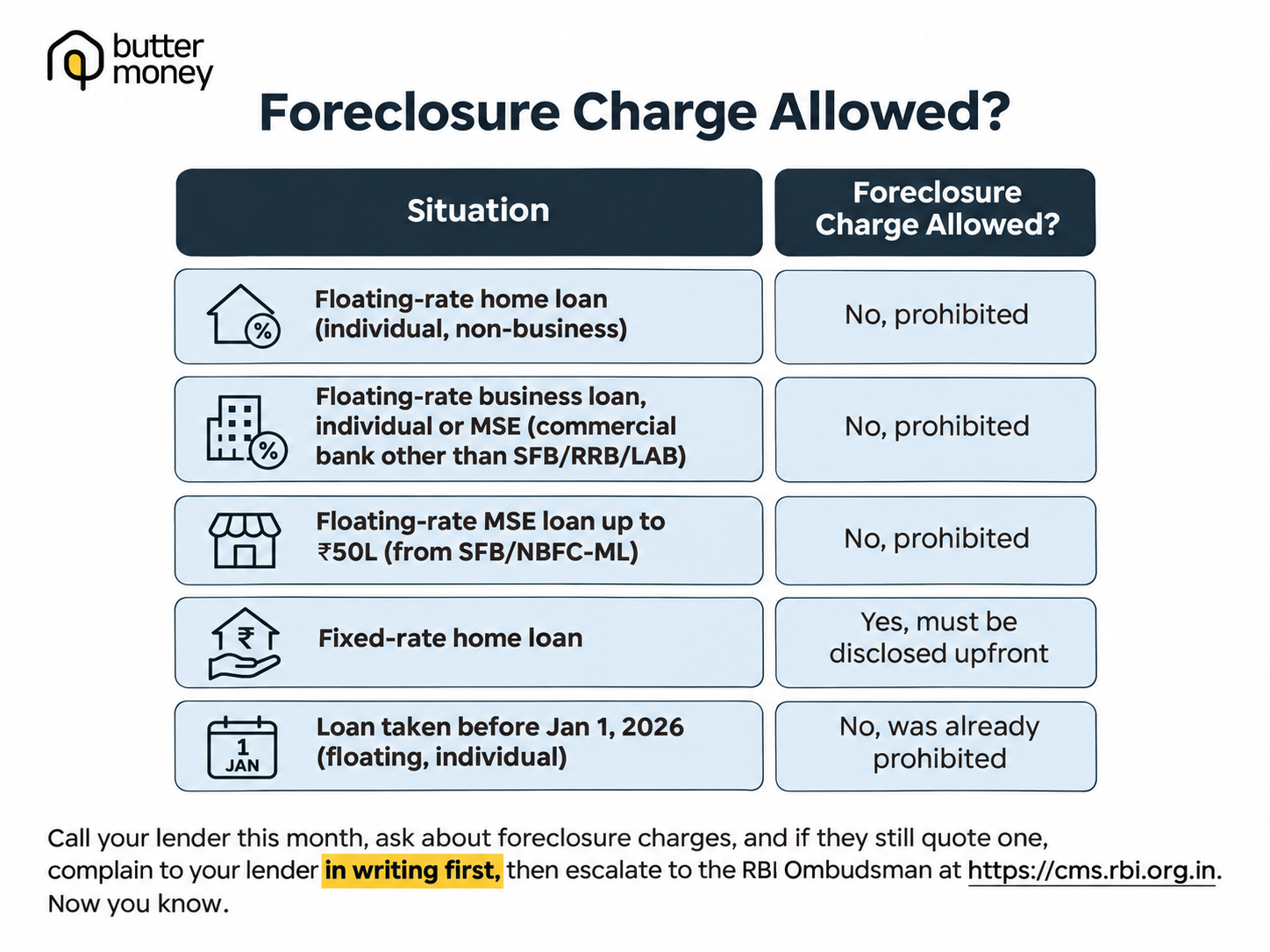
For floating-rate loans sanctioned or renewed on or after 1 January 2026, no commercial bank (other than payments banks), co-operative bank, NBFC (including housing finance companies) or All India Financial Institution can charge a foreclosure or pre-payment penalty on a loan taken by an individual for a non-business purpose, such as a home loan.
This means that:
- If you are paying off your entire home loan from your own savings
- If you are making a partial pre-payment on your home loan to reduce your principal outstanding
And most importantly, there is no lock-in period. You can pre-pay on Day 1 of your home loan if you have the money for it, and no lender will be able to penalize you for it.
Who Does This Rule Cover?
Individual Borrowers: If you have taken a floating-rate home loan in your name to acquire or construct a home, you are totally covered. This applies to all home loans, irrespective of the amount of the loan taken.
Not Covered
Fixed Rate Loans: If your home loan is a fixed interest rate loan, the banks can still impose foreclosure charges. However, the RBI mandates that these charges must be disclosed upfront in the sanction letter. No hidden charges, and no retrospective charges.
Loans taken before January 1, 2026: The new regulations will be effective for all loans sanctioned or renewed from January 1, 2026. If you have an existing loan that is a floating-rate loan for your home, unless the loan is renewed, it does not fall under this category.
Important: The majority of borrowers who have taken a floating rate loan for their home were already protected by previous RBI circulars in 2012 and 2014 that prohibited the levying of foreclosure charges for individuals. The 2026 Directions create a uniform and legally enforceable code that eliminates loopholes and also protects MSE borrowers.
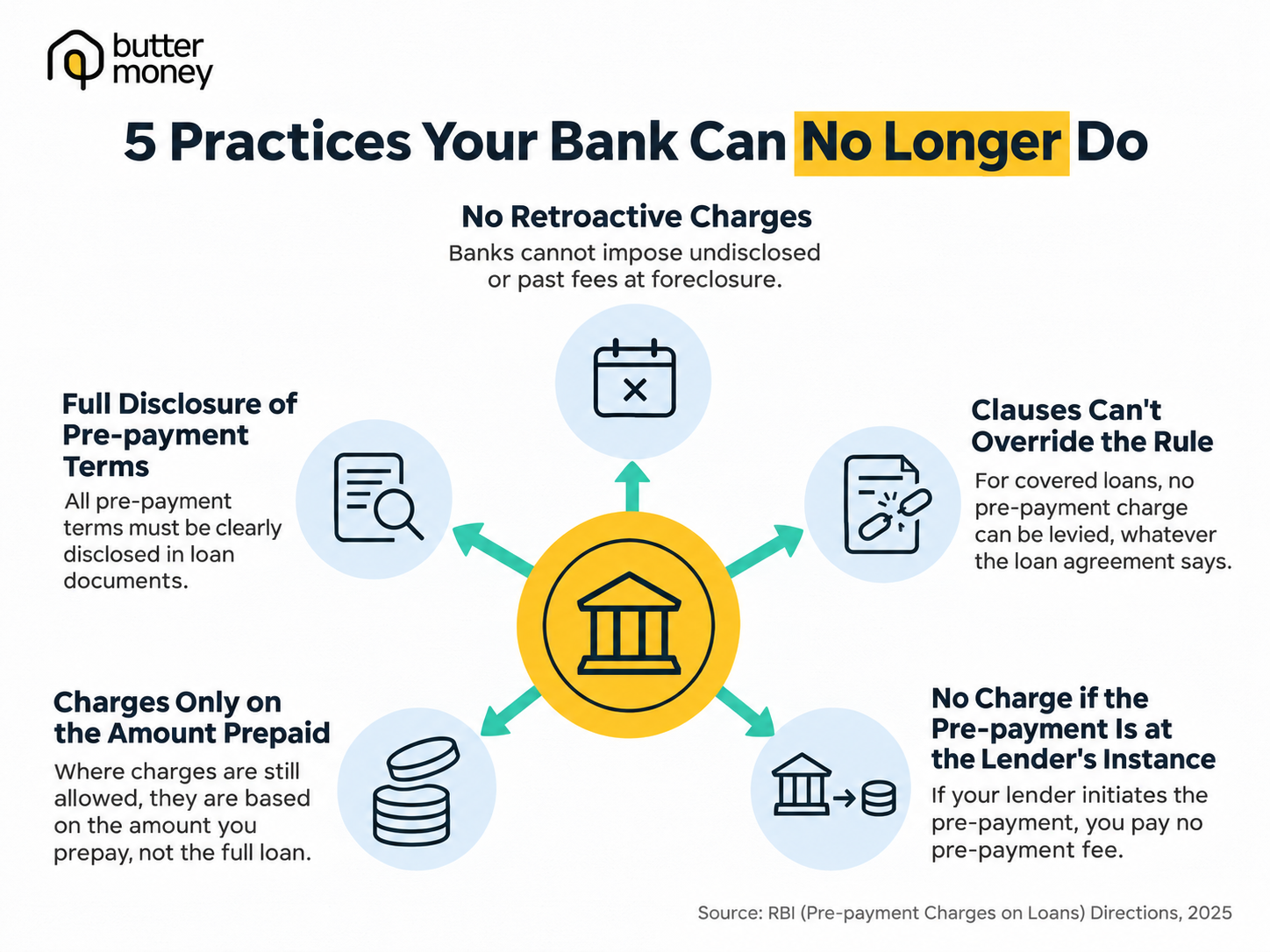
What Banks Cannot Do Anymore
The new Directions are quite clear on this. In addition to disallowing the penalty, the RBI has also disallowed these:
- Undisclosed or Retroactive Charges: The lender cannot charge you a fee at the time of foreclosure that was not disclosed in your original loan agreement. If your bank had exempted you from a charge in the past, it cannot suddenly charge you for it when you try to close your loan.
- Restrictive Clauses: The RBI flagged clauses that deter borrowers from switching lenders as a problem these Directions address. They don’t declare existing agreements void. But for a loan they cover, the lender cannot levy a pre-payment charge, whatever the agreement says.
- Pre-payment Initiated by the Lender: If the pre-payment happens at the lender’s instance, the lender cannot charge you a pre-payment fee.
- Charges Only on the Amount Prepaid: Where pre-payment charges are still allowed (for example, on a fixed-rate loan), they must follow the lender’s board-approved policy. On a term loan, they must be based on the amount you prepay, not the full loan.
- Non-Disclosure: All prepayment terms, whether charges are applicable or not, must be disclosed in your sanction letter, loan agreement, and Key Facts Statement (KFS) as per RBI’s April 2024 guidelines.
Why Most Borrowers Are Still Unaware And Losing Money
The reality is that banks do not disclose this information. Loan officers may continue to disclose prepayment fees simply due to habit or training that is no longer relevant. Some banks are banking on this inertia of customers.
This is costing people real money in two ways:
Way 1: Unnecessary charges are being collected. Those who do not know that the rule is in effect are still paying the home loan foreclosure charges that no longer need to be paid.
Way 2: Avoiding balance transfers out of assumed cost. There are many borrowers who are holding a home loan at 9%-9.5% interest rates, while other banks offer 8.5% or less. They do not make the switch because of the foreclosure penalty. The barrier no longer exists when the rule is in effect. Moving a ₹40 lakh loan from 9%–9.5% to 8.5% can save roughly ₹1 lakh to ₹2 lakh in interest over the first 5 years.
The 5 Actions Every Home Loan Borrower Must Take This Month
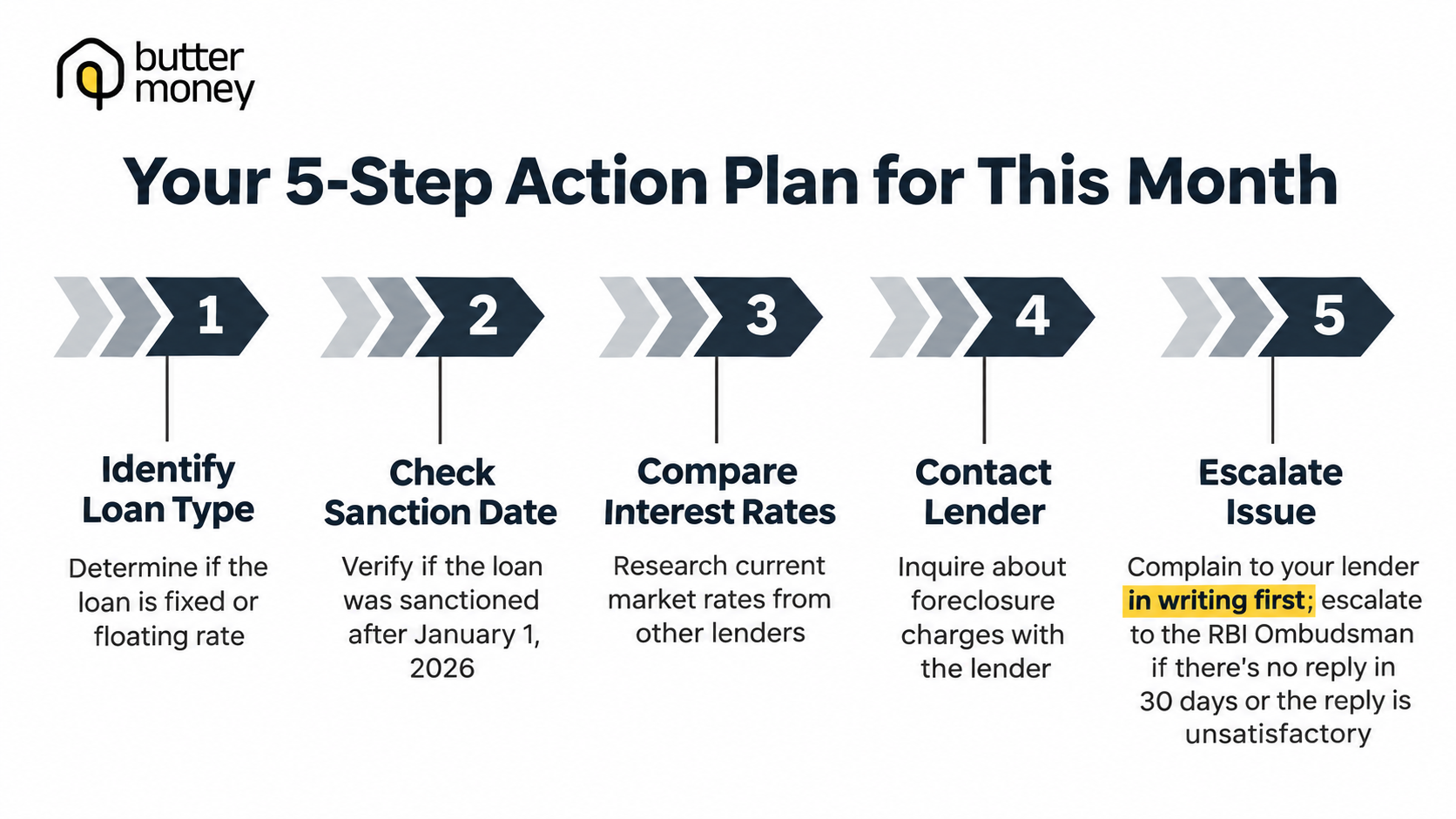
Step 1: Identify Your Loan Type
Take out your home loan sanction letter or simply log in to your net banking website. Check to see if your home loan is a floating rate or a fixed rate loan. If it is a floating-rate home loan in India, you are probably already covered.
Step 2: Check When Your Loan Was Sanctioned
If your home loan was sanctioned or renewed on or after January 1st, 2026, you are already covered by the new Directions. Even if your home loan is an older one but is a floating rate one, you were probably already covered even under the previous RBI circulars of 2012/2014.
Step 3: Compare Your Interest Rate Against the Market
Visit the websites of 3-4 major home loan lenders and check their latest home loan floating interest rates. Rates have moved since early 2026: the RBI raised the repo rate by 25 basis points to 5.50% on 7 October 2026, and lenders such as SBI raised their repo-linked rates soon after. So compare today’s rates, not older figures. If another lender is quoting 50 basis points or more below your existing rate, a home loan balance transfer can save you a substantial amount, with no foreclosure penalty on a covered loan
Here’s a rough calculation: if your outstanding home loan is ₹30 lakh with 15 years remaining, a rate that is 50 basis points lower saves about ₹1.6 lakh in total interest (for example, moving from 9.0% to 8.5%).
Step 4: Contact Your Lender and Ask Directly
You can directly ask your lender: “What foreclosure or pre-payment charges apply to my loan under the RBI (Pre-payment Charges on Loans) Directions, 2025?”
Step 5: Know Your Escalation Path
If your lender still levies a foreclosure charge on you despite your insistence that it is not allowed under the RBI Directions, you can escalate the issue as follows:
- First, complain in writing to your lender’s grievance redressal officer, citing the RBI (Pre-payment Charges on Loans) Directions, 2025. Keep a copy and note the date you sent it.
- If the lender rejects your complaint, you’re not satisfied with its reply, or it doesn’t reply within 30 days, file a complaint with the RBI Ombudsman at https://cms.rbi.org.in. It’s free and online, and you don’t need a lawyer. File within 90 days of the lender’s last reply or the end of the 30-day wait, whichever is later.
our banker will take your complaint seriously. You don’t need a lawyer.
A Word on Part-Prepayment Strategy
Many may not have the money for closing their loan, but they may have surplus funds lying idle in a savings bank account or a maturing Fixed Deposit. Under the new rules, part prepayment of a home loan will also be without penalty for floating-rate home loans.
Making a lump sum part prepayment directly will reduce your outstanding principal. This will either reduce your loan tenure (which is recommended, as more interest is saved) or your EMI, depending on your lender’s policies. Even a single part prepayment of ₹2-3 lakhs in the middle of your loan tenure will save you a disproportionately higher amount in interest.
Inquire with your lender if part prepayments are made to reduce your loan tenure or EMI, and request a tenure reduction if given a choice.
The Bigger Picture
This rule is part of a larger paradigm shift in the way the RBI is thinking about borrower rights. This is all part of a larger shift that includes the restriction on penal interest (now replaced by penal charges applicable from April 2024), the requirement for Key Facts Statements, and faster CIBIL reporting by lenders. The tide is shifting in favor of transparency and borrower mobility.
Borrowers have, for far too long, been held captive by the fear of fine print and the imposition of hidden charges. The 2026 Directions remove one of the largest locks.
The opportunity is real. The savings are real. But the rule only works for you if you know it exists and act on it.
Summary
Frequently Asked Questions (FAQ)
Q1. Does this rule apply to my existing home loan taken before January 2026?
Not directly. The 2025 Directions apply to loans sanctioned or renewed on or after 1 January 2026. But if you took a floating-rate home loan from a bank as an individual before that, earlier RBI circulars of 2012 and 2014 already barred the bank from charging a foreclosure penalty on it. If your lender is an NBFC or housing finance company, or your loan is fixed-rate, check your loan agreement.
Q2. My bank is still quoting a prepayment charge. What do I do?
Ask for it in writing, and check your loan type. If it’s a floating-rate loan you took as an individual for a non-business purpose, a covered lender can’t charge it, so cite the RBI (Pre-payment Charges on Loans) Directions, 2025 in a written complaint to the lender. Fixed-rate loans and some business loans can still carry a charge if it was disclosed in your sanction letter and loan agreement. If the lender rejects your complaint, replies unsatisfactorily or doesn’t reply within 30 days, file with the RBI Ombudsman at https://cms.rbi.org.in. It’s free.
Q3. Is a home loan balance transfer worth it now?
Often, yes: for a floating-rate home loan, the penalty barrier is gone. But the saving depends on your balance, the rate gap and your remaining tenure. On a ₹30 lakh loan with 5 years left, a rate 50 basis points lower saves about ₹44,000 in total interest; with 15 years left, about ₹1.6 lakh. Weigh that against the new lender’s processing and legal fees. Use Butter Money to compare lenders and get it done end-to-end.


