
A Khata vs B Khata: Can You Get a Home Loan on Your Bengaluru Property?
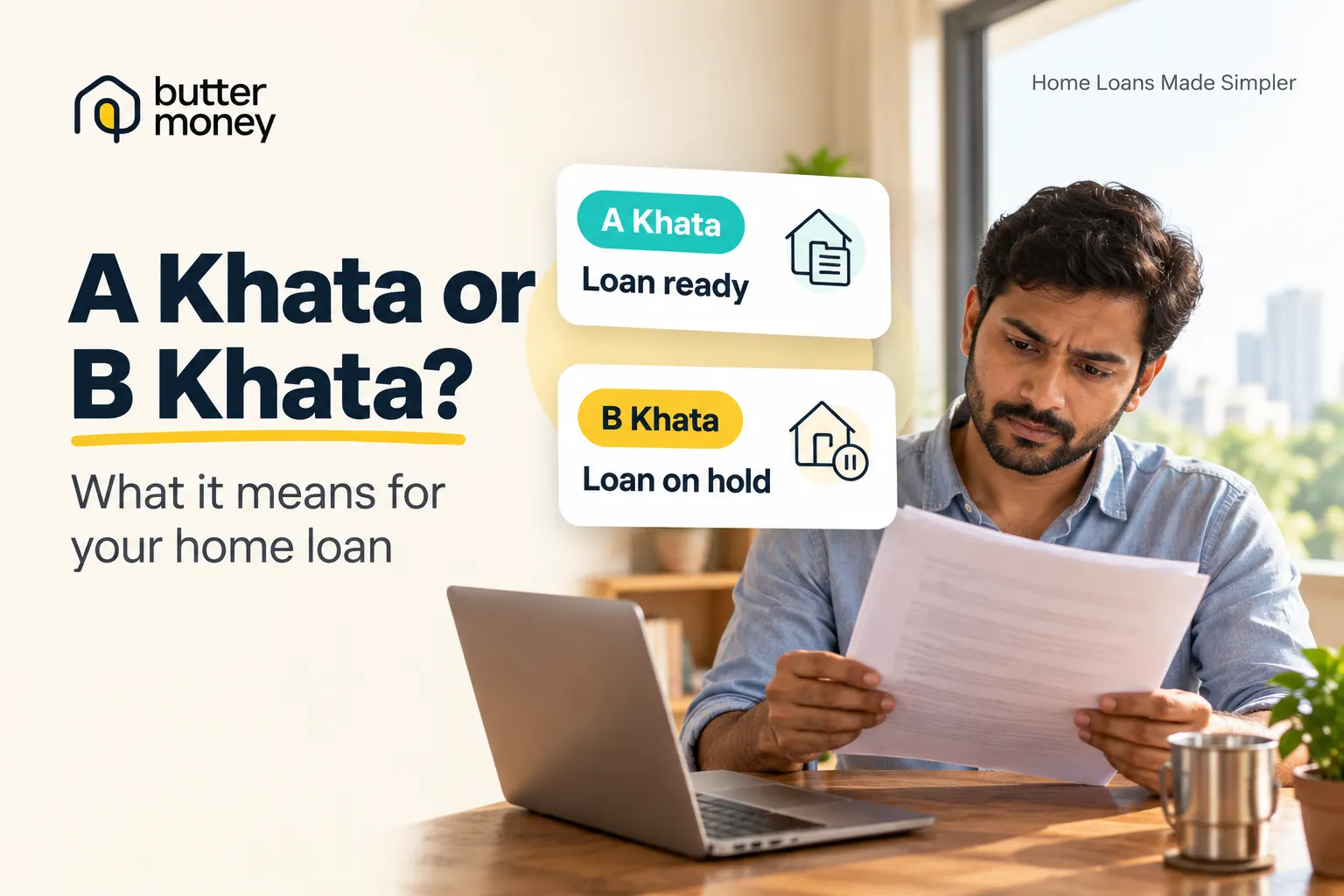
You’ve found a site in Bengaluru at a price that works, and the seller mentions it’s a B khata. If you’re counting on a home loan, that one line matters more than the price. Most banks and housing finance companies won’t lend against a B khata property, so the loan you planned for may not exist for this purchase.
This guide covers how the two differ, who will still lend, and the legal risks. It also shows the papers you need and what conversion costs now that the 2% offer has ended.
Before you pay a token advance, check which lenders would fund both you and this property. It takes about 2 minutes, it’s free, and it does not touch your CIBIL score. Check your eligibility
Key takeaways
- A khata means the property meets the city’s layout, land-use and building rules. B khata means the city collects tax on it, but something is irregular.
- Most banks and housing finance companies (HFCs) decline home loans on B khata property. A few non-banking lenders consider it, usually at a higher rate.
- An e-Khata is a digital record, not an upgrade. A B khata property with an e-Khata is still B khata.
- In Greater Bengaluru, converting to A khata costs 5% of the property’s guidance value for applications filed after 23 August 2026.
- Only properties on the B register by 30 September 2024 qualify. Land on lakes, storm-water drains, roads or government land cannot be converted.
What is the difference between A khata and B khata?
A khata is the city’s record for a property that follows the rules. That means an approved layout, land converted for non-agricultural use, a sanctioned plan and taxes paid. B khata is a separate register the city keeps so it can collect property tax from properties that break one or more of those rules. Paying tax on a B khata property does not make it legal.
“Khata” means account, and BBMP kept both registers for years. Since 2 September 2025, the Greater Bengaluru Authority (GBA) and five city corporations have replaced BBMP. The A and B registers carried over.
A property usually lands on the B register for one of these reasons:
- Revenue site: a plot in a layout that the planning authority never approved
- No land conversion: agricultural land sold as house sites without a conversion order from the Deputy Commissioner (DC conversion)
- Building problems: a house built without a sanctioned plan, or with deviations from it
| A khata | B khata | |
|---|---|---|
| What it records | Property meets layout, land-use and building rules | Property is taxed, but has an irregularity |
| Home loan from a bank | Possible, subject to the lender’s legal and technical checks | Most banks and HFCs decline |
| New building plan | You can apply for sanction | Additional construction or rebuilding is not permitted |
| Trade licence | You can apply | Not available |
| Resale | Your buyer can use a home loan | Harder, because most buyers can’t get a bank loan for it |
| e-Khata | Issued, shows A | Issued, still shows B |
| Upgrade route | Not needed | Pay a betterment fee and apply for conversion |
Can you get a home loan on a B khata property?
Usually not from a bank. Housing finance companies’ own buyer guides, published as recently as June 2026, say most banks and housing finance companies refuse home loans against B khata property. A few non-banking finance companies (NBFCs) and smaller lenders do consider it, typically at a higher interest rate and with stricter legal scrutiny.
Why the bank’s lawyer stops the file
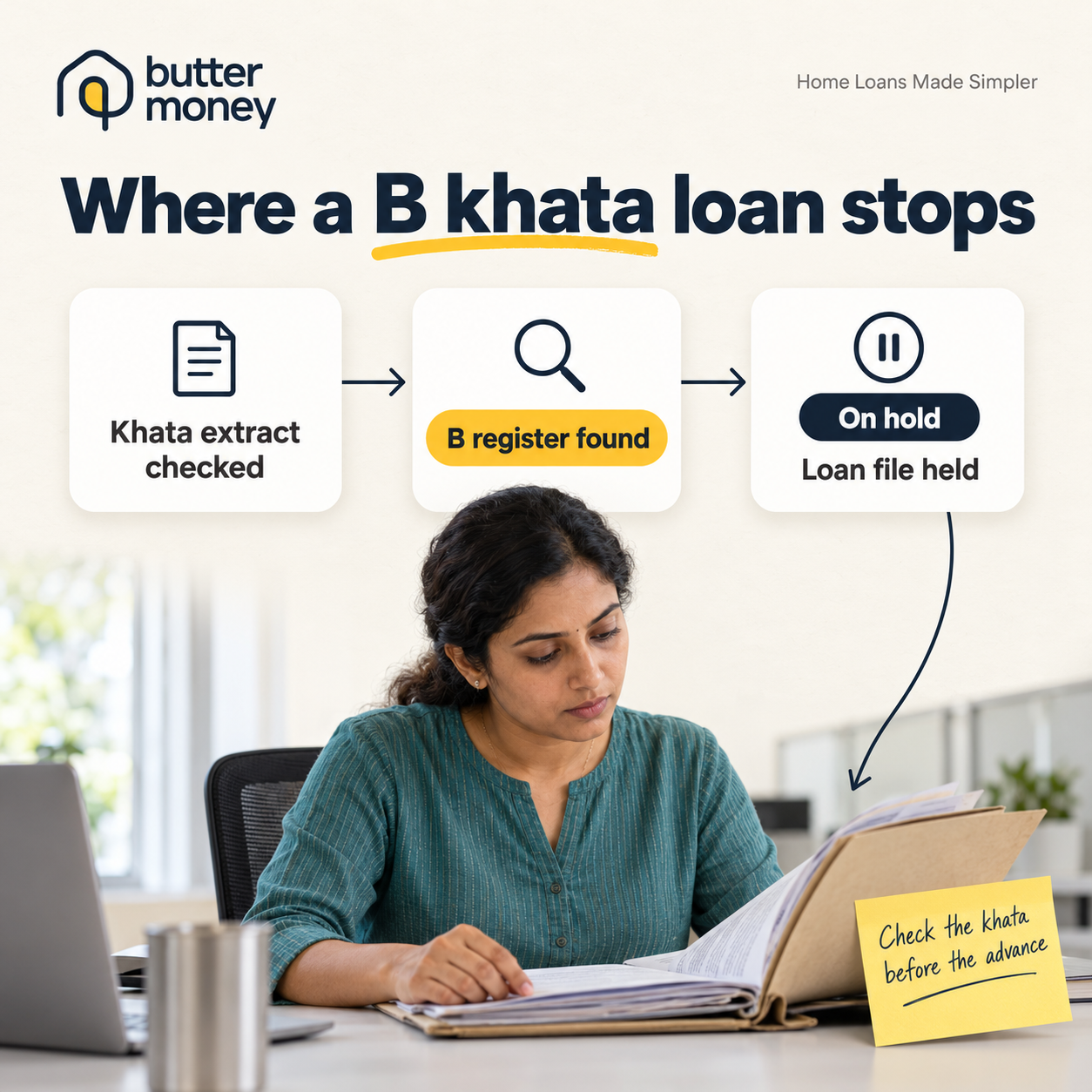
A home loan gives the bank a legal claim on the property, which it must be able to sell if you stop paying. So before sanction, the bank’s lawyer reads the title papers and khata extract. A valuer checks the property against the approved plan.
A B khata entry tells both of them that the layout, land use or building isn’t approved. The property can’t get a new building plan, and the next buyer faces the same loan problem. For the bank, that’s collateral it may struggle to sell. This check usually happens after you’ve paid the seller an advance, which is why you want the khata status first. Our guide to legal and technical verification shows where this check sits in the loan process.
Who might still lend
The lenders that consider B khata are mostly NBFCs with their own legal policies. This is where the difference between banks, HFCs and NBFCs shows. Expect a higher rate and a harder look at the title chain.
Lenders don’t publish their B khata policy on their rate pages, so you only find out by asking with the papers in hand. Butter Money compares your profile and this property against the policies of 40+ lenders and shows where you actually qualify, before any lender pulls your credit report.
Have the khata extract on your phone? Send it to a Butter Money advisor on WhatsApp and find out which lenders will even look at this property. Free, no obligation, and no credit check at this stage. Chat with an advisor
An e-Khata does not turn B khata into A khata
Karnataka made e-Khata mandatory for property registration in Bengaluru from October 2024, so every property sold now has one. It records which register the property is in. If it says B khata, the property is still B khata, even if the seller calls it “e-Khata ready”. Our post on property registration delays covers what holds up the e-Khata step.
What are the legal risks of buying a B khata property?
The biggest risk is that you can’t build, rebuild or borrow normally until the property converts, and some B khata land can never convert. Here is what to check before you commit:
- No new construction approvals. City bodies don’t permit additional construction, reconstruction or demolition until the property is regularised. That rules out building on a B khata site for now.
- Some land is excluded for good. Government land, lake or tank beds, rajakaluves (storm-water drains), roads and land reserved for public use cannot be converted. Neither can land under acquisition or a court stay.
- There’s a cut-off date. Karnataka’s cabinet limited regularisation in Bengaluru to properties issued a B khata before 30 September 2024. No new B khata is issued for unauthorised structures after that.
- Title gaps block conversion. Watch for a missing DC conversion order or an earlier owner’s khata transfer that was never completed. A survey number that doesn’t match city records will also stall the file.
- Flats are a different problem. When GBA launched the conversion scheme in October 2025, it covered land and sites. B khata flats and apartment units were not included.
How much does B khata to A khata conversion cost in 2026?
In Greater Bengaluru, you pay a betterment fee of 5% of the property’s guidance value. Guidance value is the government’s rate for the land, not your purchase price. Under the state’s “Bhoo Guarantee” campaign, applications filed from 15 May to 23 August 2026 paid 2% instead. That window has closed, and as of October 2026 no new concession has been notified.
Guidance value is usually below the market price, so the fee works out smaller than 5% of what you pay. Our post on the property valuation gap explains why the two numbers differ.
Worked example: what the fee looks like on a 30x40 site
Illustrative figures. Arjun, 36, is a software engineer in Electronic City taking home ₹1.6 lakh a month. He likes a 30x40 ft site (1,200 sq ft) near Begur, quoted at ₹78 lakh. The seller says it’s B khata. The guidance value on record works out to ₹4,300 per sq ft.
| Item | Amount |
|---|---|
| Guidance value (1,200 sq ft × ₹4,300) | ₹51.6 lakh |
| Betterment fee at 5% (applications after 23 August 2026) | ₹2,58,000 |
| The same fee at 2% (the window that closed) | ₹1,03,200 |
| Extra cost of missing the window | ₹1,54,800 |
| Fee as a share of the ₹78 lakh asking price | About 3.3% |
So Arjun needs about ₹2.6 lakh, plus a few weeks for approval, before most banks will lend on this site. That’s his negotiating point. He can ask the seller to convert before the sale, or to cut the price by the fee.
Fees are as notified by the Karnataka government and GBA as of October 2026 and can change. Check the current rate on the GBA portal before you apply.
Conversion isn’t the only cost on top of the price. Add stamp duty and registration charges for your exact property value with the stamp duty calculator. Free, and it takes under a minute. Calculate stamp duty
How do you convert B khata to A khata in Bengaluru?
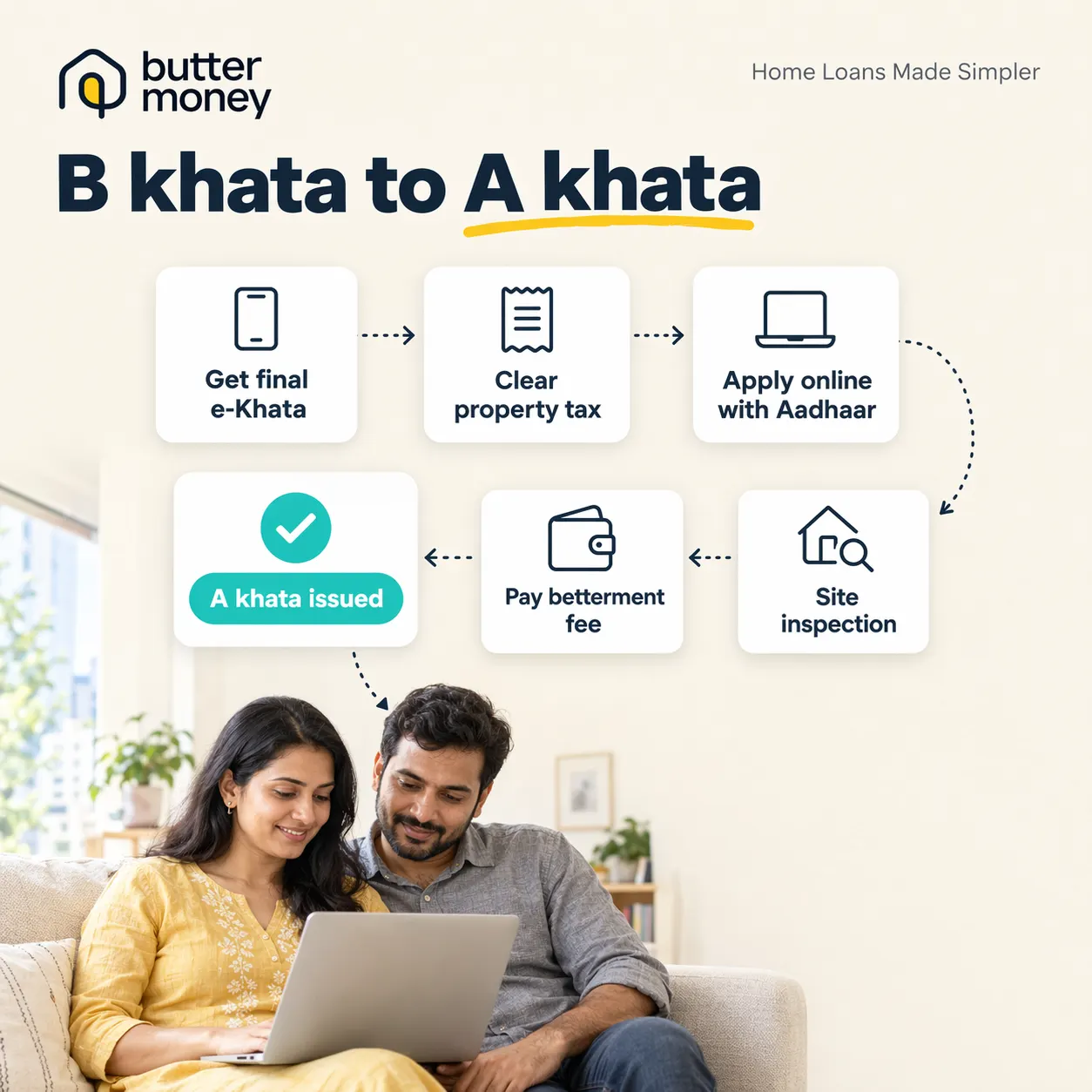
You apply online through GBA’s B to A khata service once you have a final e-Khata and your tax is paid. Officials inspect the site, you pay the fee, and the commissioner’s approval converts the record. Since 21 September 2026, GBA’s e-Aasthi 2.0 portal also takes these applications.
- Get your final e-Khata. The application runs on the property’s e-Khata ID (ePID), so a draft or missing e-Khata stops you at the first screen.
- Clear all property tax dues. Unpaid tax will hold the file.
- Apply online with Aadhaar authentication. Sites up to 2,000 sq m apply directly. Larger sites apply through the building plan portal (BPAS) with a registered architect or engineer.
- Give consent for roads, if asked. In private layouts, owners consent to the layout’s private roads becoming public roads.
- Allow a site inspection. Officials from your city corporation visit and verify the property.
- Pay the betterment fee online when the corporation notifies you.
- Get the A khata. The commissioner approves, and the record converts. You can track status online with your acknowledgement number and ePID.
Plan for several weeks at the least. Clean files move fastest. A missing DC conversion order or an incomplete earlier khata transfer is what usually holds a file up.
If the property is outside GBA limits
Many sites on Bengaluru’s edges fall under a town municipal council or a gram panchayat, not GBA. A Revenue Department order dated 9 September 2026 lets these bodies convert B khata plots up to 1,000 sq m. It runs until 31 December 2027. Urban properties need a B khata recorded on or before 10 September 2024. Gram panchayat properties need one on or before 7 April 2025. Fees are calculated at application and haven’t been published as fixed rates.
What documents do you need?
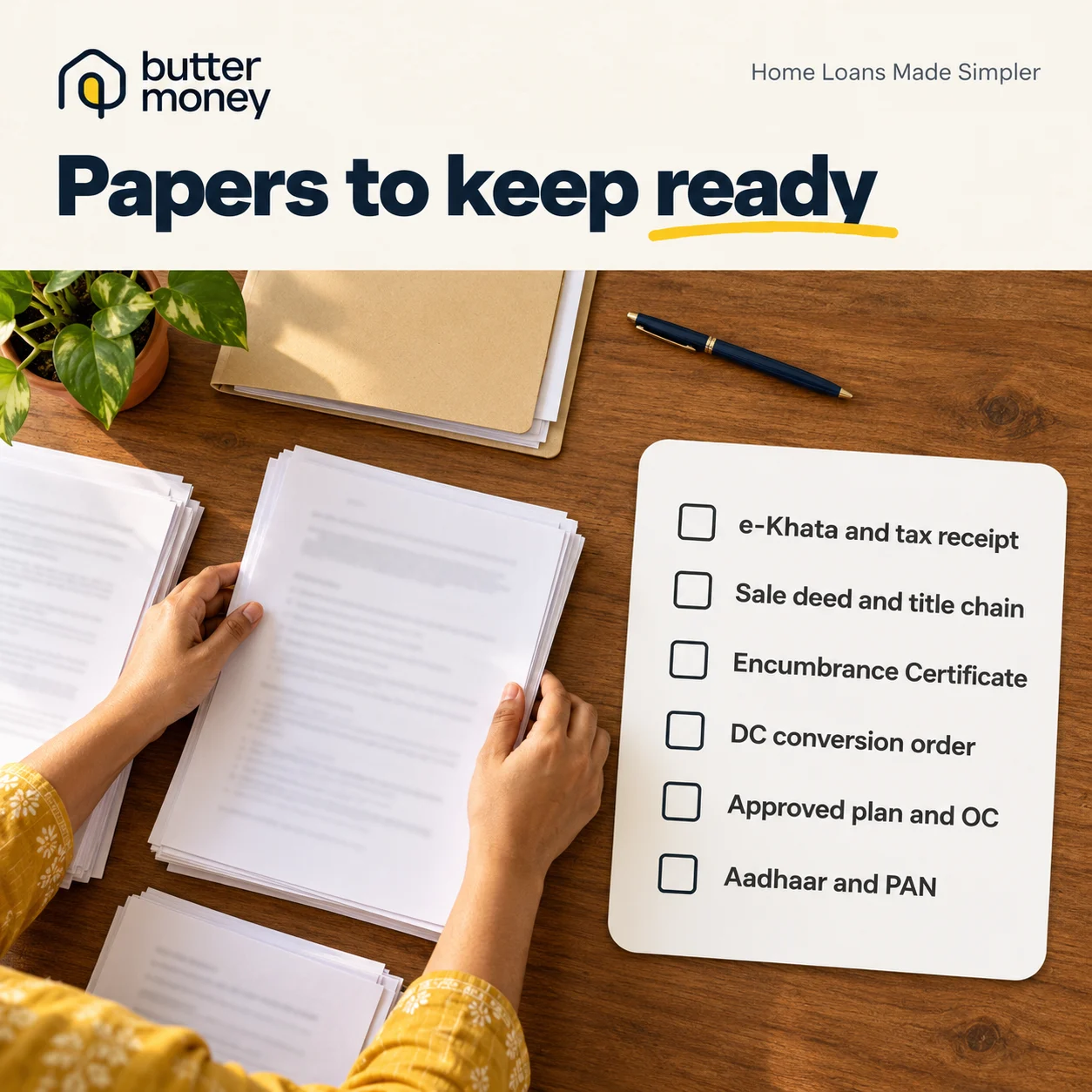
You need one set of papers to convert and a slightly different set for the loan. Keep the originals ready for the bank’s lawyer.
For B khata to A khata conversion
- e-Khata with ePID, and the latest property tax receipt
- Registered sale deed and the earlier title chain
- Encumbrance Certificate (EC), usually covering at least 15 years
- DC conversion order, if the land was once agricultural
- Approved building plan, if there’s a building on the site
- Site sketch
- Aadhaar and PAN for e-KYC
- For inherited property: legal heir certificate and death certificate
For a home loan on an A khata property
- A khata certificate and khata extract, or a final e-Khata showing A khata
- Latest property tax paid receipt
- Sale deed or sale agreement, with the earlier title chain
- Encumbrance Certificate for the period the lender’s lawyer asks for
- Approved building plan, and the occupancy certificate (OC) for a completed building
- DC conversion order, if the land was once agricultural
Stuck on a khata step the portal doesn’t explain? Ask in Butter Hood, Butter Money’s home-loan community, where Bengaluru buyers compare notes. Free to join, and you can post without sharing your documents. Ask the community
What to do if the property you want is B khata
Get it converted before you pay for it, or don’t count on a bank loan. In order of safety, your options are:
- Make conversion the seller’s job. Write it into the sale agreement: the seller applies and pays the fee. You pay the balance only once the A khata is issued.
- Convert it yourself and price it in. If the seller won’t, knock the fee off the price and budget for the wait.
- Borrow from a lender that accepts B khata, then switch. You’ll likely pay a higher rate at first. Once the property converts, you can try to move the loan to a cheaper lender through a balance transfer.
- Walk away if the land falls in an excluded category or the title chain has gaps nobody can fix.
Already paying a higher rate on a loan for a B khata property? Once it converts to A khata, see what moving to a lower rate could save you. Free, and nothing is shared with any lender. Open the savings calculator
When this doesn’t apply to you
- You’re buying an under-construction flat. There’s no individual khata yet. Lenders check the project’s approved plan, RERA registration and title instead. Ask the builder how the khata will be issued at handover.
- The property is in a town council or panchayat area. The September 2026 Revenue Department order applies instead of the GBA scheme.
FAQs
Can I get a home loan for a B khata property in Bangalore?
Rarely from a bank. Most banks and housing finance companies decline it, because the property can’t get building approvals and is hard to resell. Some NBFCs consider it, usually at a higher rate. Converting to A khata first opens up far more lenders.
Is e-Khata the same as A khata?
No. An e-Khata is the digital property record that every Bengaluru property now needs for registration. It shows whether the property is on the A or B register. A B khata property with an e-Khata is still B khata.
How much does B khata to A khata conversion cost in 2026? Is the 2% offer still on?
The 2% offer covered applications filed from 15 May to 23 August 2026. Applications filed after that pay 5% of guidance value in Greater Bengaluru. On a ₹50 lakh guidance value, that’s ₹2.5 lakh. As of October 2026, no new concession has been notified.
Can a B khata flat be converted to A khata?
Not through the GBA conversion scheme. When it launched in October 2025, it covered land and sites, not flats or apartment units. For a B khata flat, assume a bank loan is unlikely.
How do I check whether a property is A khata or B khata?
Ask the seller for the e-Khata and the khata extract, then verify the ePID on GBA’s e-Aasthi portal. The record shows which register the property is in. Don’t rely on a broker’s word.
Before you pay the advance
If the site you like is B khata, decide who pays the conversion fee and when the A khata must arrive. Put both in the sale agreement before any money changes hands.
Once the papers are clear, find out how much you can borrow and which lenders would say yes. One check across 40+ lenders, no CIBIL impact, no documents needed yet. Check your loan eligibility
Explore more:


