

Dearness Allowance: 63% From July 2026, in Rupees
Dearness allowance today: 63%, dated
In short: Dearness allowance for central government staff is 63% of basic pay from 1 July 2026, approved on 28 October 2026. On a basic of ₹10,000 that is ₹6,300 a month, and it is fully taxable.
If you are on a salary and wondering what that does to your loan plans, the eligibility check shows which lenders would take your profile in about 2 minutes, without a hard inquiry on your CIBIL report. It is a good place to see where you stand before you apply anywhere. Butter Money is not a lender.
Why this post? The pages that rank for DA are mostly glossaries, and several still carry old rates. So I went to the news reports of the latest order and to the formula itself. Where a page refused to open for me, I say so.
The rate in one box, read 2026-11-13
| Current rate | 63% of basic pay (and of basic pension, as dearness relief) |
| Effective from | 1 July 2026 |
| Approved | 28 October 2026, by the Union Cabinet |
| Change | Up 3 points, from 60% |
| Arrears | The July to October difference, paid with October 2026 salary |
| Who it covers | About 48.54 lakh serving central government employees and 68.71 lakh pensioners |
Source: Outlook Money, read 2026-11-13
Outlook Money also puts the annual cost to the government at Rs 10,016.10 crore. That is the government's estimate, not something that changes your payslip.
I could not find the Department of Expenditure's own order for the 63% on a page I could open. What I have is news coverage of the Cabinet decision. If your payroll office has issued its own circular, that is the one to trust.
How the rate got to 63%
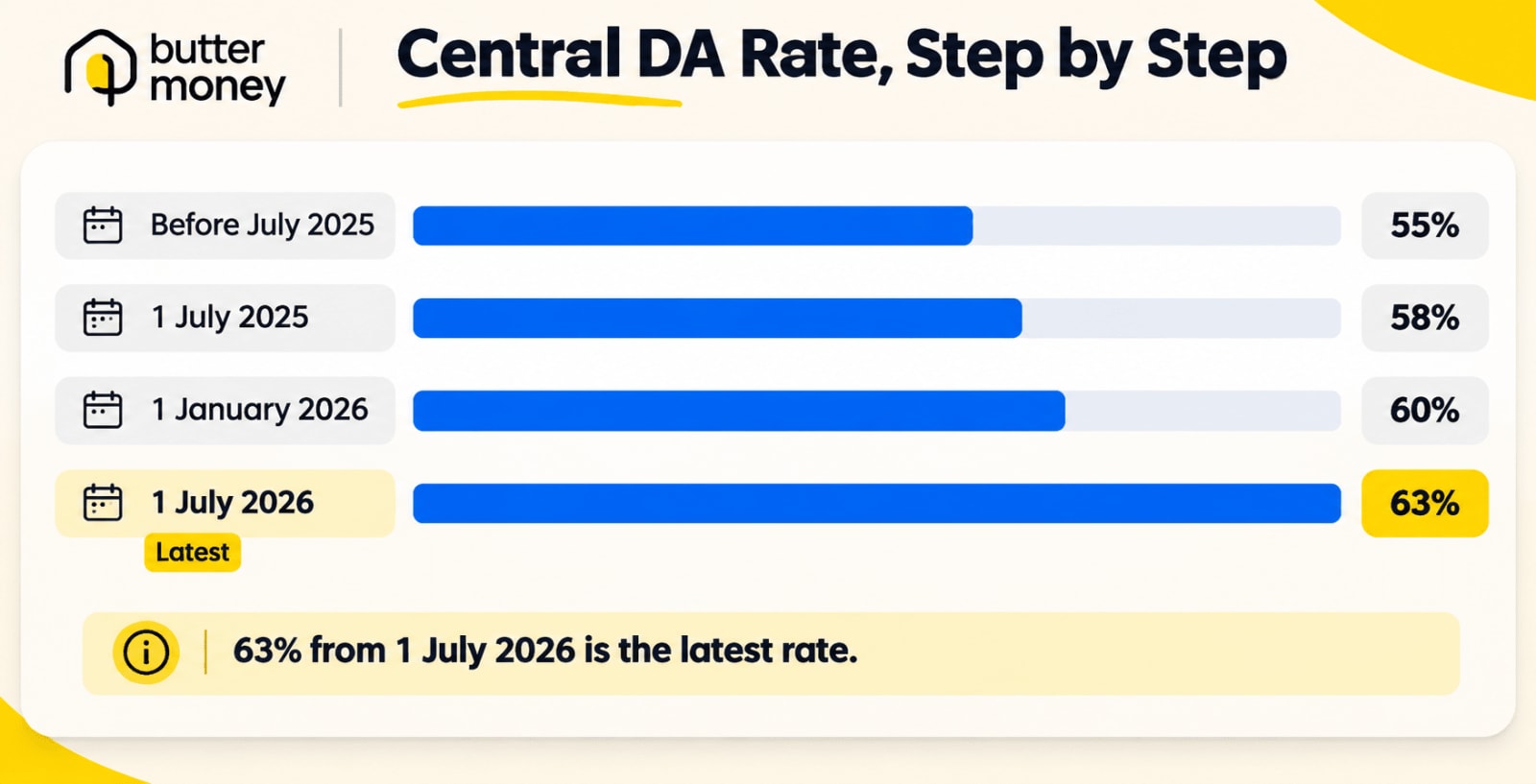
DA moves in steps, and it moves twice a year. The review dates are 1 January and 1 July, which Wikipedia lists as the standard schedule. Here is the recent run.
Recent central government DA rates
| Rate | Effective from | Change |
|---|---|---|
| 55% | Before July 2025 | The starting point |
| 58% | 1 July 2025 | Up 3 points |
| 60% | 1 January 2026 | Up 2 points |
| 63% | 1 July 2026 | Up 3 points |
Source: Business Today for 58% to 60%, Outlook Money for 60% to 63%, read 2026-11-13. The 55% and 58% steps are as listed on Wikipedia; I did not open a 2025 order.
Business Today reports that the Department of Expenditure issued the order for the 60% on 22 April 2026. It took DA from 58% to 60% of basic pay with effect from 1 January 2026, and it came with arrears from January. So the order landed almost four months after the date it applied from. That is normal. The rate applies from the first of the month, and the paperwork follows.
The same thing happened this time. The 63% applies from 1 July, the Cabinet approved it on 28 October, and the difference for July, August, September and October reaches you in one lump with October salary.
Here is the lesson I take from that. Never trust a calculator that says "current" without a date next to it. A rate that was right in April was already behind by July.
What dearness allowance is, and who gets it
DA is an add-on to basic pay that moves with prices. Wikipedia describes it as a cost-of-living adjustment, a percentage of basic salary meant to soften the effect of inflation. Your basic does not change when prices rise. DA does.
Who gets it:
- Central government employees.
- State government employees, at whatever rate their own state has announced.
- Employees of public sector undertakings.
- Pensioners, who get the same idea under a different name.
For pensioners the name is dearness relief, or DR. It is a percentage of basic pension. Wikipedia says pensioners have been paid it since 1 October 1984. The Outlook Money report on the latest hike counts 68.71 lakh pensioners alongside the serving staff, and calls it "DA and DR".
State rates differ from the central one. Each state government decides its own. I did not read any state's current figure for this post, so I am not going to guess one. If you work for a state, check your state finance department's latest order. The post on Manav Sampada covers which portal state staff open and what to ask your DDO.
A quirk for central public sector enterprises. Wikipedia says their DA is declared quarterly by the Department of Public Enterprises, and FactoHR calls it industrial dearness allowance. More on that below.
How the rate is worked out
The percentage is not picked. It comes from an inflation index, the All India Consumer Price Index for Industrial Workers, usually written CPI-IW. The Labour Bureau publishes it every month.
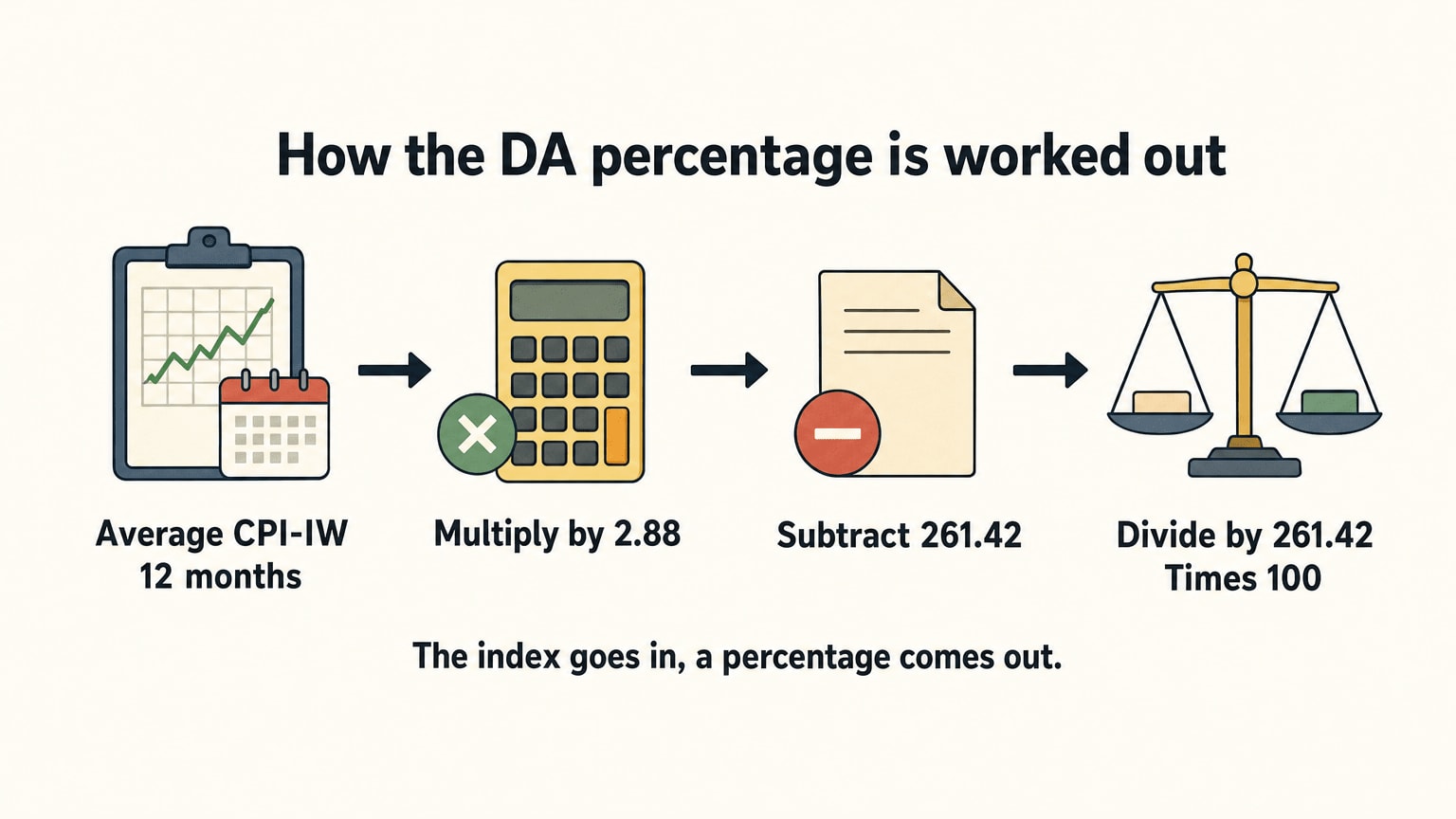
Outlook Money's explainer gives the formula:
DA % = (average CPI-IW for 12 months × 2.88 − 261.42) ÷ 261.42 × 100
Taking the pieces in turn.
The index. The current series has a base year of 2016, set to 100, and it took effect in October 2020, per Outlook Money. Each month's reading is a number a little above 100 that says how much more a basket of goods costs than it did in the base year.
The 12-month average. DA falls due on 1 January and 1 July. The average is taken over the 12 months before the month it falls due. That smooths out a sudden spike in one month.
The 2.88. The old index used a base of 2001. The new series has to be matched to it, so the Labour Bureau set a linking factor of 2.88. Multiply a 2016-base reading by 2.88 and you are back on the old scale. Wikipedia and Outlook Money both give this number.
The 261.42. This is the fixed starting line. Outlook Money says it is the average monthly index for 2015, or the index value on 1 January 2016. Anything above it, once converted, becomes DA. Wikipedia writes it as 261.4. Same constant, rounded.
One more thing to say plainly. Many pages online still show the 2001-base numbers, 115.76 and 126.33, as if they were today's formula. They belong to the earlier series. They are not what is used now. If a page you are reading has them in the working, it is out of date.
A made-up example, so you can see the mechanics
I do not have the live 12-month average, because it comes from Labour Bureau releases I did not open. So here is the arithmetic with a number I made up. It is not a real reading, and it is not a forecast of anything.
Say the 12-month average came to 150.
- 150 × 2.88 = 432
- 432 − 261.42 = 170.58
- 170.58 ÷ 261.42 = about 0.6525, which is about 65.25%
So an average of 150 would point to a DA in the mid-60s. The real figure is whatever the average was, and the government then announces a whole-number rate. Outlook Money's own worked example rounds 64.38% to 64%. I could not confirm the official rounding rule on a page, so I will not state one.
The takeaway: the 63% is the output of this sum and the Cabinet's decision. You cannot work out the next rate from this post. Nobody can say it before the index data is in, and I will not guess.
What it adds to your salary, in rupees
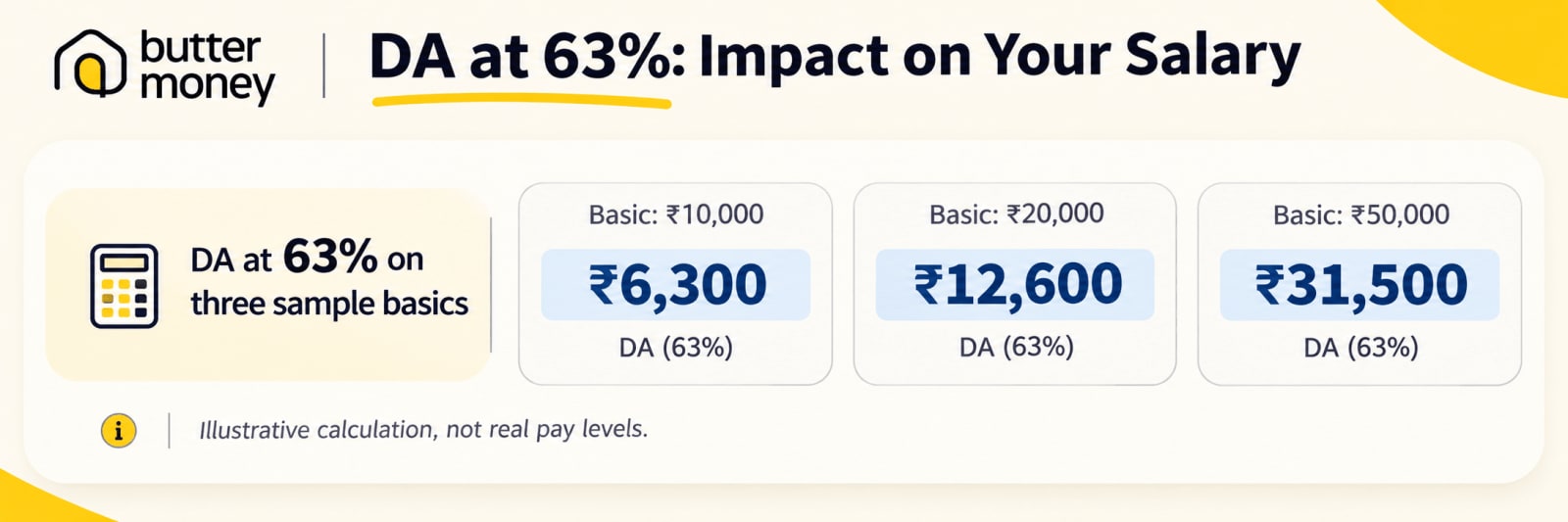
The money part is simple. DA = basic pay × DA% ÷ 100.
Use basic pay, not gross salary. DA is a percentage of basic only. Allowances, HRA and everything else on the slip stay out of the base.
I have used round basic pays below. They are illustrations, not real salaries or real pay levels, and your own basic is on your payslip.
DA at 63%, and what the 3-point rise added, on three round basic pays
| Basic pay | DA at 63% | Added by the 3-point rise | Arrears for 4 months |
|---|---|---|---|
| ₹10,000 | ₹6,300 | ₹300 | ₹1,200 |
| ₹20,000 | ₹12,600 | ₹600 | ₹2,400 |
| ₹50,000 | ₹31,500 | ₹1,500 | ₹6,000 |
Source: my arithmetic on the 63% rate and the 3-point rise reported by Outlook Money, read 2026-11-13. The basic pays are illustrative.
Walk through the first row. ₹10,000 × 63 ÷ 100 = ₹6,300. At the old 60% it was ₹6,000, so the rise is ₹300 a month. For the four months from July to October, that is ₹1,200 in arrears, paid with October salary.
The third row is five times the first, and every figure scales the same way. Double the basic, double the DA.
Two cautions. First, the arrears figure assumes your basic did not change in those four months. An increment or promotion in between would alter the sum. Second, your payslip will show DA rounded as your payroll system rounds it, so a rupee here or there is not an error.
If you are reading your own slip: basic, then DA, then HRA, then the rest. Check that DA equals basic times the current rate. If it does not, the rate in your payroll may not yet have caught up with the order.
Variable DA and Industrial DA
"Dearness allowance" covers more than one scheme. The central government employee's DA above is one. The two other names you will see are variable DA and industrial DA, and they apply to different workers.
Three kinds of DA, and who they are for
| Name | Who it is for | How often it is revised |
|---|---|---|
| DA (central government) | Serving central government staff, with DR for pensioners | Twice a year, 1 January and 1 July |
| Industrial DA (IDA) | Employees of central public sector enterprises | Quarterly |
| Variable DA (VDA) | Workers on a statutory minimum wage | Twice a year, 1 April and 1 October (central sphere) |
Source: Wikipedia, FactoHR and a gconnect note on the Lok Sabha reply, read 2026-11-13
VDA is the inflation-linked part of a minimum wage. The central government revises it every six months, from 1 April and 1 October, on the CPI for industrial workers. That date is different from the 1 January and 1 July of the central staff DA. If you read that VDA moves in January and July, the source is wrong or is talking about something else. I found one article that said exactly that, and it did not match the official wording.
IDA is for central public sector enterprises. FactoHR says it is revised four times a year. Wikipedia says the Department of Public Enterprises declares it quarterly. Both agree.
I could not open the labour ministry's own PDF notices on VDA (the site refused my request). The gconnect page quotes the official answer, but it is a news aggregator for government staff. The page also says VDA was last revised from 1 April 2022, which is plainly old. I did not find a page I could open that confirms the latest VDA revision, so I am giving you the schedule and no current VDA rupee amount.
Is dearness allowance taxable?
Yes. DA is fully taxable. Wikipedia says so, and FactoHR puts it in one line: it is fully taxable in your hands, and unlike HRA it has no exemption of its own.
That matters when you are adding up what a rise is worth. The ₹300 a month in the first row above is before tax. Whatever tax rate applies to your last slice of income applies to it.
I tried to open the Income Tax Department's salary page to give you its wording and it returned an access error. So this rests on the two pages above. I am also not going to tell you which line of your return DA sits on. I did not read the return form for this post, and a wrong line is worse than none. Your employer's Form 16 shows how it was treated for you.
Two related points, both from FactoHR:
- DA counts toward gratuity. For covered employers, the formula uses your last drawn basic pay plus DA.
- Under the labour codes, which FactoHR says came into force on 21 November 2025, wages include basic pay plus DA plus any retaining allowance. Allowances over half of total pay get pulled into wages.
I have not tested either of those against the codes themselves. They are the FactoHR reading. If a payout depends on them, ask your payroll or HR team.
DA vs HRA: what each one is for
People mix these up because both are percentages of pay and both sit on the same slip. They do different jobs.
Dearness allowance next to house rent allowance
| Dearness allowance | House rent allowance | |
|---|---|---|
| What it is for | Prices going up | Paying rent |
| What decides it | A percentage of basic, set from the CPI-IW | Your city and the rent you pay |
| How often it changes | Twice a year for central staff | Not on a fixed review cycle that I could confirm |
| Tax | Fully taxable, no exemption of its own | Partly exempt if you meet the rules |
| Does it count toward gratuity? | Yes, for covered employers | No |
Source: FactoHR, read 2026-11-13
I have left HRA percentages out. I did not read an official page for them, and the rates depend on city class. Your payslip shows what you get.
One practical difference. If you rent, HRA's exemption can lower your tax. DA's cannot. So a rupee of DA and a rupee of HRA are not worth the same after tax, even if they look alike on the slip.
Does the private sector get dearness allowance?
Mostly no, not by default. FactoHR says private sector employees are not automatically entitled to it. Large older companies sometimes pay it, as Wikipedia notes, and some private pay structures include it under that name.
The exception is minimum-wage work. Workers on a statutory minimum wage get the VDA part by law, as the table above shows.
If you are in the private sector and your slip has a line called "DA", it was set by your employer. It is part of your pay structure, and the central rate of 63% has no hold over it. A private DA can be any percentage your contract says. Read the offer letter.
The 50% merger question and the 8th Pay Commission
Two questions keep coming up. Will DA be merged into basic pay, and what happens when the 8th Pay Commission reports?
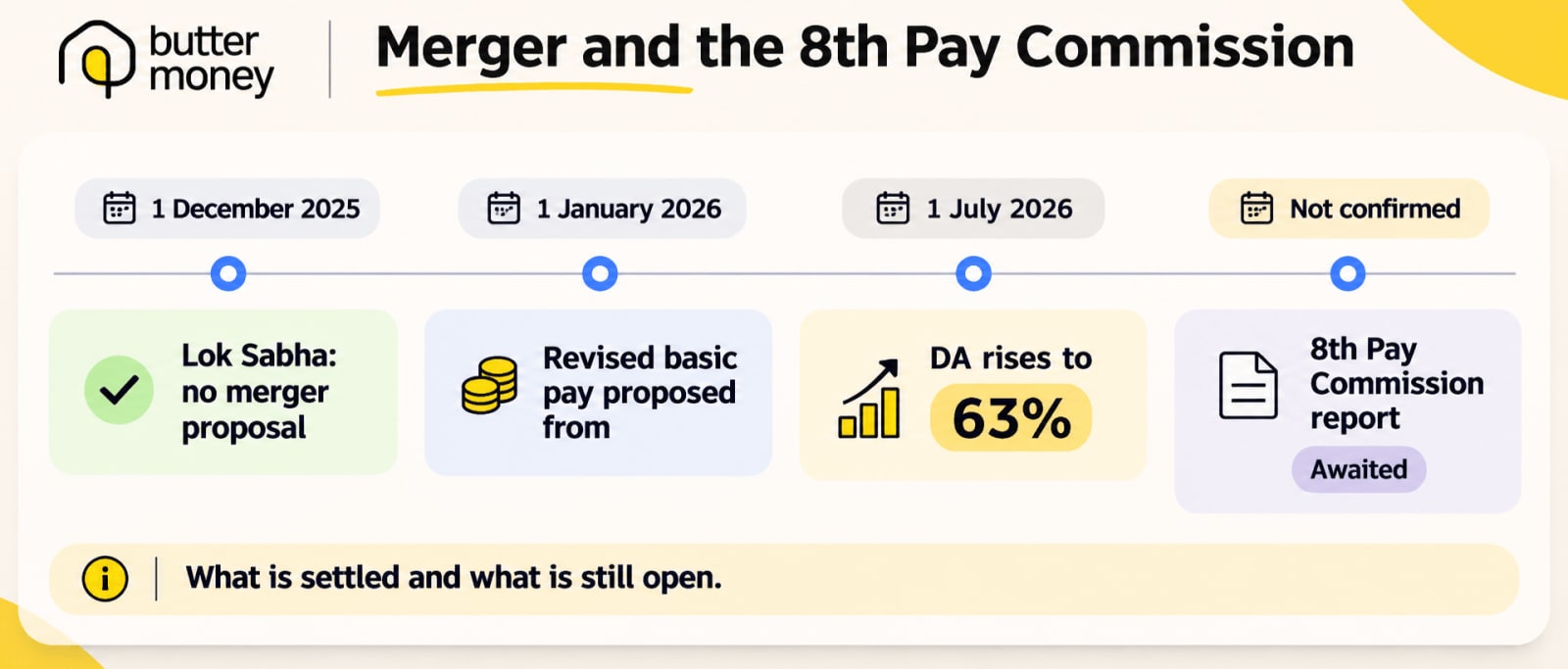
The merger. Wikipedia notes that 50% of DA was merged into basic pay, with effect from 1 April 2004 (the same page also mentions 1994 in that sentence, so treat the year with care). The rate is well past 50% now, so the question is fair to ask. On 1 December 2025, Minister of State for Finance Pankaj Chaudhary told the Lok Sabha that no proposal to merge the existing dearness allowance with basic pay is under consideration. Outlook Money reports the reply. That is a statement about that day. I have not seen anything newer.
The 8th Pay Commission. Business Today reports that once the 8th Pay Commission is implemented, the existing DA will be folded into the revised basic pay. Until then, DA continues exactly as it does now: a percentage of basic, reviewed every January and July.
So there are two things that can look like a merger but are different. A one-off merger of DA into basic is not planned, per the Lok Sabha reply. A new pay commission resetting the pay structure, with DA rolled into the new basic, is how the system has normally worked, and Business Today says it is expected here as well.
Timing is where I will be careful. Business Today says no implementation date is confirmed. A Sunday Guardian piece updated on 3 October 2026 says revised basic pay has been proposed to be considered from 1 January 2026, and that arrears are normally provided for revised basic pay only, so allowance arrears may be treated differently. It says the report is awaited within the 18-month window, without saying when that window began. I could not find a government page confirming a report date.
None of this tells you what the next DA rate will be, or what your pay will be under the new structure. Anyone who gives you a number is guessing. I have not tried to.
What this means for a home loan
DA is part of what you earn, so it feeds into the conversation with a lender, but I did not find a page saying how any particular lender counts it. Lenders look at income, your existing EMIs and your credit history together, and each decides for itself. Ask the lender how it treats allowances before you rely on a number.
When you are weighing what EMI you can carry, remember that a pay rise from DA is one thing and a tenure choice is another. The EMI calculator post shows what tenure does to the monthly figure, with illustrative numbers. And if you are about to apply, check your own file first. The post on a free CIBIL score check explains how to do that without hurting your score.
Frequently asked questions
What is the dearness allowance rate now?
For central government employees it is 63% of basic pay from 1 July 2026, up from 60%. The Union Cabinet approved it on 28 October 2026. Arrears for July to October are paid with October 2026 salary, per Outlook Money. State government rates differ.
How is dearness allowance calculated?
DA = basic pay × DA% ÷ 100. On a basic of ₹10,000 at 63%, that is ₹6,300. The percentage itself comes from the 12-month average of CPI-IW (base 2016), multiplied by 2.88, minus 261.42, divided by 261.42, times 100.
Is DA part of basic pay?
No. DA is a separate allowance worked out as a percentage of basic. Your basic stays where it is when DA rises. For gratuity at covered employers, FactoHR says the formula uses basic pay plus DA.
Is dearness allowance taxable?
Yes, fully. Wikipedia and FactoHR both say so. Unlike HRA, DA has no exemption of its own. I could not open the Income Tax Department's page to confirm it there.
What is the difference between DA and HRA?
DA responds to rising prices and is a percentage of basic. HRA is for rent and depends on your city and the rent you pay. HRA can be partly exempt from tax if you meet the rules. DA cannot.
How often is DA revised?
For central government staff, twice a year, on 1 January and 1 July. Industrial DA for central public sector enterprises is revised quarterly. Variable DA on minimum wages is revised on 1 April and 1 October in the central sphere.
Do pensioners get dearness allowance?
Pensioners get dearness relief, a percentage of basic pension. Outlook Money says the 63% covers 68.71 lakh pensioners as well as serving staff.
Do private sector employees get DA?
Not automatically. FactoHR says private employees are not entitled to it by default. Some employers pay it as part of pay, and minimum-wage workers get variable DA by law. A private DA follows your contract, not the central rate.
Will DA be merged into basic pay?
On 1 December 2025 the government told the Lok Sabha it had no proposal for such a merger. Business Today reports that existing DA will be folded into revised basic once the 8th Pay Commission is implemented. I found no confirmed date.
Can I know the next DA hike in advance?
No. The next review date is 1 January, but the rate depends on the CPI-IW data and a Cabinet decision. Any specific figure quoted before then is a guess.


