

Freedom From Home Loan EMIs: 5 Practical Ways to Close Your Loan Faster
Somewhere around year three or four of a home loan, most borrowers run the same quiet calculation: multiply the EMI by the months left, and feel a small jolt at how large that number still is. You’ve paid on time, every month, without fail, and the loan still doesn’t feel any smaller.
Here’s what’s changed since you signed that agreement: closing your loan early no longer costs a penalty, and for most salaried borrowers, no longer costs a tax deduction either. The two biggest reasons people talked themselves out of prepaying have quietly stopped applying to most home loans in India. This piece covers five practical ways to shorten your tenure, why the tax objection mostly doesn’t hold anymore, and the one thing to check before you act.
Quick answer: the fastest way to close a home loan faster is to attack the tenure, not just wait for a lower rate.
- Renegotiate your spread
- Add one extra EMI a year
- Step up your EMI with each raise
- Prepay early rather than late
- Use an overdraft-linked structure if your income is irregular
None of this costs anything extra to try — there’s no prepayment penalty, and for most borrowers, no tax deduction at stake either.
Run your own loan through the Butter Money ++Prepayment Calculator++ before you read on. Two minutes, and it’ll show you where you actually stand.
The examples here use one loan throughout: ₹50 lakh, 20-year tenure, 8.5% floating rate, a fairly typical profile for a salaried buyer with a decent credit score today. Swap in your own numbers using the calculators linked as you go.
Why the Tenure, Not the Rate, Is the Number to Attack
Your EMI was sized on day one to what the bank judged you could safely pay. That number doesn’t move just because you want it to. Your rate is set by the RBI’s repo rate (5.25% as of August 2026, held for a fourth straight meeting) plus your bank’s spread, neither of which you control either. Tenure is different. It’s the one number you can actually push on, and the mathematics of amortisation make it worth pushing on hard.
Here’s why. In the first five years of our ₹50 lakh, 8.5%, 20-year example, you’ll pay roughly ₹26 lakh in EMIs:
- About 77% goes to interest — only 23% actually reduces what you owe
- After a quarter of your tenure has passed, you’re still carrying about 88% of the original loan
This is why a home loan feels stuck for years even when you’re never late on a payment: for a long stretch, you barely are.
It also explains why rate cuts alone move the needle less than people expect. Say your bank passes through a 25 basis point cut, from 8.5% to 8.25%:
- Take the lower EMI, the standard path → you save about ₹1.9 lakh over the life of the loan
- Hold your EMI where it was instead → the saving jumps to roughly ₹4.6 lakh, nearly 2.5x more
That gap compounds down your principal every month instead of landing in your account. Rate cuts help. What you do with them helps more.
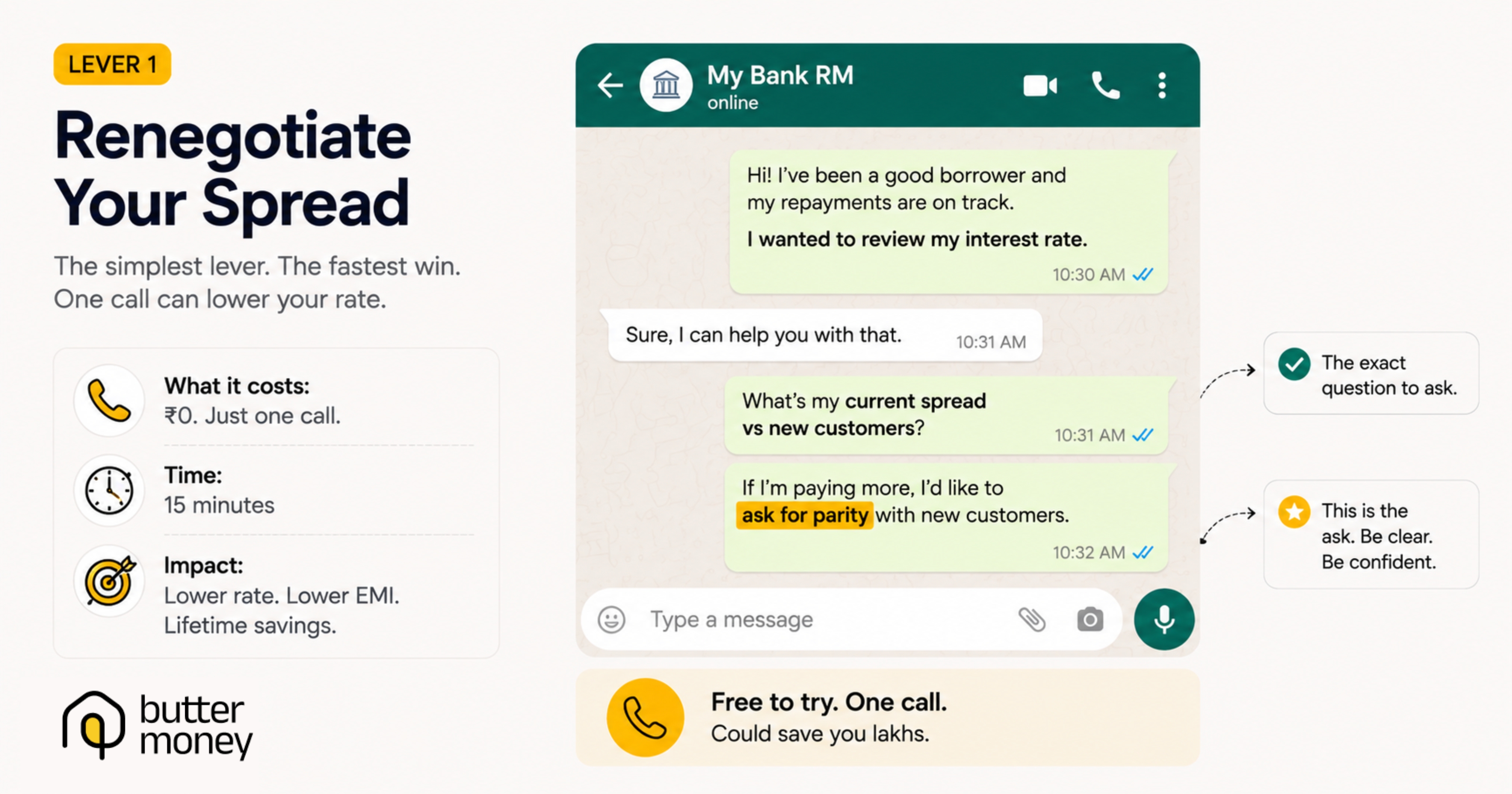
Lever 1: Renegotiate Your Spread (Free, One Conversation, Most Ignored)
Your rate is repo plus spread. The repo rate moves with the RBI and applies to you automatically. Your spread was fixed the day your loan was sanctioned and, unless you ask, it just sits there, even while your bank quietly offers better spreads to new customers with the same credit profile as you.
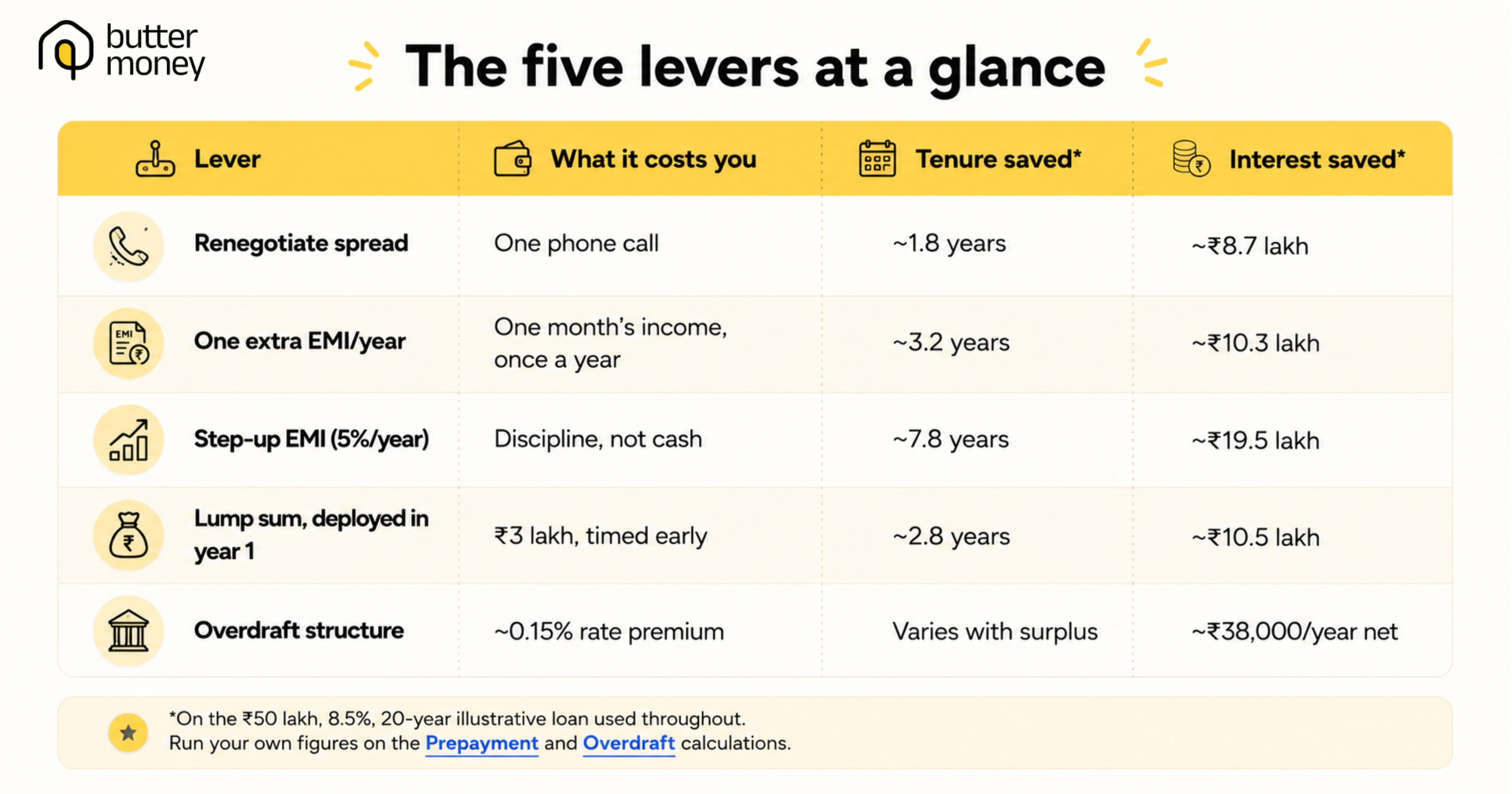
Asking to have it corrected costs nothing but a phone call or a branch visit, occasionally a small conversion fee. Result: a 50 basis point spread cut on our ₹50 lakh example, taken as a held EMI rather than a lower payment, saves about 1.6 years and roughly ₹8.7 lakh in interest. That’s a free lever most borrowers never pull — mostly because nobody at the bank will volunteer it. On the origination side at Butter Money, spread parity is one of the most common gaps we see when we review a borrower’s existing loan.
What to say:
- Call your relationship manager or raise a service request — ask directly what your current effective spread is versus what new customers on your loan product are getting
- If there’s a gap, ask for parity
- You have real leverage now: switching lenders via a ++balance transfer++ carries no foreclosure penalty (more on that below), so the threat of walking is credible and free to act on
For the full walkthrough on finding your benchmark and running your own numbers: ++why your EMI didn’t drop after the last rate cut++.
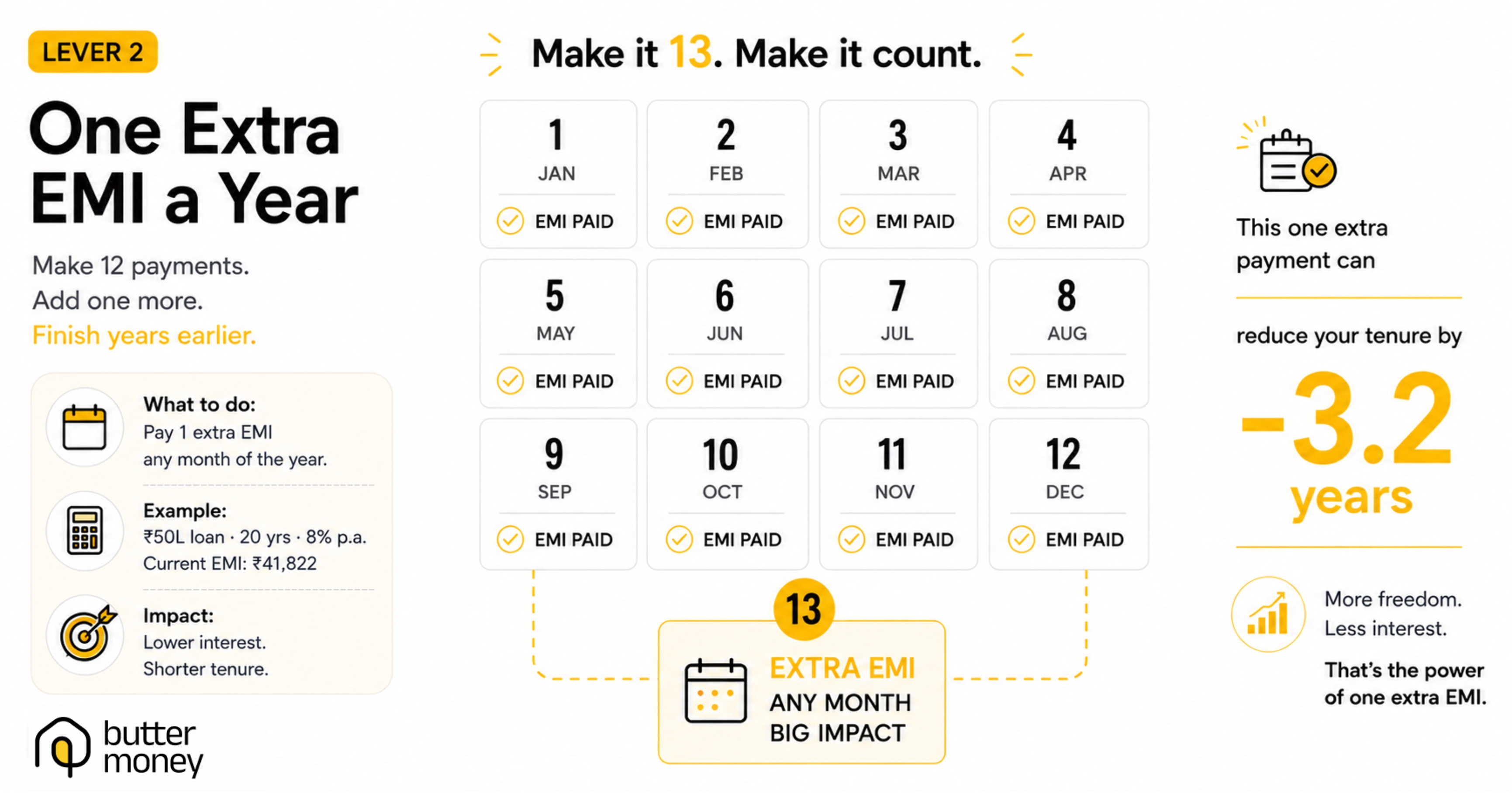
Lever 2: One Extra EMI a Year
This is the classic move for a reason. Redirect one month’s bonus, your 13th-month salary if you get one, or a tax refund toward a single extra EMI-sized payment once a year, applied straight against your principal.
Result: on the same ₹50 lakh loan, this alone takes a 20-year tenure down to roughly 16.8 years — a saving of about 3.2 years and ₹10.3 lakh in interest, from one payment a year.
The catch to watch for:
- Tell your lender explicitly that you want the extra payment applied to reduce tenure, not EMI. Most will ask — reducing EMI feels like relief in the moment but saves far less interest over time
- RBI’s prepayment rules apply from day one with no lock-in, so you can start this in year one rather than waiting
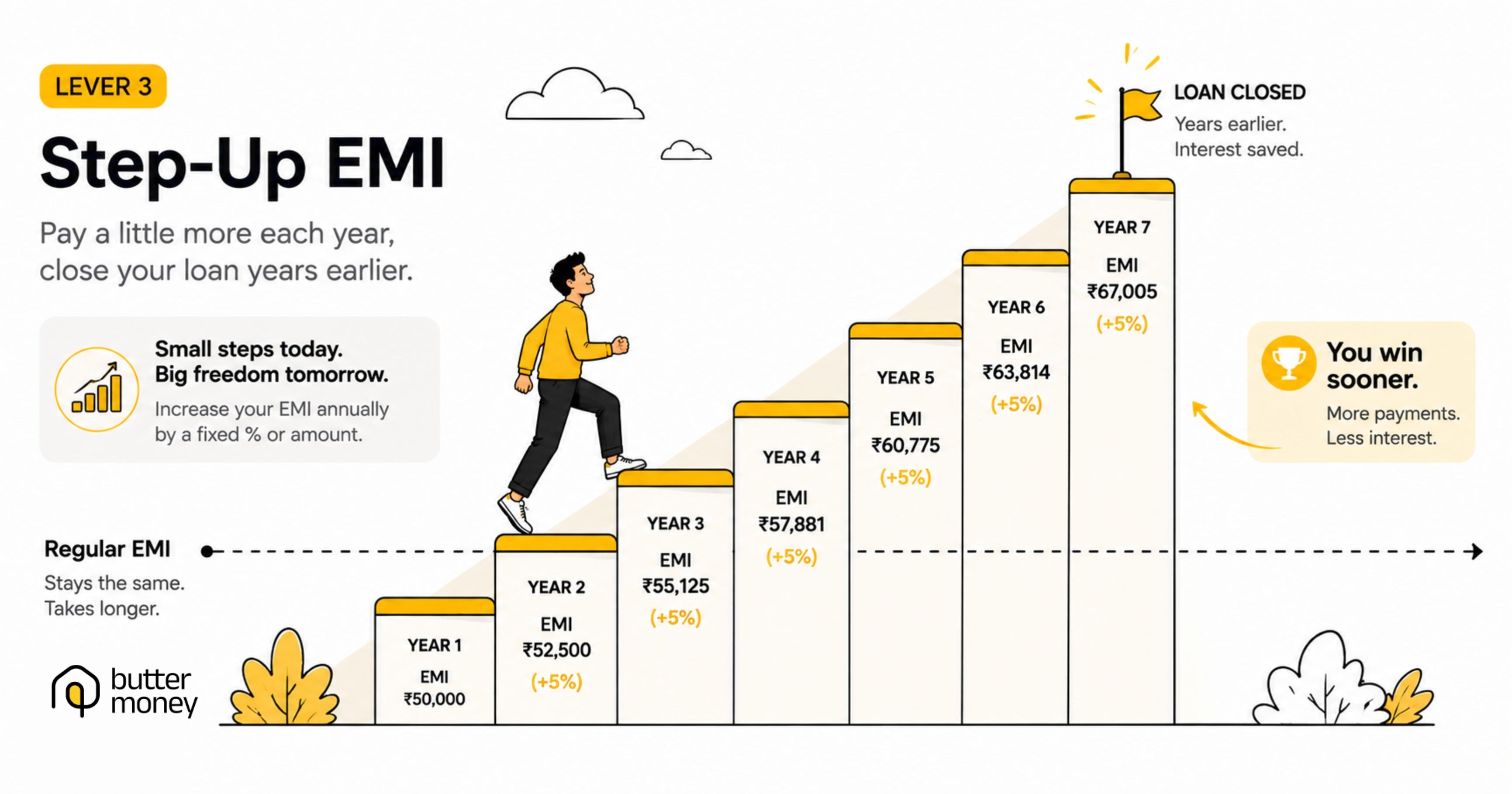
Lever 3: Step-Up EMI Tied to Your Increment
This is the single most powerful lever in this list, and it costs you nothing but discipline. Each time you get an appraisal, ask your lender to raise your EMI by the same percentage, or set up your own standing instruction to route the difference as a recurring extra payment if your lender doesn’t support a direct EMI increase. Either way achieves close to the same result.
Run this on our example loan:
- At a conservative 5% step-up a year → the 20-year tenure collapses to about 12.2 years, saving roughly 7.8 years and ₹19.5 lakh in interest
- At 8%, closer to what many salaried professionals actually see across a normal appraisal cycle → it drops further, to around 10.4 years, saving close to ₹24 lakh
The honest caveat: this only works if you keep doing it, year after year, without letting your lifestyle absorb the raise first. One skipped year won’t undo progress already made — but the effect depends on the habit sticking more than any other lever here. Even a 3-4% step-up changes the picture meaningfully over 20 years. (This isn’t the same as a bank’s “step-up loan” product for fresh borrowers — see the FAQ below for the distinction.)
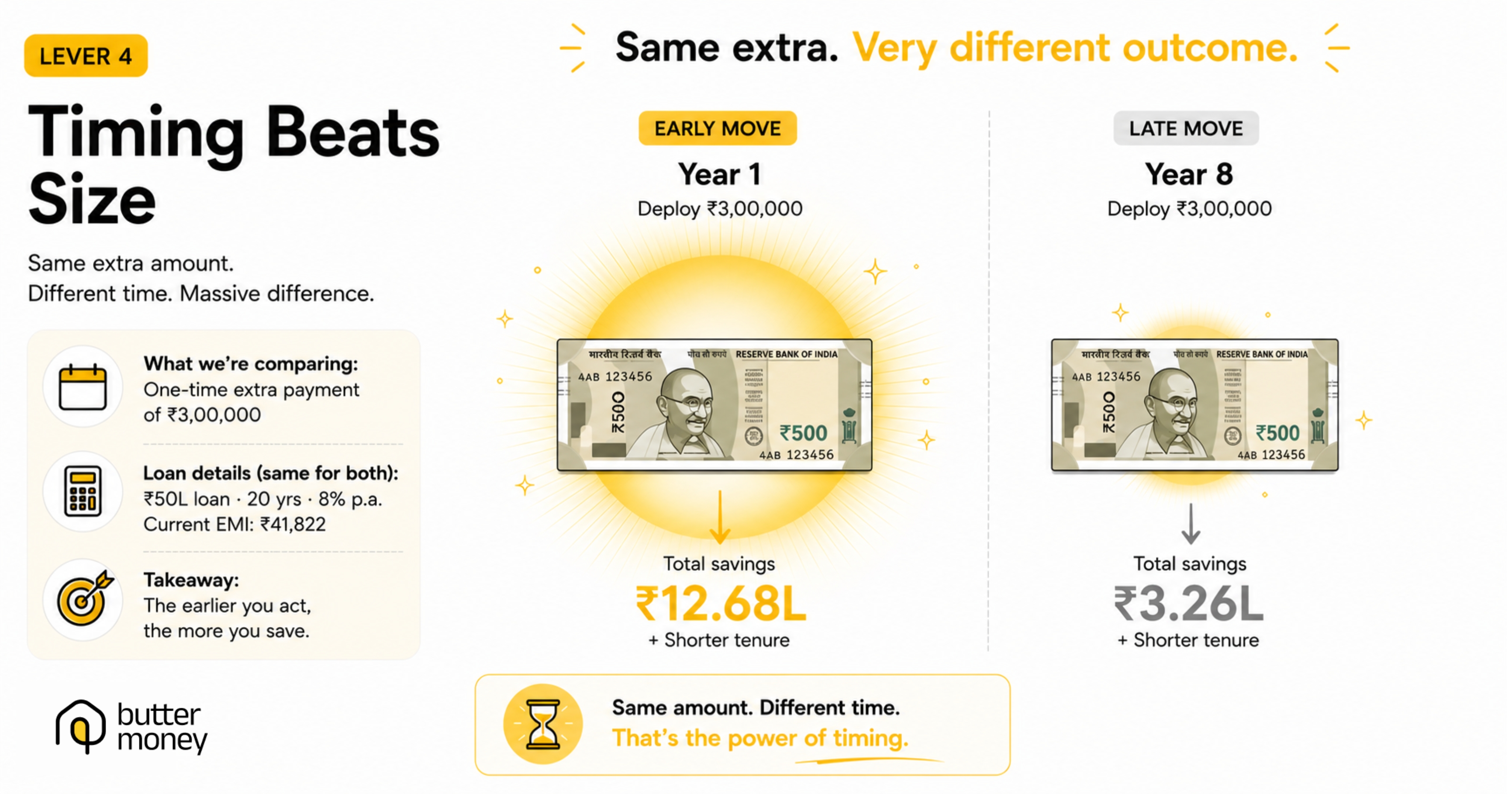
Lever 4: Lump Sums, and Why Timing Beats Size
The standard advice, prepay whenever you have surplus cash, is true but incomplete. When you prepay matters almost as much as how much, because of the same amortisation skew from Section 1: a rupee taken off your principal early cancels far more future interest than the same rupee removed later, simply because it has more remaining tenure to compound against.
Here’s the proof, using the identical ₹3 lakh prepayment on our example loan:
- Made in year 1 → saves about 2.6 years and ₹10.5 lakh in interest
- Made in year 8 instead → the exact same ₹3 lakh saves only about 1.4 years and ₹4.8 lakh
More than double the benefit, for the same money, purely from doing it seven years earlier.
The practical takeaway: if you’re holding a maturing FD or an annual bonus, the earliest defensible year to deploy it beats waiting to save up a “bigger” lump sum later. Defensible is the operative word here, which is exactly what the next section is about.
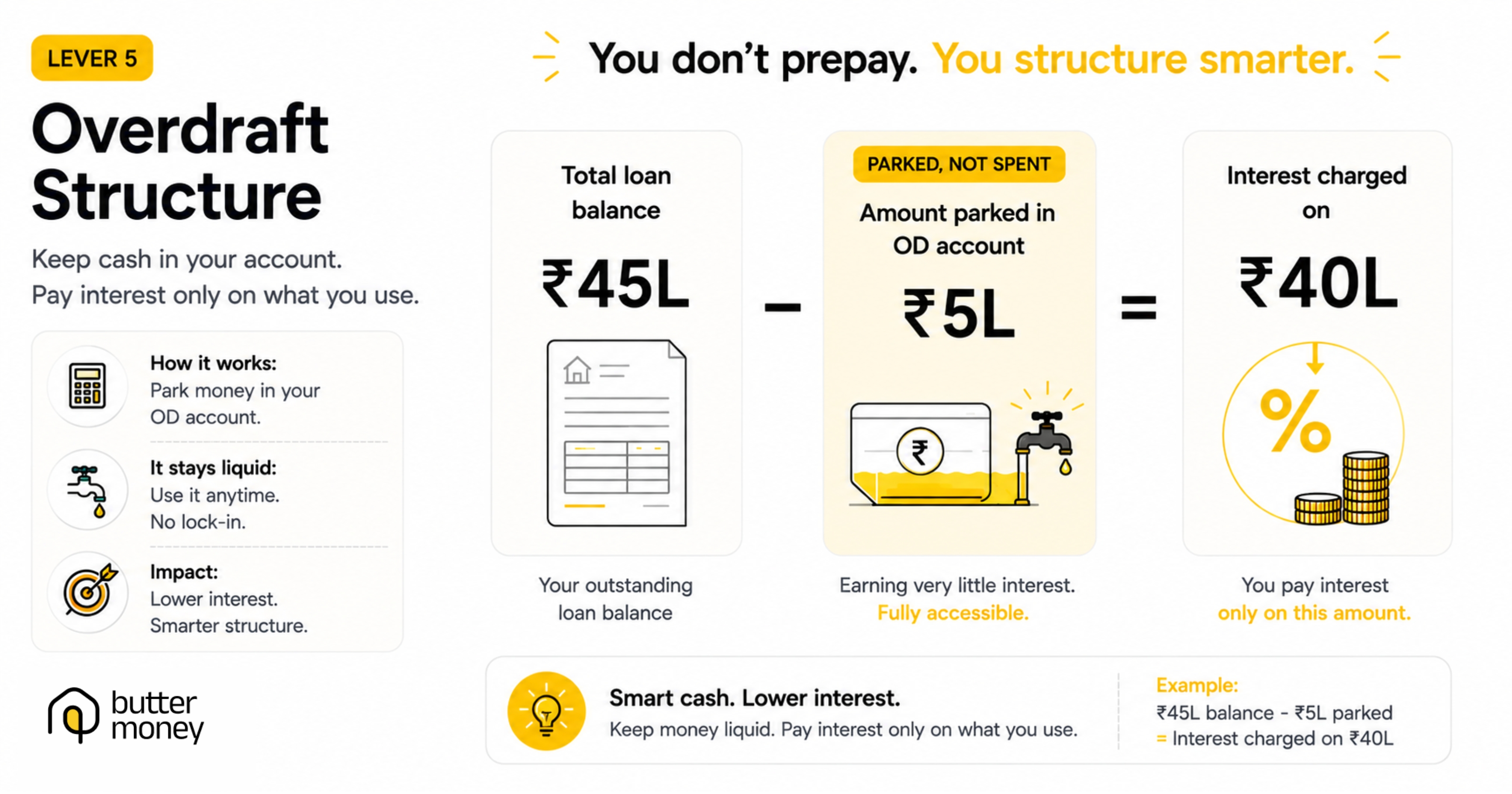
Lever 5: The Overdraft Structure for Lumpy Income
If your income arrives in irregular chunks (commission, RSU vesting, project payouts, freelance invoices) rather than a steady monthly number, a straight prepayment can feel too permanent. An overdraft-linked home loan solves that specific problem. Products like SBI Maxgain, HDFC’s Home Saver, and ICICI’s Money Saver link your loan to a current account: any surplus you park there is netted off against your outstanding principal before interest is calculated each day, while remaining fully and instantly withdrawable, unlike a lump-sum prepayment.
Result: on a ₹45 lakh outstanding balance, parking an average ₹5 lakh surplus nets out to roughly ₹38,000 saved in interest over a year, even after accounting for the 0.10–0.25% rate premium these products typically carry over a plain loan. The ₹5 lakh itself stays as accessible as a savings account throughout.
The trade-off to be honest about: that parked money earns zero interest sitting there, unlike an FD or a liquid fund, so this only wins if you’d otherwise have left the surplus idle anyway. And if your income is genuinely steady month to month, a plain loan combined with Lever 2 or Lever 3 does the same job more simply. This structure earns its keep specifically for lumpy, unpredictable income.
++Check whether an overdraft structure beats your current loan on the Overdraft Calculator++.
The Tax Objection That No Longer Holds
Nearly every article on this topic warns you to think twice before prepaying because you’ll lose your Section 24(b) deduction, up to ₹2 lakh a year on home loan interest, worth around ₹62,400 a year in actual tax saved if you’re in the 30% bracket once cess is included. That used to be a real number and a real reason to hesitate.
But that deduction only exists under the old tax regime:
- Old regime, self-occupied property → up to ₹2 lakh/year Section 24(b) deduction
- New regime (default since FY 2023-24, unchanged by Budget 2026), self-occupied property → no home loan interest deduction. Not reduced. None
So if you’re among the now-majority of salaried borrowers on the new regime, there’s no Section 24(b) benefit sitting there to protect by keeping your loan alive longer. The objection describes a deduction you were never claiming — almost nobody spells this out plainly, probably because “check which regime you’re on” is a less satisfying warning than “you’ll lose your tax break.”
Pair that with the other half of the picture. As of January 1, 2026, RBI’s (Pre-payment Charges on Loans) Directions, 2025 closed out foreclosure and prepayment charges on floating-rate loans for individuals, across every bank, NBFC, and housing finance company. Floating-rate borrowers had partial protection under earlier RBI circulars (2012, 2014) — the 2025 Directions closed the loopholes some lenders were working around and made enforcement uniform, regardless of when your loan was sanctioned. ++Full rule, who it covers, and how to escalate if a lender still tries to charge you++.
Put together: the two most commonly cited reasons to avoid prepaying, a tax hit and a penalty, no longer apply to most borrowers in India.
When Not to Do Any of This
Two honest exceptions, and they matter more than any of the five levers above.
Build your emergency fund first. Prepaying with no liquid buffer doesn’t remove risk — it trades one risk for a worse one. A loan that runs a little longer is manageable; a medical emergency or job loss with zero cash on hand is what pushes people into a personal loan or credit card debt at rates far higher than any home loan. Get 3-6 months of essential expenses into something genuinely liquid before directing a single extra rupee toward any lever above. Not there yet? That’s where the next rupee goes — not into an extra EMI or a lump sum.
Check your regime if you hold a let-out property. If you’re on the old regime because you own a let-out (rented) property, the calculus above doesn’t fully apply to you. Interest on a let-out property is deductible against rental income with no upper cap under either regime — but if that interest exceeds your rental income (common with a recent, heavily leveraged purchase):
- Old regime → you can set off up to ₹2 lakh of that loss against your salary each year, with the remainder carried forward for eight years
- New regime → blocks that set-off entirely, no carry-forward
If this is you, closing the loan faster genuinely shrinks a live tax benefit — worth running past a CA before you accelerate it. (On the old regime with a self-occupied property instead? The standard ₹2 lakh Section 24(b) deduction is still alive — real, just capped, not a reason to avoid prepaying.)
Neither of these is a reason to abandon the five levers above. They’re a reason to sequence them correctly: buffer first, regime check second, then attack the tenure.
Getting to Zero, Faster
None of this requires a windfall or a single heroic payment — just picking one lever that fits this month’s reality. A phone call about your spread. One extra transfer a year. A standing instruction that grows with your next raise.
Run the numbers, confirm your buffer is solid, and start with whichever lever costs you the least to begin. Compounding does the rest. The loan that felt permanent at year three doesn’t have to still feel that way at year ten.
Frequently Asked Questions
Q1.Does prepaying my home loan attract a penalty in 2026? No, if it’s a floating-rate loan taken for personal use. RBI’s (Pre-payment Charges on Loans) Directions, 2025 ban foreclosure and prepayment charges on floating-rate loans to individuals across all regulated lenders, with no lock-in period and no minimum amount, regardless of when your loan was sanctioned.
Q2.Will I lose my Section 24(b) tax deduction if I prepay? Only if you’re on the old tax regime with a self-occupied property. Under the new tax regime, the default since FY 2023-24, there’s no self-occupied interest deduction to begin with, so there’s nothing to lose by prepaying.
Q3.What’s the single most effective lever if I can only pick one? Mathematically, a step-up EMI tied to your annual increment saves the most, since the effect compounds every year. Practically, the one you’ll actually sustain matters more than the one with the best spreadsheet result.
Q4.Is a step-up EMI the same as a bank’s step-up loan product? No. A step-up loan product structures lower EMIs at the start of a fresh loan for someone with expected rising income. A step-up EMI, as used here, means raising the EMI on a loan you already hold, in line with your own raises.
Q5.Should I prepay my home loan or invest the surplus instead? It depends on your loan rate against a realistic, post-tax return elsewhere, and your appetite for risk versus a guaranteed reduction in what you owe. There’s no universal answer, so run both scenarios with your actual numbers before deciding.
Q6.Is the home loan overdraft facility worth the higher interest rate? Usually, if you carry a meaningful average surplus and your income is irregular. If your income is steady, a plain loan combined with Lever 2 or Lever 3 is simpler and just as effective.
Q7.Do I need an emergency fund before I start prepaying? Yes. Build 3-6 months of essential expenses into a liquid buffer first. Prepaying without one converts a manageable, long-term risk into an acute, short-term one.


