
MCLR vs EBLR: Why Your EMI Didn't Drop After the RBI Cut
If the RBI cuts rates, Why Is Your EMI exactly the Same?
In 2025, the RBI cut its repo rate by 125 basis points over four moves, in February, April, June and December, with pauses in between. That took the benchmark rate from 6.50% to 5.25%. On 7 October 2026, the RBI raised it by 25 basis points to 5.50%, its first hike since February 2023. As a homeowner with an existing home loan, you would have definitely read about each of these announcements. In fact, some of your friends may even have bragged to you about how their EMI has reduced.
This article does not just explain the three benchmarks in simple terms. More importantly, it offers you a calculation to find out if changing your benchmark is financially advisable for your loan, what to ask your bank, and so on.
→ Are you already aware of your existing loan’s benchmark and want to find out if you’re on the right one? Use the Butter Money Savings Calculator to find out what impact a change in benchmark would have on your total cost of interest. Use the Butter Money Savings Calculator to model what a rate switch could mean for your total interest cost.
The Three Benchmarks and Why Only One Responds to the RBI
Every floating rate loan in India has a rate determined by: Benchmark Rate + Spread
The spread is set at the time of loan sanction and usually stays the same for long stretches, but it is not frozen. For bank loans linked to an external benchmark, RBI rules let the credit risk premium change if your credit assessment changes substantially, as agreed in your loan contract. Other parts of the spread, such as operating cost, can be revised once every three years. Most of the time, the part that moves is the benchmark, and how fast it moves depends on which benchmark your loan is based on.
MCLR – Marginal Cost of Funds Based Lending Rate
MCLR is an internal benchmark, introduced by the RBI in April 2016. Every bank has its own MCLR, based on its own costs of deposits, its own operating costs, and its own reserve requirements. The RBI can cut its repo rate, but MCLR does not automatically adjust. The bank can choose when and by how much it will pass on the rate cut, but most MCLR-based home loans have an annual reset, which means you can wait up to 12 months even after a rate cut.
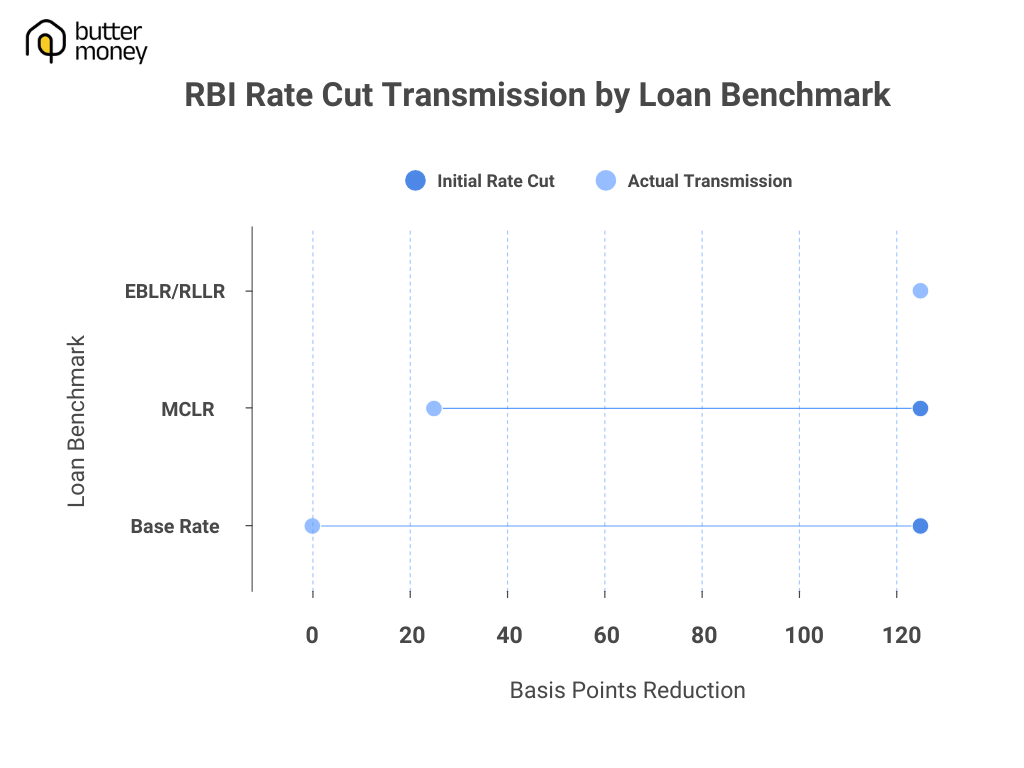
This lag is the main issue. For example, after four repo rate cuts totalling 125 bps in 2025, the median 1-year MCLR of banks fell by only about 65 bps between February 2025 and March 2026. And an MCLR borrower gets even that only after their reset date passes.
EBLR – External Benchmark Lending Rate
From 1 October 2019, the Reserve Bank of India required banks to link all new floating-rate retail loans, including home loans, to an external benchmark. The rule covers banks. Housing finance companies and NBFCs are not required to use an external benchmark, so their floating-rate loans may follow the lender’s own benchmark.The overwhelming majority of banks have opted for the repo rate as the external benchmark. With EBLR, every time the Reserve Bank of India changes the repo rate, your loan interest rate will have to be changed within three months. There is no discretion involved in the interest rate reset.
RLLR – Repo Linked Lending Rate
Technically speaking, RLLR is a type of EBLR: both are external benchmark rates, and both are linked to the repo rate. But a bank can publish them as two separate rates. SBI, for example, publishes both: from 15 October 2026, its EBLR is 8.15% and its RLLR is 7.75%, and SBI’s rate chart says all its home loans are linked to EBLR. So check which benchmark your sanction letter names, and look up that exact rate.
What the 125 bps Cut Actually Meant for Borrowers by Benchmark
The following is how the same 125 basis points RBI rate cut in 2025 would have affected different types of loans. This is no hypothetical scenario; rather, it is based on the experience seen in banks across India in 2025.
Borrower on EBLR/RLLR: The loan rate would have been changed in 1-3 months on each occasion. The complete 125 basis points reduction would have been passed on by early 2026.
Borrower on MCLR: Banks revised their MCLR gradually and in small steps. RBI data shows the median 1-year MCLR fell from 9.05% in February 2025 to 8.40% in March 2026, about 65 basis points, roughly half the repo cut. A borrower whose loan reset in January 2025 got none of it at that reset, because the first repo cut only came in February 2025. They had to wait for their January 2026 reset to see the lower MCLR.
Borrower on Base Rate (pre-April 2016 loans): The slowest transmission of all. Since 1 April 2018, RBI has required banks to link their Base Rate to MCLR, so the Base Rate can move when MCLR moves, but it follows slowly. Base Rate borrowers do get some benefit from rate cuts, but later than MCLR or EBLR borrowers.
The Real Question: Should You Switch?
And this is where most articles stop providing any kind of guidance. The answer, of course, isn’t “always yes, switch to EBLR.” The answer depends on a single calculation.
The formula to remember:
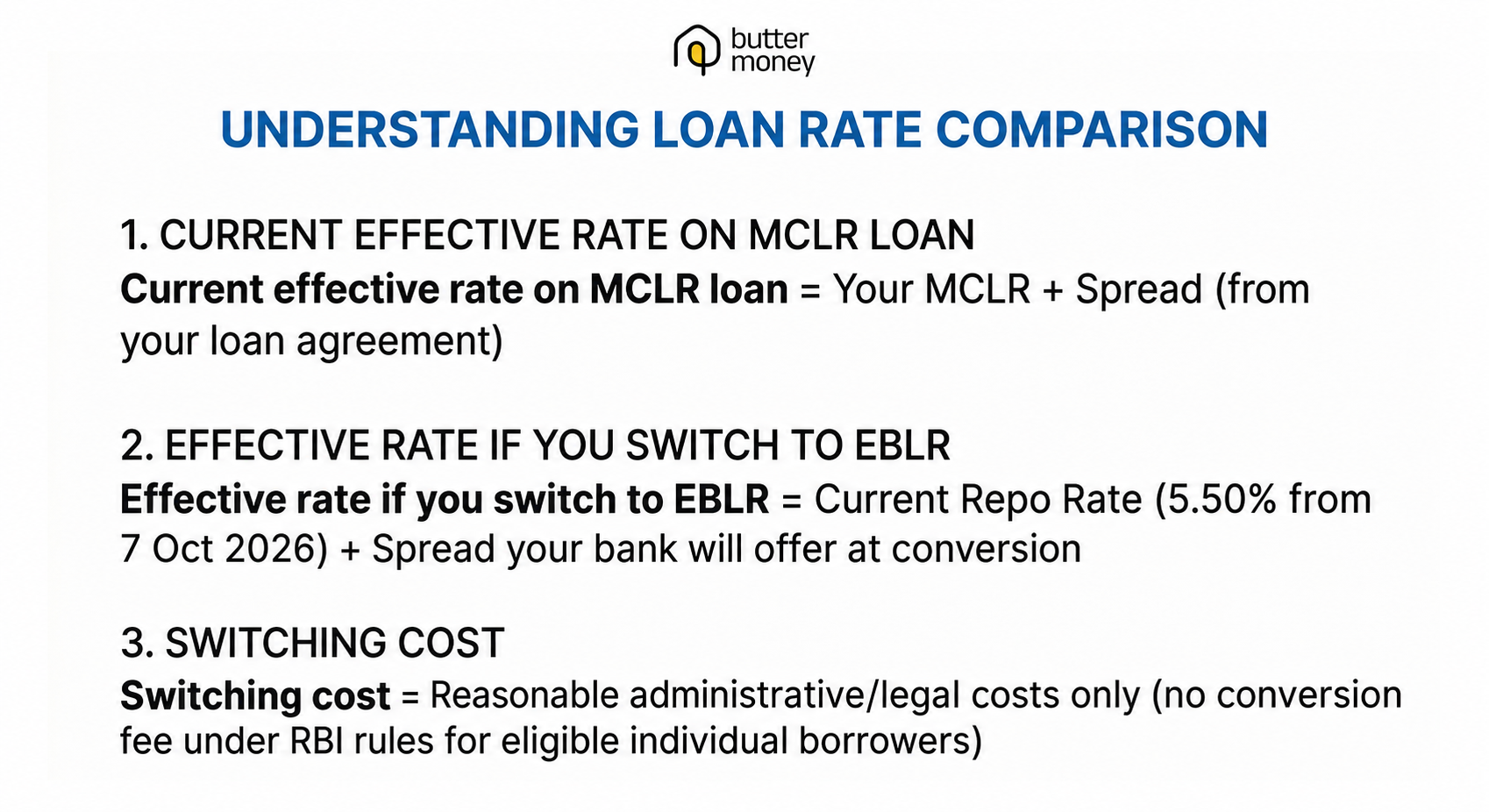
If your EBLR after switching is substantially lower than your existing MCLR, and your loan term is long enough to recover any administrative or legal costs of switching, it will be worthwhile to switch.
Worked Example - Scenario A - Switching Will Be Worthwhile
Profile: ₹48 lakh outstanding, 18 years remaining.
Current MCLR loan: Bank’s 1-year MCLR is 8.75%, spread is 0.55% → Effective rate 9.30%. EMI at 9.30%: approximately ₹45,850/month
EBLR conversion offer: Repo 5.25% + spread 2.75% → Effective rate 8.00%. EMI at 8.00%: approximately ₹42,000/month
Monthly savings: about ₹3,850. Annual savings: about ₹46,250. Switching cost: no conversion fee under RBI rules, only reasonable administrative or legal costs, if any. Even ₹10,000 of such costs would be recovered in under 3 months.
In this scenario, switching is straightforward. Over the remaining 18 years, the lower EMI adds up to roughly ₹8.3 lakh less in interest.
Worked Example — Scenario B: Switching May Not Make Sense
Profile: ₹30 lakh home loan, 4 years remaining. Loan taken in 2019 with a very low negotiated spread.
Current MCLR loan: Bank’s MCLR 8.75%, spread 0.05% → Effective rate 8.80% EBLR conversion offer: Repo 5.25% + spread 3.50% → Effective rate 8.75%
The difference is a mere 5 basis points, which saves only about ₹3,400 over the remaining 4 years. Even small administrative or legal costs could wipe that out, so it is not worth switching. It would be better to continue with the MCLR loan.
The spread your bank is offering at the time of conversion is the most important factor. It is negotiable. Do not accept the first figure quoted to you.
→ Run this calculation for your own loan. Use the Butter Money EMI Calculator to compare your current EMI against what you would pay at a new rate. Bring the output to your bank conversation.
How to Find Out Which Benchmark You Are On
Most borrowers do not know their benchmark. Here is how you can find out which one you are on:
Refer to your loan sanction letter or loan account statement. The loan account statement will refer to MCLR, Base Rate, or RBLR/EBLR/RLLR. The tenure of the benchmark will also be disclosed, e.g., 1-Year MCLR. Log in to the net banking account of your bank. The loan account page will disclose the current rate as well as the benchmark. Call up your relationship manager and ask, “What is my current effective interest rate, and what benchmark is it linked to?” This also provides an opportunity to ask about the conversion spread. If you took the loan before October 2019, it is quite likely you are on MCLR or Base Rate.
If you took a floating-rate loan from a bank after October 2019, it is almost certainly on EBLR. If your lender is a housing finance company or NBFC, it may use its own benchmark instead, so check your sanction letter. The spread you were offered at the time of loan origination, however, might be a good opportunity to renegotiate. On a smarter home loan strategy, knowing what lies beyond the headline rate is the more important question to ask your bank.
What to Ask Your Bank Before You Decide
Don’t walk into this conversation without any specific questions. The bank has no incentive to inform you that your benchmark is causing you to pay more.
Ask yourself these questions:
- What is my current outstanding principal, remaining tenure, and effective interest rate?
- What spread would you apply to me if I convert to EBLR now? What would my new effective rate be?
- What is the conversion fee? Will it be waived?
- How would my EMI change? When would the first reset occur?
All of these should be presented to you in writing or on a sheet. The difference between the spread offered to a prepared borrower and an unprepared borrower can vary by 25-50 basis points. This equates to lakhs of rupees on a ₹50 lakh loan with 15 years remaining.
A stronger credit score gives you leverage to negotiate a lower spread at conversion. If your CIBIL score has improved since you took the loan, mention it. Here is what lenders actually look at when they assess your creditworthiness.
→ Not sure where your credit profile stands before this conversation? Check your home loan eligibility on Butter Money to understand how lenders currently read your profile and what puts power in your hands.
One More Option: Balance Transfer to a Different Lender
Your current bank is offering you an EBLR spread of 3.25-3.50%. What if another bank is offering a better deal for your next balance transfer? A balance transfer is a loan from another bank to transfer your outstanding principal amount at a lower interest rate. If the new lender is a bank, the floating-rate loan will be linked to an external benchmark such as the repo rate. A housing finance company or NBFC may use its own benchmark.
It takes a bit more paperwork than a benchmark transfer, but the difference in the spread can be 50-75 basis points lower than that of another bank. That is a large difference for a loan of ₹50 lakhs with 15+ years to go. Understanding when a balance transfer makes more sense than a top-up or internal switch is the next question to answer once you have confirmed your current benchmark.
What This Means if You Have Yet to Take a Loan
If you are yet to take a home loan and are planning to apply for one in 2026, any floating-rate home loan from a bank must be linked to an external benchmark, usually the repo rate. A bank will not offer you MCLR as a new product. Housing finance companies and NBFCs are not bound by this rule and may price loans off their own benchmark, so ask which benchmark applies before you sign. What you can and should negotiate is the spread. It is set when the loan is sanctioned and largely stays with you, though RBI rules let the bank revise parts of it. If you are paying 0.25% more in spread on a ₹60 lakh loan for 20 years, that adds roughly ₹2.2–2.3 lakh to your total interest.
→ Planning to apply in the next 3-6 months? Check your eligibility across 40+ lenders on Butter Money — free, no branch visit, and no impact on your CIBIL score. Knowing which lenders will approve your profile gives you the room to negotiate the spread, not just accept it.
In Summary
The benchmark that your home loan is pegged to will influence how quickly you will benefit from the RBI’s rate cuts. MCLR is an internally managed, slow-to-spread benchmark linked to banks’ cost of funds. EBLR and RLLR are externally linked to the repo rate. These rates are passed on within three months. After 125 basis points of rate cuts in 2025, the difference between MCLR and EBLR is not only actual but also tangible.
The only factor that determines whether you will gain financially by switching to EBLR from MCLR is a straightforward calculation. This calculation involves your existing effective rate vis-à-vis the EBLR offered by your bank at the time of conversion. This calculation takes only ten minutes to complete. The potential savings could be in lakhs.
Sources: RBI Monetary Policy Committee announcements (2025–2026) | RBI Annual Report 2025 — floating rate loan benchmark distribution | BankBazaar, ClearTax repo rate historical data | Upstox lending rate analysis, January 2026
Explore more: Smarter Home Loan Strategy: Beyond the Interest Rate | Balance Transfer vs Top-Up: Which Makes Sense | CIBIL Score & Home Loans | EMI Calculator
FAQ’s
Q1. Why didn’t my home loan EMI reduce after the RBI rate cut?
Your loan is likely on MCLR, an internal bank benchmark that doesn’t automatically follow RBI cuts. It resets only once a year, so you could wait up to 12 months to see any change, and even then, the reduction is partial.
Q2. What is the difference between MCLR and EBLR?
MCLR is set internally by your bank and changes slowly. EBLR is linked directly to the RBI repo rate and must be reset within 3 months of any rate change. EBLR passes on cuts faster and more transparently.
Q3. What is RLLR, and is it different from EBLR?
RLLR (Repo Linked Lending Rate) is technically a type of EBLR, and both are linked to the RBI repo rate. They are not always the same number, though. SBI publishes a separate EBLR and RLLR, and its rate chart says all SBI home loans are linked to EBLR. Under RBI rules, an external benchmark rate must be reset at least once every three months
Q4. Should I switch my home loan from MCLR to EBLR?
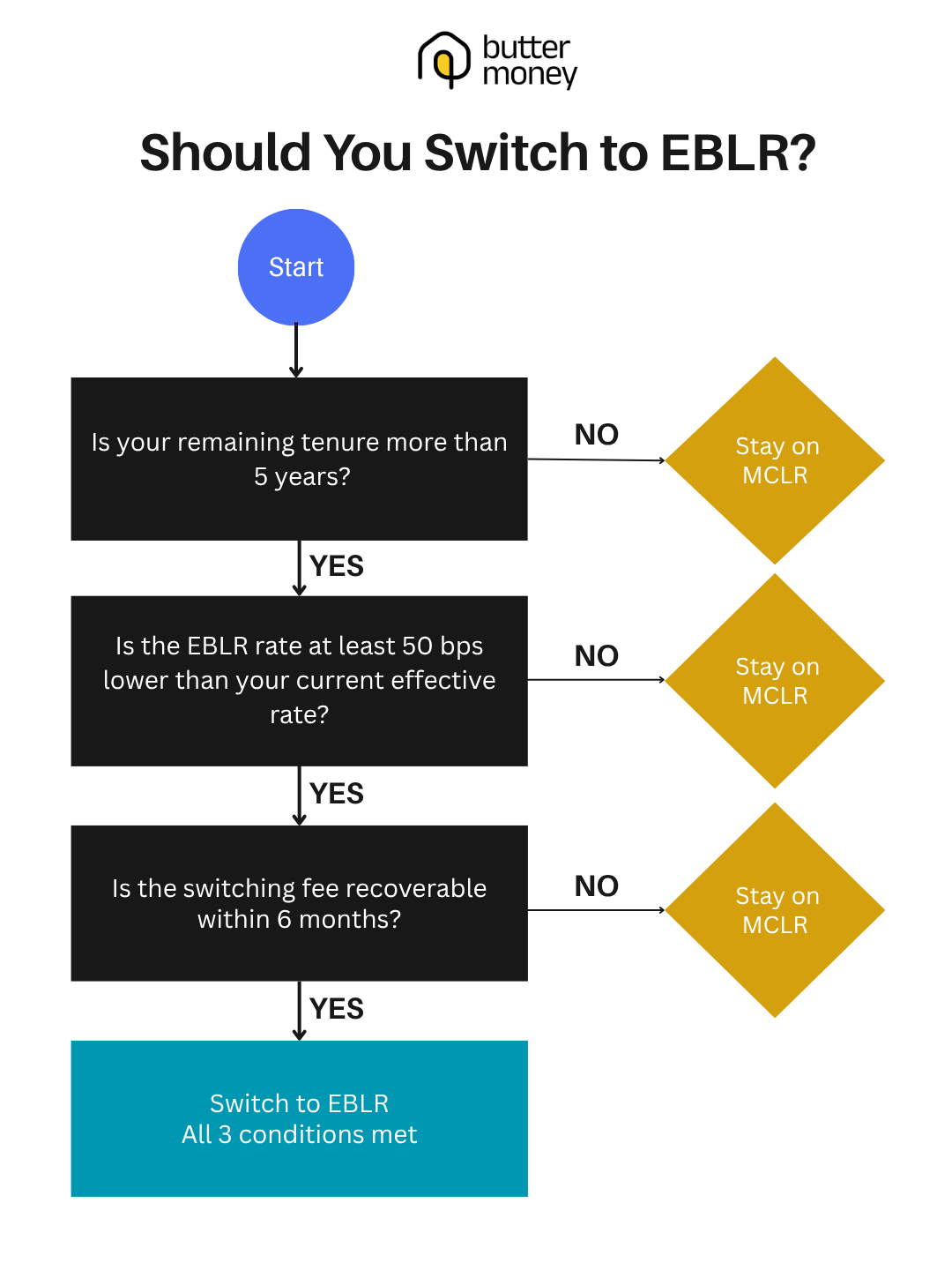
Only if three conditions are met: your remaining tenure is more than 5 years, the EBLR rate offered is at least 50 bps lower than your current effective rate, and the switching fee is recoverable within 6 months of savings.
Q5. What is the current repo rate in India in 2026?
The RBI repo rate is 5.50%. The RBI cut it by a cumulative 125 basis points in 2025, to 5.25%, and held it at that level until October 2026. On 7 October 2026, it raised the rate by 25 basis points to 5.50%.
Q6. How much is the fee to switch from MCLR to EBLR?
Under RBI’s 2019 rules, an individual borrower on a floating-rate loan who can prepay without penalty can switch from MCLR to an external benchmark without any charges or fees, except reasonable administrative or legal costs. Ask your bank for these costs in writing. If it quotes a “conversion fee”, ask what the fee covers.
Q7. How do I find out which benchmark my home loan is on?
Check your loan sanction letter or net banking account, it will mention MCLR, Base Rate, or EBLR/RLLR. You can also call your relationship manager and directly ask: “What benchmark is my loan linked to, and what is my current effective rate?”
Q8. Is switching to EBLR always the right move?
No. If your remaining tenure is short or your bank offers a high spread at conversion, the effective EBLR rate may barely differ from your current MCLR rate. Always run the numbers: on a ₹30 lakh loan with 4 years left, a 5 bps difference saves only about ₹3,400 in total, which even small administrative or legal costs can cancel out.Q9. What is a “spread” in a home loan, and can I negotiate it?
The spread is the margin added to the benchmark rate to arrive at your final interest rate. It is set at origination or conversion. For bank loans linked to an external benchmark, the credit risk premium can change only if your credit assessment changes substantially, and other spread components can change once in three years. Yes, it is negotiable, especially if your credit score has improved since you took the loan.
Q10. I’m taking a new home loan in 2026. Will it be on MCLR or EBLR?
If you borrow from a bank, EBLR. Since October 2019, banks must link new floating-rate home loans to an external benchmark, so a bank won’t offer you MCLR. Housing finance companies and NBFCs aren’t covered by this rule and may use their own benchmark. Either way, negotiate the spread: even 0.25% more on a ₹60 lakh, 20-year loan adds roughly ₹2.2–2.3 lakh to your total interest cost.


