

How Much Emergency Fund to Keep After Paying Your Home Down Payment
You’ve paid the down payment, the stamp duty and the registration fee. For most buyers, that leaves the savings account at its lowest point in years, right when the first EMI falls due.
Keep at least six months of your EMI plus essential living costs in cash you can reach within a day or two. Keep it separate from the money for interiors and moving.
This guide shows how to work out your number, with a worked rupee example from Bengaluru. It also covers rising rates, overdraft loans, and what happens if an EMI slips.
Your EMI is half of your emergency fund number. Work it out in under a minute. Free, no sign-up, and nothing goes to any lender. Open the EMI calculator
Key takeaways
- Keep six months of EMI plus essential costs. Keep 9 to 12 months if you have one income, variable income or dependents.
- Stamp duty, interiors and GST are planned costs. Budget for them separately so they don’t eat the fund.
- In Bengaluru, stamp duty, cess and registration add about 7.6% on homes above ₹45 lakh, and the home loan doesn’t cover it.
- The RBI raised the repo rate to 5.50% on 7 October 2026. Size your fund for a slightly higher EMI.
- A bigger down payment cuts your EMI. It’s a bad trade if it leaves you with almost no cash.
How much emergency fund should you keep after buying a home?
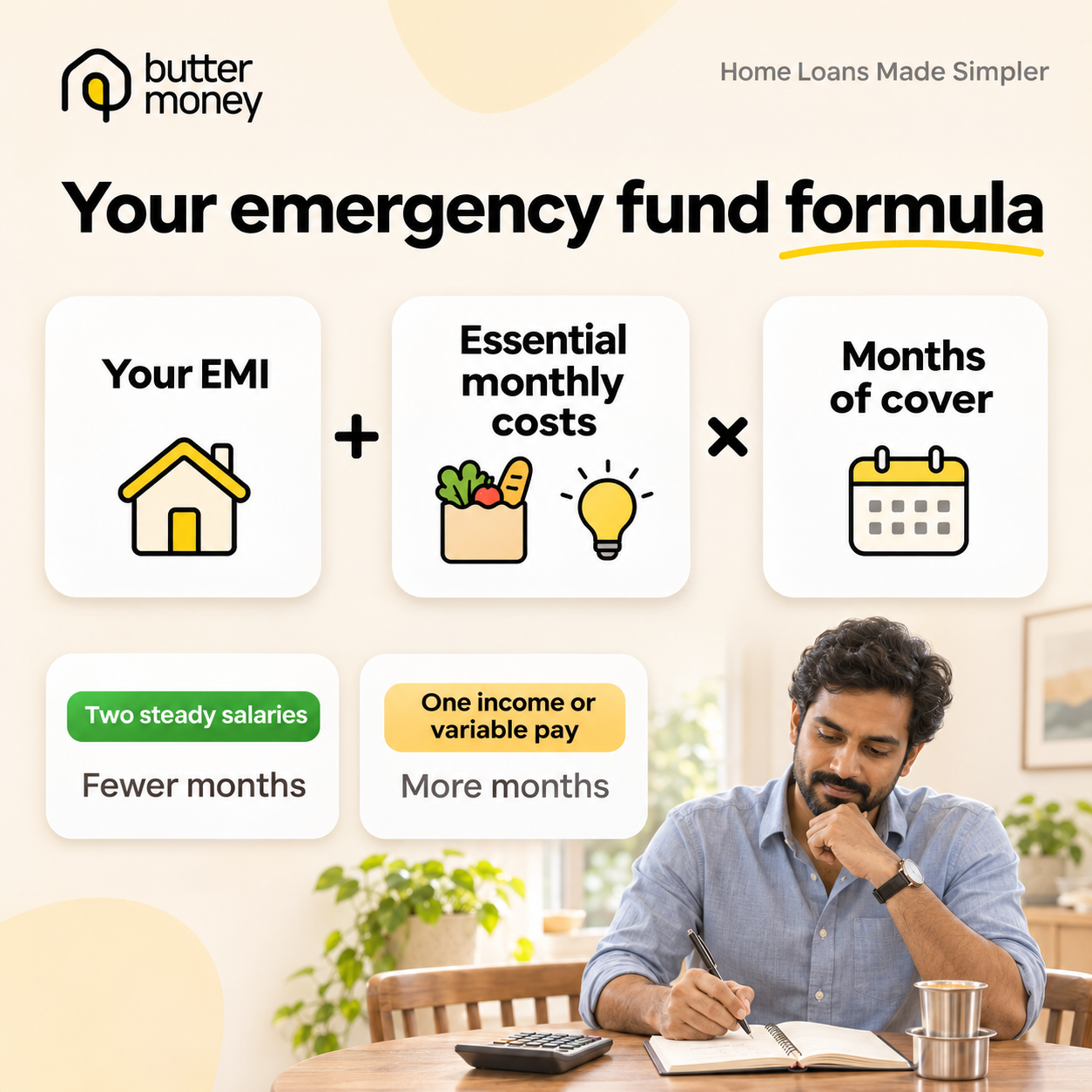
Keep six months of your EMI plus essential monthly costs as a starting point. Bank guides put the general rule at three to six months of expenses. With a home loan, aim for the top of that range, because the EMI is the one bill you can’t cut or delay without consequences.
Use this formula:
Emergency fund = (EMI + essential monthly costs) × number of months
Essential costs are the bills you pay even in a bad month. Think groceries, electricity, water, apartment maintenance, insurance premiums, school fees, transport and support for your parents. Leave out eating out, travel and SIPs, which you can pause.
How many months depends on how steady your income is:
| Your situation | Months to keep |
|---|---|
| Two stable salaries | 6 |
| One income, or dependent parents or children | 9 to 12 |
| Self-employed, or income from commission or contracts | 9 to 12 |
| Under-construction home: paying rent and pre-EMI together | 6, counting both rent and pre-EMI |
What leaves your account before you get the keys?
The down payment is only the biggest of several payments that land close together. Most of them are predictable, so give them their own “move-in budget” and keep the emergency fund untouched.
| Cost | How much | Notes |
|---|---|---|
| Down payment | 10% to 25% of the price | Depends on the loan size (see below) |
| Stamp duty, cess and registration | About 7.6% in Bengaluru above ₹45 lakh | Not counted in the loan amount |
| GST, under-construction flats only | 5%, or 1% for affordable housing | Nil on ready-to-move and resale homes |
| Interiors, furniture and moving | Your own estimate | Can be phased over months |
| Advance maintenance or corpus deposit | As per your sale agreement | Common in new projects; check the agreement |
The down payment is set by RBI limits. Banks can lend up to 90% of the property value on loans up to ₹30 lakh. The cap is 80% from ₹30 lakh to ₹75 lakh, and 75% above that. Our loan-to-value guide explains the limits.
Stamp duty and registration come out of your pocket. The RBI tells banks to leave these charges out when they value the property for the loan. The only exception is homes costing up to ₹10 lakh.
Figures are indicative of typical market practice as of November 2026 and vary by lender, borrower profile, and over time.
Planning your move-in budget? See the stamp duty and registration fee for your property in one step. Free, and you don’t need any documents. Calculate stamp duty
Worked example: an ₹85 lakh flat in Varthur
Illustrative figures. Kiran, 34, and Divya, 32, are both salaried. Together they take home ₹1.75 lakh a month: ₹1.10 lakh for Kiran and ₹65,000 for Divya. They’re buying a ready-to-move 2BHK in Varthur for ₹85 lakh, and they’ve saved ₹33 lakh.
What the purchase takes out
| Item | Amount |
|---|---|
| Flat price | ₹85 lakh |
| Home loan at 80% | ₹68 lakh |
| Down payment | ₹17 lakh |
| Stamp duty, cess, surcharge and registration (7.6%) | ₹6.46 lakh |
| Interiors, furniture and moving (their estimate) | ₹4 lakh |
| Left in savings | ₹5.54 lakh |
What the fund needs to cover
At 8.5% over 20 years, their EMI is ₹59,012. Their essential costs come to ₹60,000 a month. So they have to find about ₹1.19 lakh every month, whatever happens.
Six months of that is ₹7.14 lakh. They’re ₹1.6 lakh short.
What ₹5.54 lakh buys them
- If Kiran loses his job, Divya’s salary leaves a gap of about ₹54,000 a month. The savings cover that gap for about 10 months.
- If both incomes stop, or a hospital bill arrives, the savings cover all costs for about 4.7 months.
How they close the gap
After the EMI and essentials, they have about ₹56,000 left each month. If they hold back ₹1.6 lakh of the interiors and save that surplus instead, they reach six months of cover in about three months.
Should you put more down or keep the cash?
Put extra money towards the loan only after your emergency fund is in place. A smaller loan saves interest, but cash in the bank is what keeps the EMI paid in a bad month.
Here’s the trade for Kiran and Divya if they put an extra ₹5 lakh down:
| ₹68 lakh loan | ₹63 lakh loan | |
|---|---|---|
| EMI at 8.5%, 20 years | ₹59,012 | ₹54,673 |
| Interest saved over 20 years | ₹5.4 lakh | |
| Savings left after moving in | ₹5.54 lakh | ₹54,000 |
| Months of costs covered | About 4.7 | Under 2 weeks |
The lower EMI saves ₹4,339 a month. It also leaves them less than two weeks of costs in the bank.
Waiting costs little. Under the RBI’s pre-payment directions, lenders can’t charge you for prepaying a floating-rate home loan taken by an individual. This applies to loans sanctioned or renewed from 1 January 2026, so you can build the fund first and prepay later. Our guide to closing your home loan faster shows how.
Rates are rising again: plan for a higher EMI
Build a little room for a higher EMI into your fund. On 7 October 2026, the RBI raised the repo rate by 25 basis points (0.25%) to 5.50%. It also moved its stance to “calibrated tightening”. The next policy meeting is on 2 to 4 December 2026.
Lenders followed. SBI, for example, raised its external benchmark lending rate (EBLR) to 8.15% from 15 October 2026. Repo-linked home loans must reset at least once every three months, so a hike reaches your loan quickly. Our post on MCLR vs EBLR explains why the timing differs by loan type.
Here’s what higher rates do to Kiran and Divya’s ₹68 lakh, 20-year loan:
| Interest rate | EMI | Extra each month |
|---|---|---|
| 8.50% | ₹59,012 | |
| 8.75% | ₹60,092 | ₹1,080 |
| 9.00% | ₹61,181 | ₹2,169 |
| 9.50% | ₹63,385 | ₹4,373 |
Higher EMI or longer tenure?
The RBI’s rules on EMI resets say your lender must tell you how a rate change affects your loan. You then choose a higher EMI, a longer tenure, or a mix. Since October 2025, offering a switch to a fixed rate is up to the lender.
Pick the higher EMI if your fund can absorb it. Say the rate stays 0.50% higher for the whole loan. Keeping the EMI unchanged adds 27 more EMIs and about ₹16.1 lakh of extra interest. Paying ₹2,169 more each month adds about ₹5.2 lakh instead.
Can a home loan overdraft hold your emergency fund?
Yes, and it can lower your interest, but only if you park enough. In an overdraft home loan, money kept in the linked account reduces the balance you pay interest on. You can still withdraw it when you need it.
The catch is price. Overdraft versions usually cost more than the same lender’s regular home loan:
| SBI home loan type | Interest rate from 15 October 2026 |
|---|---|
| Regular home loan | 7.50% to 8.80% |
| MaxGain (overdraft) | 8.00% to 9.30% |
Advertised rates go to the strongest profiles. See which lenders offer an overdraft home loan to you, and at what rate. One check across 40+ lenders, with no CIBIL impact. Check your eligibility
Rates as of 15 October 2026, as reported by Business Today and HelloBanker. Full sources below.
That 0.50% premium applies to the whole loan, not only to the parked cash. In the first year, on Kiran and Divya’s ₹68 lakh loan:
- ₹5.54 lakh parked all year saves about ₹17,900 in interest.
- ₹2 lakh parked costs about ₹15,300 more than a regular loan.
- The break-even is about ₹3.8 lakh. Below that, the regular loan works out cheaper.
An overdraft suits you if you’ll keep a large balance there and won’t dip into it for everyday spending. Every withdrawal raises your interest again.
Thinking about an overdraft loan? Enter your loan and the cash you’d park, and see the interest you’d save. Free, and nothing goes to any lender. Try the overdraft calculator
Where should you keep the rest?
Keep the fund where you can reach it within a day or two and where its value doesn’t swing.
- One month’s costs in your savings account, for same-day needs.
- The rest in a sweep-in fixed deposit or a liquid fund, which you can break or redeem quickly.
- Not in stocks, equity funds or long lock-in deposits. You may have to sell at a loss when you most need the money.
- A credit card limit doesn’t count. Borrowing to pay an EMI stacks a costlier debt on top of it.

What happens if you miss an EMI?
Your loan is marked overdue from the first day you miss a payment. Under RBI rules, it moves through three warning stages called special mention accounts (SMA). After 90 days, it becomes a non-performing asset (NPA).
| Days overdue | How the lender classifies your loan |
|---|---|
| Up to 30 | SMA-0 |
| 31 to 60 | SMA-1 |
| 61 to 90 | SMA-2 |
| More than 90 | NPA |
Since 2024, lenders can levy a penal charge for default, but not penal interest. They must also tell you each time they charge it. Lenders report your repayments to credit bureaus, so a late EMI shows up on your CIBIL report.
If you can see trouble coming, call your lender before the due date, not after. Ask about a short repayment holiday or a restructured EMI. Lenders decide these case by case. Also check what your home loan insurance covers before you count on it as a safety net.
Worried your EMI won’t fit if one salary stops? Share your numbers with a Butter Money advisor on WhatsApp and work out a safe loan size. Free, no obligation, and no credit check. Chat with an advisor
When this guide doesn’t apply to you
- You’re buying without a loan. There’s no EMI to protect, so six months of living costs is usually enough.
- Your home is under construction. You may pay rent and pre-EMI (interest only) at the same time. Count both in your monthly costs.
- You have other money you can reach quickly. Fixed deposits you can break without much loss count towards the fund. Retirement savings and long lock-ins don’t.
- Your rate is fixed. The rate-rise buffer matters less, but the six-month rule still applies.
FAQs
Should I use my emergency fund for the down payment?
No. Pay the down payment and stamp duty from savings set aside for the purchase. If that leaves less than six months of EMI and essential costs, look at a lower budget or wait a few months. Draining the fund leaves your EMI unprotected from the first month.
Is a 6-month emergency fund enough after buying a house?
For two stable salaries, yes. Count six months of EMI plus essential costs, not six months of salary. If you have one income, variable income or dependents, keep 9 to 12 months.
Should the emergency fund include my home loan EMI?
Yes. The EMI is the one cost you can’t pause, and missing it marks your loan overdue from day one. Add it to your essential monthly costs before you multiply by the number of months.
Should I prepay my home loan or build my emergency fund first?
Build the fund first. Prepaying saves interest, but you can’t get that money back easily in a bad month. Lenders can’t charge individuals for prepaying floating-rate home loans sanctioned or renewed from 1 January 2026, so you lose little by waiting.
Before you fix your down payment
Write down two numbers before you sign the sale agreement: your move-in budget and your emergency fund. If both don’t fit beside the down payment, change the flat budget or the timing, not the fund.
Butter Money compares your profile across 40+ lenders and shows the loan you qualify for, which sets your down payment.
See how much you can borrow before you agree a price. One check across 40+ lenders, no CIBIL impact, no documents needed yet. See what you qualify for
Explore more:


