
PMAY Scheme 2.0: Who Qualifies and What It Pays
The PMAY scheme in one page
In short: The PMAY scheme (PMAY-U 2.0) helps urban families with no pucca house. Households earning up to ₹9 lakh get a 4% subsidy on the first ₹8 lakh of a home loan, capped at ₹1.80 lakh.
If you want to see which lenders would take your profile before you apply anywhere, the eligibility check shows offers from 40+ lenders in about 2 minutes without a hard inquiry. Butter Money is not a lender, and it does not decide the subsidy. The government portal and your lender do.
Most people searching this have one worry: do I qualify, and what do I actually get? The answer depends on which of four routes you take. Most pages you will find only describe the loan subsidy, because lenders wrote them.
Everything below comes from the official PMAY-U 2.0 pages on pmaymis.gov.in, which I read on 4 November 2026, plus news reports where I say so. Rules change. Check the portal before you act on any figure here.
PMAY Urban or Gramin: which one is yours?
Two different schemes. Urban covers towns and cities. Gramin covers villages. Mix them up and you read the wrong rules.
PMAY-U 2.0 was approved by the Union Cabinet in August 2024 to give financial assistance to one crore urban poor and middle-class families. The official page says it runs for five years from 1 September 2024. PMAY-G was approved for 2024-25 to 2028-29 as well, for two crore additional rural houses, at Rs 1.20 lakh a house in plain areas and Rs 1.30 lakh in the North East, Himachal Pradesh, Uttarakhand, Jammu and Kashmir and Ladakh.
I could not open the rural portal, so I am not giving PMAY-G application steps. If you live in a village, ask the gram panchayat or block office. The rest of this guide is about PMAY-U 2.0, the one with a home loan attached.
The four verticals, and who each is for
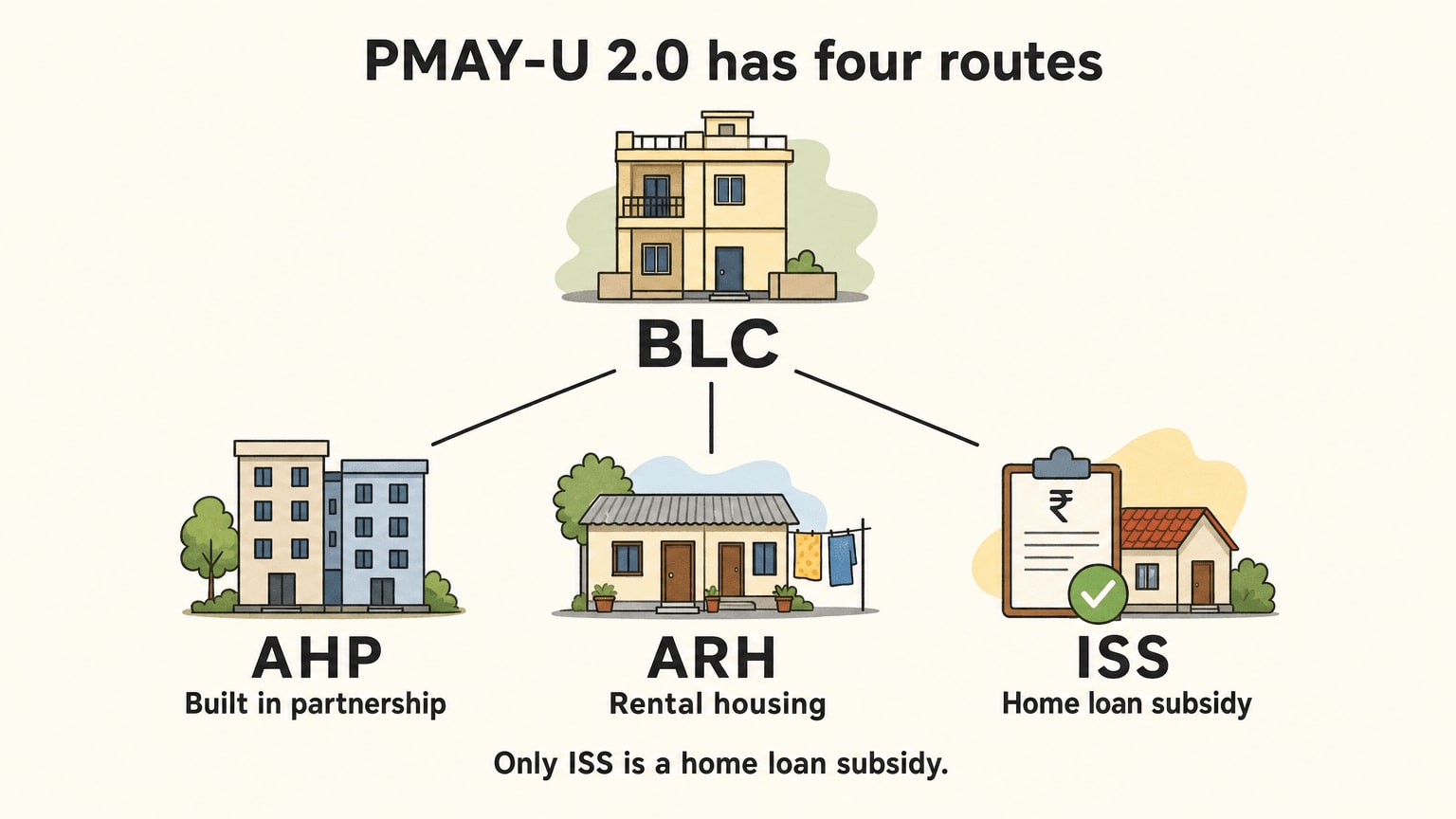
Government pages say PMAY-U 2.0 runs through four verticals. Pick by what you want to do, not by what a bank advertises.
The four PMAY-U 2.0 routes
| Vertical | What it is | Who it fits |
|---|---|---|
| BLC (Beneficiary-Led Construction) | Help to build a house on land you own | EWS families with their own plot |
| AHP (Affordable Housing in Partnership) | Houses built with states and cities; vouchers for private projects | EWS families buying a built home |
| ARH (Affordable Rental Housing) | Rental housing for working women, industrial workers, migrants, students | People who do not want to own yet |
| ISS (Interest Subsidy Scheme) | Subsidy on a home loan for a house you buy or build | EWS, LIG and MIG families taking a loan |
Source: ThePrint on the Cabinet approval and PMAY-U 2.0 FAQ. The "who it fits" column is my reading of both.
The official page says assistance under the scheme is up to 2.50 lakh per unit. That is a per-unit ceiling for the scheme as a whole, and it is not what the loan subsidy pays. I could not read a page that splits it by vertical, so I am not quoting a share.
Who is eligible: EWS, LIG and MIG limits
Income is annual household income. The ISS page sets it at up to ₹3 lakh for EWS, ₹6 lakh for LIG and ₹9 lakh for MIG.
Income groups under PMAY-U 2.0
| Group | Annual household income |
|---|---|
| EWS | Up to ₹3 lakh |
| LIG | ₹3 lakh to ₹6 lakh |
| MIG | ₹6 lakh to ₹9 lakh |
Source: PMAY-U 2.0 ISS page and FAQ, read 2026-11-04
Then the rules that trip people up. Your family, meaning husband, wife and unmarried children, plus dependent parents, must own no pucca house anywhere in India. The FAQ excludes anyone who took a housing scheme benefit in the last 20 years, and NRIs. Houses should be in the name of the woman who heads the household, or jointly with her. Where there is no adult woman, a man can hold it alone. Widows, single women and persons with disabilities get preference.
What the interest subsidy pays, in rupees
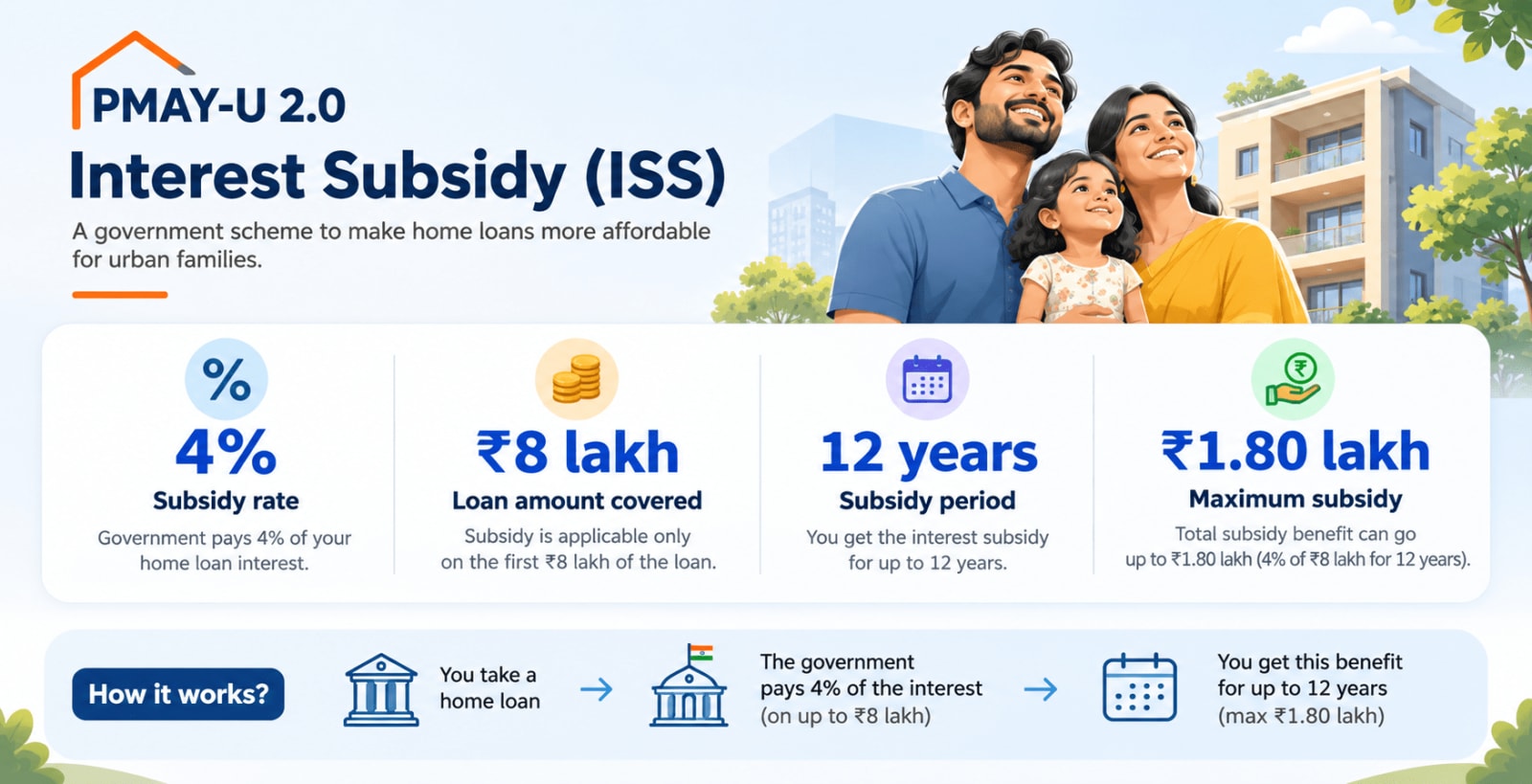
This is the part people search for. The ISS page says households with income up to ₹9 lakh get a subsidy of 4.0% on the first ₹8 lakh of the loan, for up to 12 years. The loan can be up to ₹25 lakh and the house up to ₹35 lakh, with carpet area up to 120 sqm. The subsidy never exceeds ₹1.80 lakh.
Here is what that looks like, and it is illustrative, not a promise. Take a ₹25 lakh loan on a ₹35 lakh flat, the biggest the scheme allows. Only the first ₹8 lakh is subsidised. The other ₹17 lakh carries your lender's full rate. And 4% of ₹8 lakh is ₹32,000, which is the most the subsidy could cover in year one, since interest falls as you repay. The page also says the maximum present value (NPV, discounted at 8.5%) is ₹1.50 lakh, so the ₹1.80 lakh is a ceiling and not a cheque.
One surprise. The page I read gives the same rate and cap to EWS, LIG and MIG. Your income group decides whether you qualify, not how much you get.
The money is not paid to you. It is released in 5 equal yearly instalments into your loan account, while the loan is active and more than 50% of the principal is outstanding. The FAQ adds that pre-closing within the 5-year lock-in generally means a partial recovery of the subsidy.
How to apply for the PMAY scheme
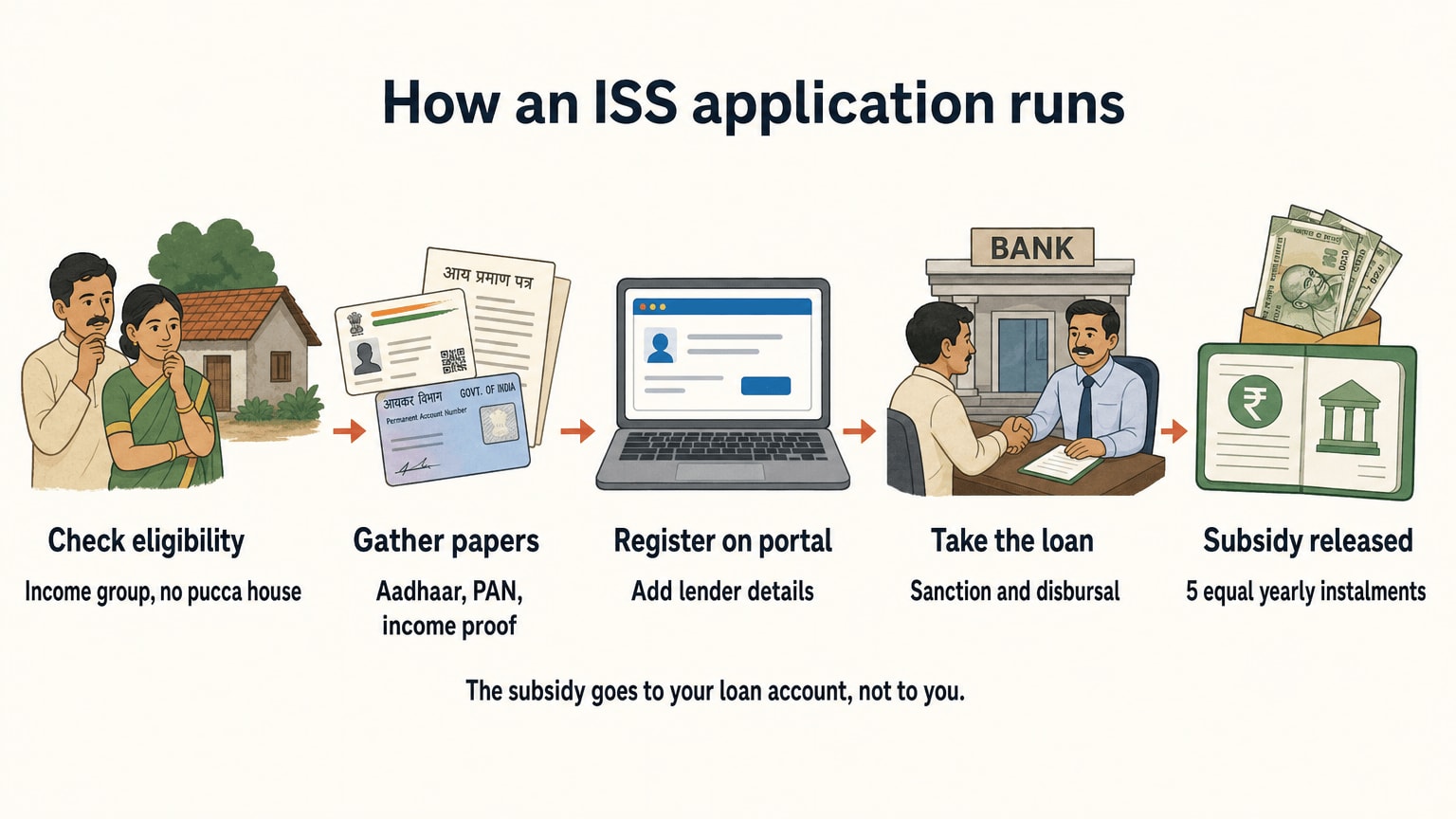
For ISS, you register on the Unified Web Portal first. The FAQ says you cannot apply for the subsidy directly through a lender, and that you provide your lender's details when you register. You can also apply at a Common Service Centre or your local municipality.
- Check you fit the income group and own no pucca house.
- Gather Aadhaar, PAN, proof of address and an income certificate. The ISS page accepts a self-certificate or affidavit as income proof for an individual applicant. For BLC you also need land papers and an affidavit that you own no pucca house.
- Register your demand on the portal and choose your vertical.
- Take the loan from a lender. Only loans sanctioned and disbursed on or after 1 September 2024 count.
- The lender claims the subsidy and it reaches your loan account in instalments.
Whether a given lender takes part is for the lender to confirm, so ask before you pay any fee.
Checking status and fixing a rejection
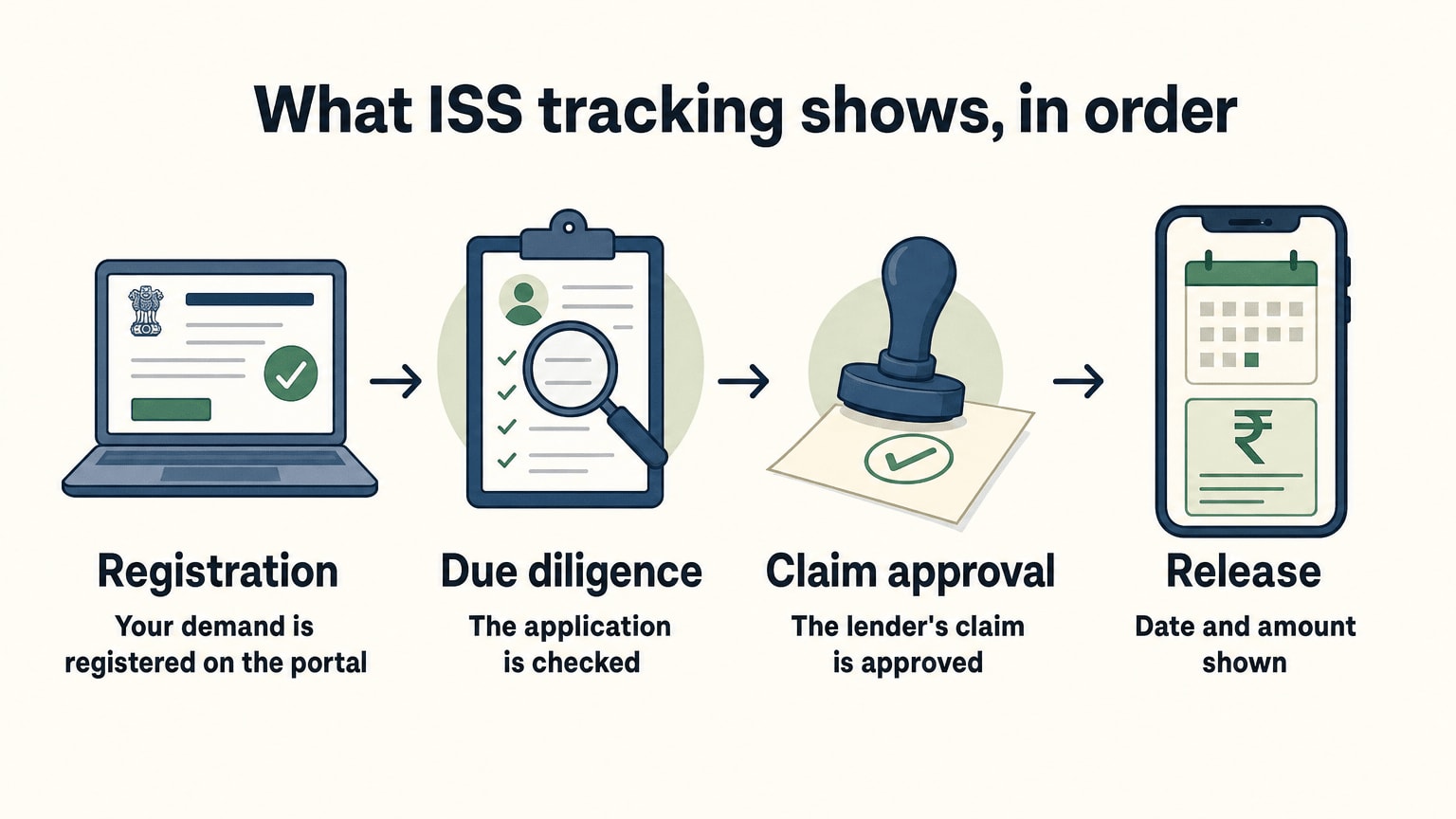
You can track an application on the portal or the mobile app with your user code, Application ID or registered mobile number. For ISS, tracking shows registration, due diligence, claim approval, and the date and amount of release.
Rejections happen. The FAQ says an error report with the reason is generated, and your lender must tell you what it says. A rejected applicant can edit the application and reapply. Other things that stop money: the loan turns into an NPA (a non-performing account, meaning missed repayments), the principal falls below 50%, or a second subsidy is claimed on the same property. Only one is allowed per property. The page also lists a false income declaration and a balance transfer among the exclusions.
I found no separate beneficiary list for ISS. The FAQ points to Application ID tracking instead.
Is the scheme still open in 2026?
For now, yes. On 17 October 2026 All India Radio reported more than 1.93 lakh additional houses approved under PMAY-U 2.0, after the 10th sanctioning committee meeting, taking the total above 20 lakh. I also saw reports of an extension to 30 September 2026. That date has passed and I could not confirm what it covered, so I am leaving it out. Read the deadline on the portal.
Where the loan side fits
The subsidy lowers the cost of a loan. It does not replace one. The lender still checks your income, your credit report and the property, and still decides on approval and rate. If you are buying, Butter Money's new home loan page lets you compare lenders for the purchase. Run your CIBIL check first, because a lender's application can add a hard enquiry. For what tenure does to your EMI, the EMI calculator post has illustrative numbers.
This is general information, not legal or tax advice. For a disputed title or a joint-ownership edge case, ask a professional.
Frequently asked questions
Who is eligible for the PMAY scheme?
EWS, LIG and MIG urban families with annual household income up to ₹3 lakh, ₹6 lakh and ₹9 lakh, owning no pucca house anywhere in India. Anyone who took a housing scheme benefit in the last 20 years is excluded, as are NRIs, per the official FAQ.
How much subsidy do I get under PMAY 2.0 ISS?
4.0% on the first ₹8 lakh of the loan for up to 12 years, never more than ₹1.80 lakh. It is paid in 5 equal yearly instalments into your loan account.
Is PMAY only for first-time buyers?
It is for families with no pucca house anywhere in India, and the subsidy is given once per property. So in practice it suits a first home. A family that already owns a pucca house is excluded.
Is PMAY Urban the same as PMAY Gramin?
No. Urban (PMAY-U 2.0) covers towns and cities and has four verticals. Gramin (PMAY-G) covers villages, with Rs 1.20 lakh a house in plain areas.
How do I check my PMAY application status?
Use your user code, Application ID or registered mobile number on the Unified Web Portal or the mobile app. For ISS it shows registration, due diligence, claim approval and release.
Can I apply for the subsidy directly through my bank?
No. The FAQ says ISS demand is registered on the Unified Web Portal with your lender's details.


