
Bhulekh Odisha: Check RoR and Plot Map Online
Bhulekh Odisha in one page: where to type, what you get
In short: Bhulekh Odisha is the state's land records site at bhulekh.ori.nic.in. Pick district, tahasil and village, then search by plot, khatiyan or tenant name to see the RoR. The free view is for checking, not for proof.
Most people come here with one job. See what the record says about a plot, get the map, find out whether a sale has reached the register. The portal does the first two for free. The third takes a visit or a status page, and the fourth, proof, takes a signed copy.
If you are checking papers because you plan to buy with a home loan, Butter Money's new home loan page is the next step once the land side is clear: you can compare lenders for the purchase there. Butter Money is not a lender, and it has no part in your land record.
A word on how I wrote this. On 29 October 2026 I opened the Bhulekh page that the Revenue and Disaster Management Department links to. What loaded for me was the session timeout screen and the Odia font instructions, not the search form. So I have not clicked through the live screens, and I am not going to pretend I did. The click paths below come from the third-party guides I read, and I say so where it matters. Where a label on your screen differs from mine, trust your screen.
Check a RoR on Bhulekh, step by step
The Bhulekh site is bhulekh.ori.nic.in, designed and developed by the National Informatics Centre, Bhubaneswar. Type it into the address bar yourself. Plenty of pages that rank for this search are guides, lender blogs or clones.
Two things about the site itself. It times you out if you use the browser's Back, Forward or Refresh button, click an option twice, or sit idle. And the text is in Odia, so if you see empty boxes where words should be, the page offers an Odia font to install. Both are on the page I read.
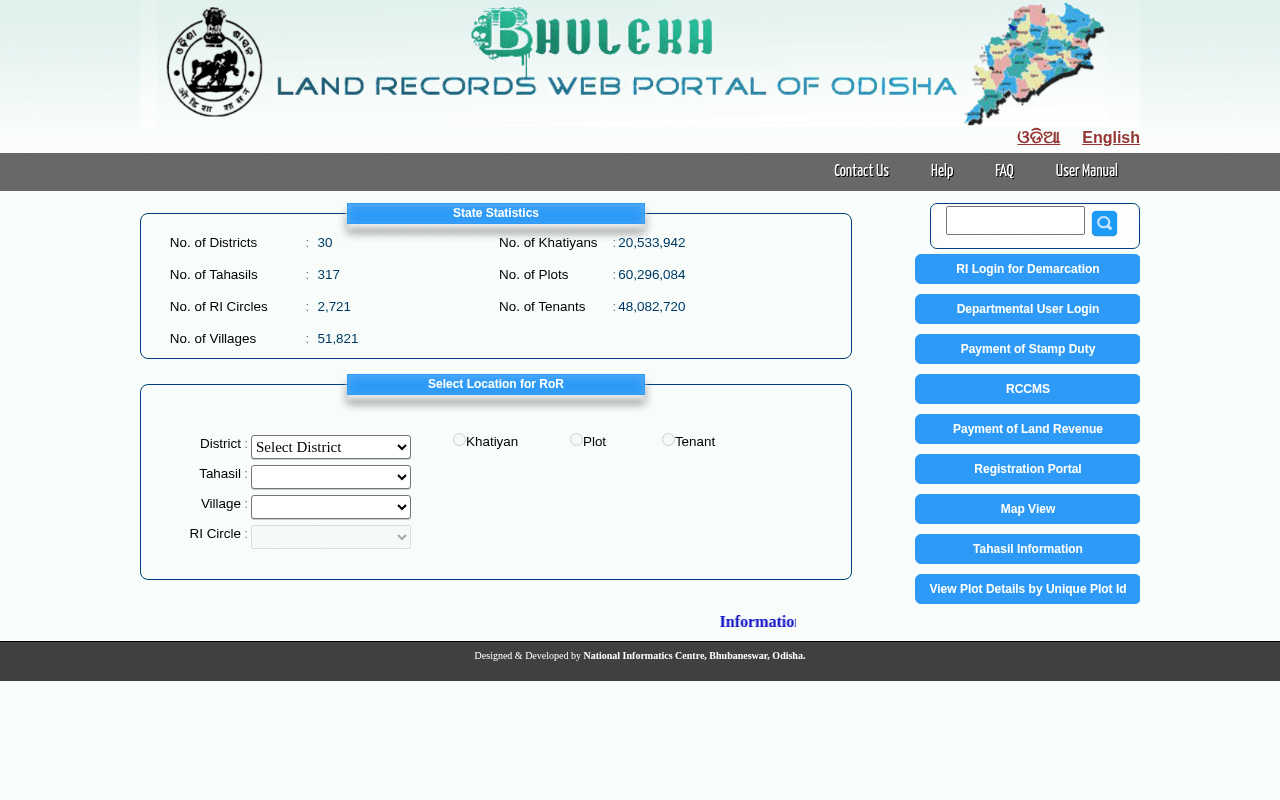
The steps, per the guides:
- Open the site and choose the RoR view.
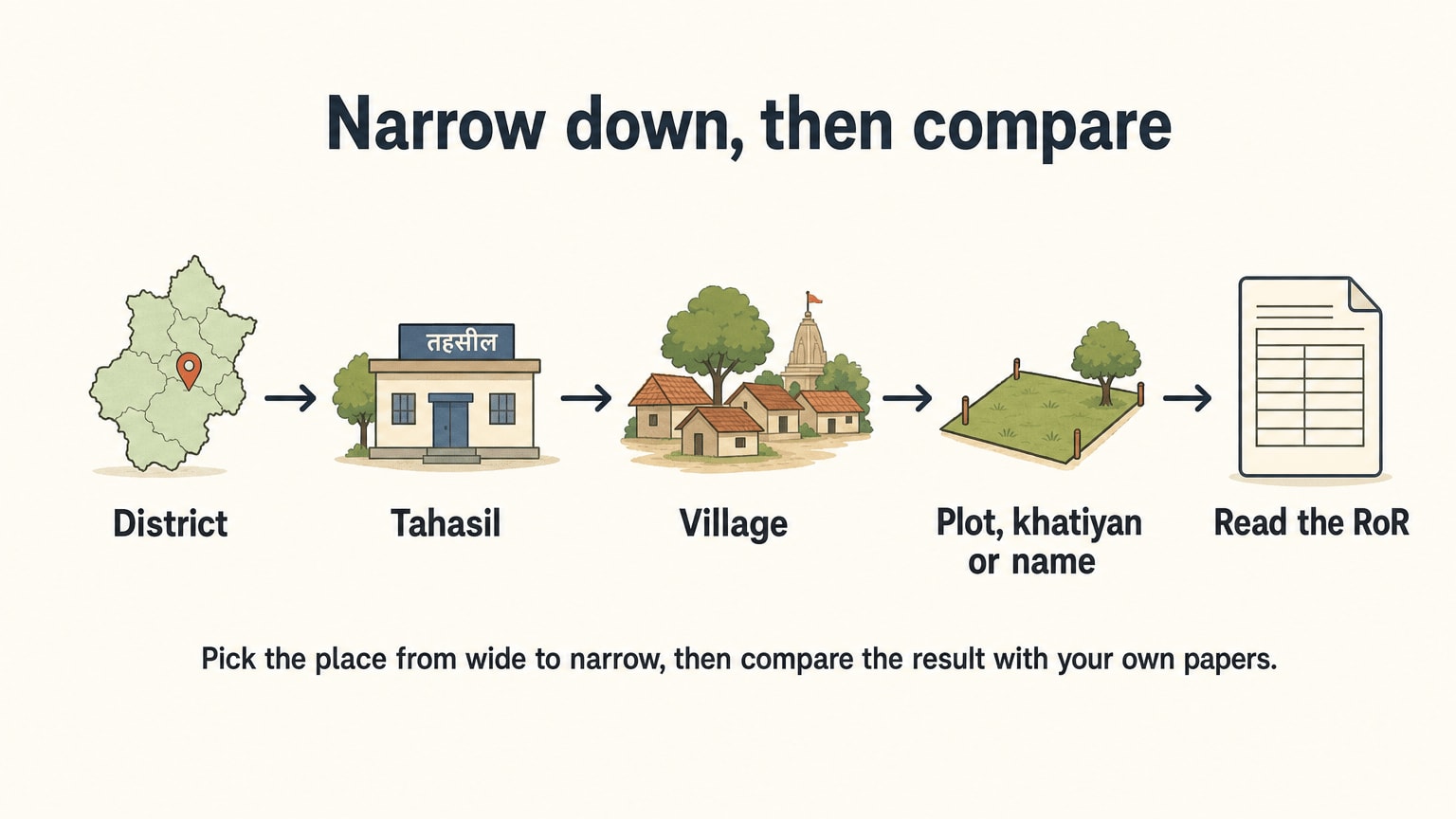
- Pick the district, then the tahasil, then the RI circle, then the village. Do them in order. The lower boxes fill after the upper ones.
- Check the village against your sale agreement. The list follows the revenue village, which may not be the name people use.
- Choose how to search (next section).
- Type the number or name, solve the captcha and submit.
- Open the RoR and read it against your own papers.
CitizenNest describes the same order. One thing the guides disagree on is whether RI circle is its own box. If your screen has it, fill it.
Search by plot, khatiyan or tenant name
You rarely have every identifier. The guides list three ways in, and 1acre adds a plot list.
Which search to use, by what you hold
| You have | Search by | What comes back | Watch for |
|---|---|---|---|
| A khatiyan number from an old receipt | Khatiyan | Every plot and holder under that khatiyan | One khatiyan can cover many plots |
| A plot number from the seller | Plot | The record for that plot | Check the village first |
| Only the holder's name | Tenant name | A list to sift | Spelling variants hide records |
Source: CitizenNest and 1acre, third-party guides, read 2026-10-29
CitizenNest says plot or khatiyan searches are more accurate than the name search. That fits what you would expect. Names are written in Odia and may carry a father's or husband's name, so one spelling difference and the record is not there. If a name search fails, don't conclude the land is unrecorded. Try the number.
Write down one line the first time you find it: district, tahasil, village, khatiyan, plot. Every other job here asks for some of it again.
Reading the RoR: the Odia fields in one table
The RoR is the Record of Rights, and in Odisha the khatiyan is that record. Several guides use the two words for the same thing, so you don't need to hunt for a difference. The khatiyan has a front page with the holder, rent and cess, and a back page that lists each plot, per Anantamias.
I found no official glossary I could open, so this table gives how the guides use the words. Check each against the record in your hand.
Fields on an Odisha RoR, in common usage
| Word | What it usually means | Why it matters |
|---|---|---|
| Khatiyan | The holding-level record of rights | The number you search by, and the one that groups plots |
| Plot | One survey unit within the khatiyan | The map is drawn plot by plot |
| Kisam (kissam) | The class of land as recorded in the settlement | Conversion of land use is a separate process |
| Rakaba | Area, in acres and decimals and in hectares | Compare it with the deed |
| Chouhaddi | Boundaries, written as the neighbour on each side | Compare it with what you see on the ground |
| Swatwa (satwa) | The nature of the right; many entries read sthitiban, the settled or occupancy status | It is the clue to what kind of holding this is |
| Hal and Sabik | Current and previous possession records, per CitizenNest | Old papers may match the Sabik |
Source: Anantamias and CitizenNest, read 2026-10-29. Spellings vary between guides.
Two traps. A khatiyan number and a plot number are different things, and putting one in the other's box returns nothing. And kisam is not a detail. 1acre's guide says even a certified copy does not clear the classification, so a restricted class needs its own check.
Match the RoR to the BhuNaksha plot map
The RoR says who holds a plot. The map says where it sits and what it touches. Buyers who skip the map tend to find the boundary problem on the day of measurement.
The Map View option on Bhulekh opens BhuNaksha Odisha, per Anantamias. The official BhuNaksha site is run by the same department and opens on a district dropdown with a Proceed button. After the district, the guides say you go to the village sheet. I could not get further than that dropdown, so I can't tell you the exact buttons for finding or downloading a plot.
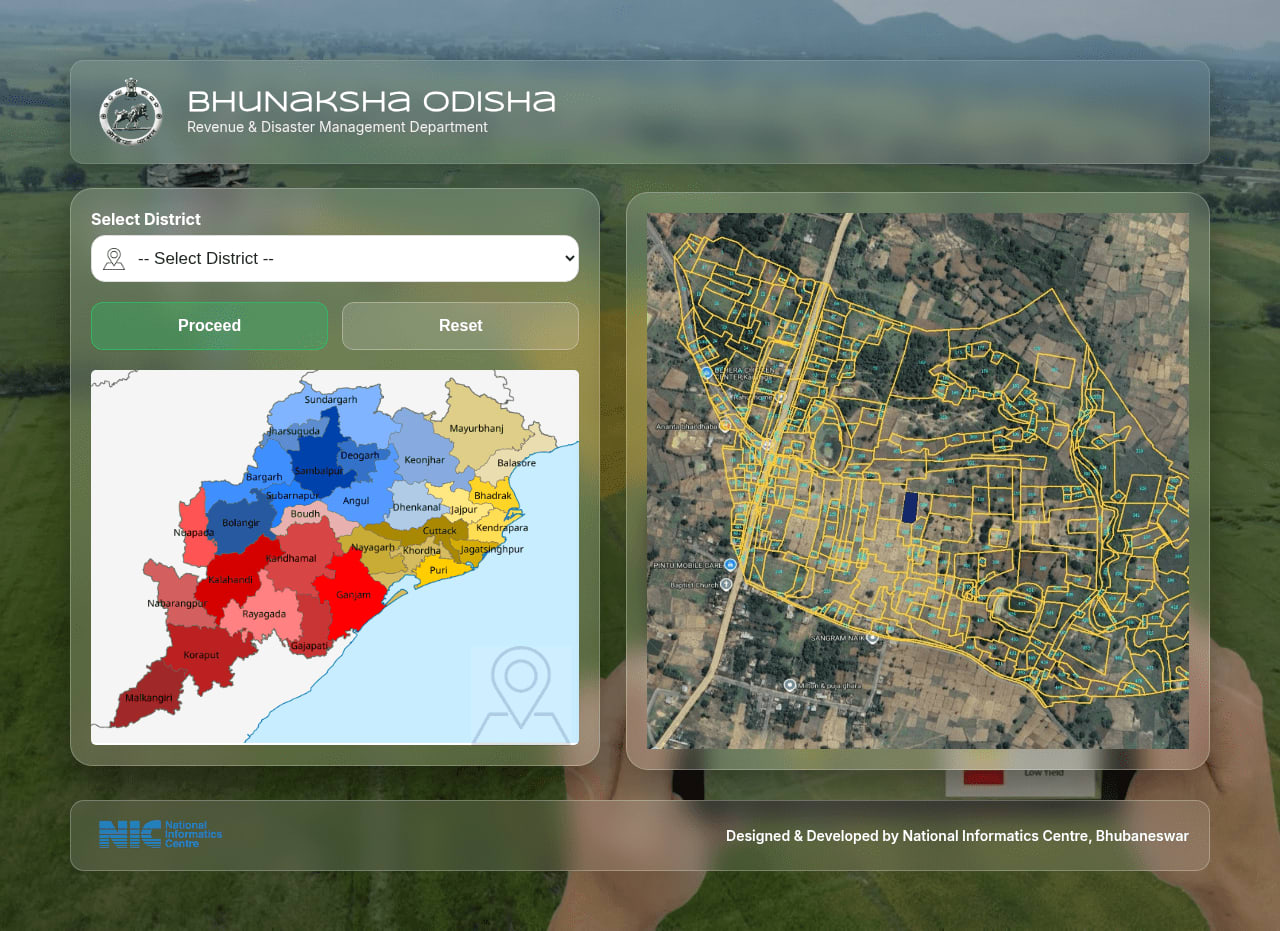
What I can pass on is the limit. Anantamias quotes BhuNaksha's disclaimer that the maps are "for viewing only and are not meant for any legal purpose". Use the map to check, then compare:
- The plot number on the map should match the plot on the RoR.
- The area on the RoR (rakaba) should be near what the map suggests.
- If the two disagree, 1acre's advice is a fresh survey through the Amin before you pay.
Free view or certified copy?
This one decides whether your paper is useful.
The online view is free, and every guide I read says it is for reference. 1acre calls it "for verification only" and says that for sale registration and bank loans you need a certified Khatiyan copy issued by the Tahasildar. CitizenNest says the same: a copy with legal validity comes from the Tehsildar or RI office.
I could not confirm the fee or the timeline for a certified copy. The department's user-fees page lists a resolution on computerised certified copies from the Tahasildars, dated 18/08/2017, and another on e-District certified copies, but prints no amounts. The guides quote different fees and different waits, so I am quoting none. Ask the Tahasil, and ask the bank or registrar what form and date of copy they want.
One more limit. Even a certified copy speaks to possession and kisam, says 1acre. The registered deed carries title. If a bank asks for the paper, a lawyer who works on Odisha land can tell you which one they mean.
Mutation, and what to do when the record is wrong
A sale deed moves ownership. Mutation moves the name on the record. After a registered sale the buyer applies at the Tahasil, and until it is done, 1acre warns, Bhulekh may keep showing the previous owner. For most buyers it is the step to do soonest.
Guides disagree on where to apply. Some say through the department's services portal, some through Bhulekh. They agree on one thing: once the Tahasildar has instituted the case, you track it on the DWIST portal at dwistodisha.nic.in. I did not open that site, and I found no official fee or processing time, so ask the Tahasil.
When something looks wrong, work down this list, easiest first.
Common problems and what to try
| What you see | What to try first |
|---|---|
| Timed out | You used Back or Refresh, or sat idle. Restart from the home page |
| Odia text shows as boxes | Install the Odia font the page offers, then reload |
| Village not in the list | Use the revenue name from an old receipt, not the postal one |
| Name not found | Search by khatiyan or plot number instead |
| Record shows the old owner | The mutation may not be done. Ask the Tahasil whether the order is final |
| Name or area differs from the deed | 1acre suggests a corrigendum or affidavit at the Tahasil, or a fresh survey for area |
Source: Anantamias and 1acre, read 2026-10-29. First tries, not official fixes.
I found no helpline number on a page I could open. If the portal won't help, the Tahasil that holds the register is where a visit with your papers settles more than a fourth attempt at a captcha.

A buyer's check: Bhulekh, BhuNaksha and the deed
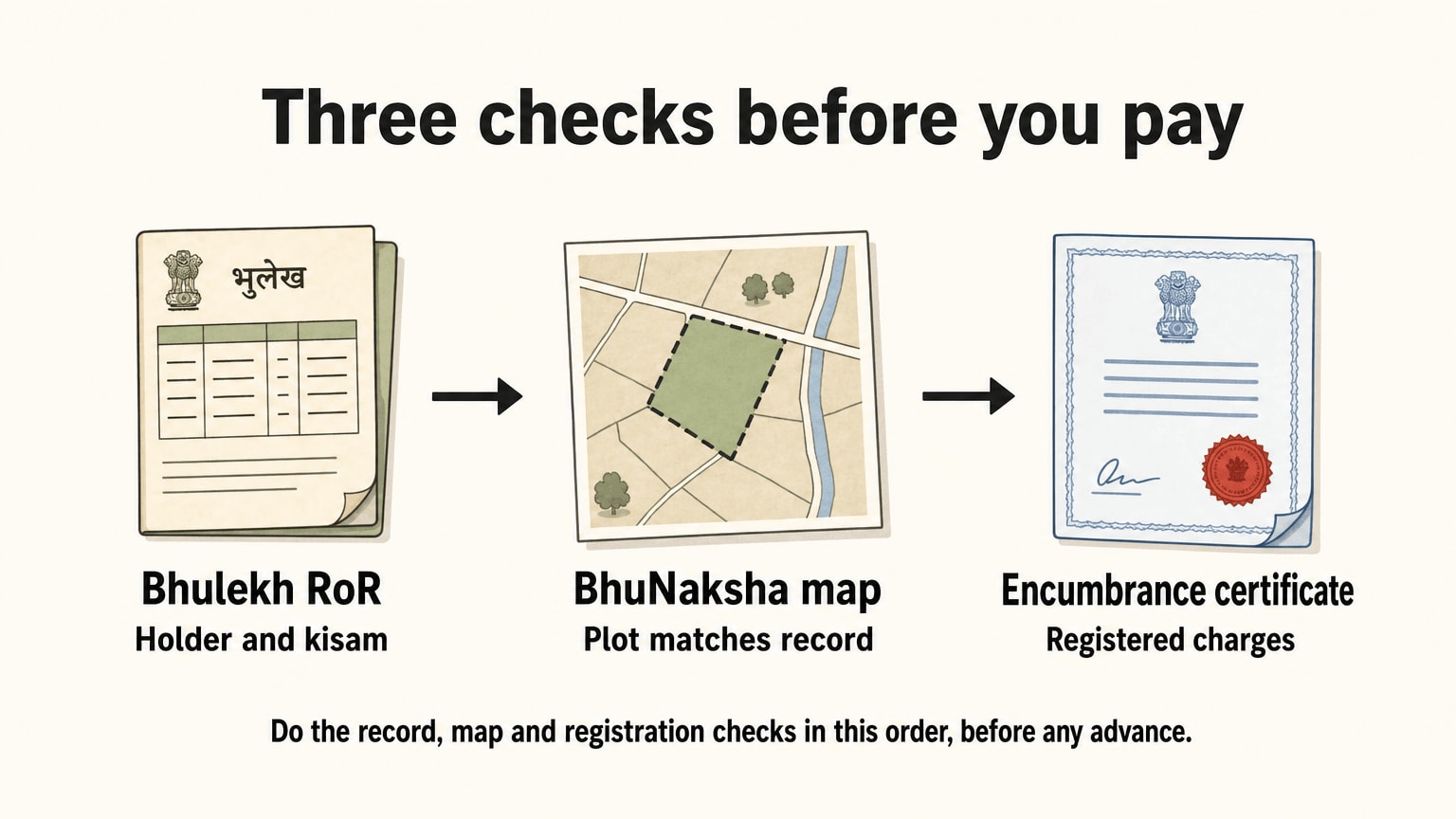
A clean RoR can sit next to a charge on the property. So a buyer's check has three parts, and it comes before any advance.
What each check tells you
| Check | Where | A mismatch means |
|---|---|---|
| Who the record shows as holder, and the kisam | Bhulekh RoR | The seller may not be the recorded holder |
| That the plot on the map is the plot on the record | BhuNaksha, then Bhulekh | Numbers or boundary don't agree |
| Registered transactions on the property | The registration office's encumbrance certificate | A deed or charge you weren't told about |
I could not read an official page on how to get the encumbrance certificate in Odisha, so I am giving the check but no click path. Ask the sub-registrar's office. And an encumbrance certificate lists only what was registered. A family arrangement never put on paper won't show.
Why a lender cares about these papers
If you are buying a plot or flat with a home loan, the lender asks where the land stands. For most lenders that means the record of rights, the registered deed and any charge on the property. A name that doesn't match or a gap in the chain of ownership can slow a file. None of it is about your income or score. It is about the property.
Fix the land side first. A lender's application can add a hard enquiry to your credit report, as the post on the free CIBIL score check explains, and you don't want to spend one on a file held up by a record problem. If your score needs work first, how to improve your credit score gives seven steps.
If you want to see which lenders would take your profile before you apply anywhere, the eligibility check shows offers from 40+ lenders in about 2 minutes without a hard inquiry. It looks at you, not at the land, so the land papers still go through the lender's own checks. To see what the monthly payment looks like at different tenures, the EMI calculator comparison walks through 20, 25 and 30 years. Same exercise in another state? The Banglarbhumi guide and the Bihar Bhumi guide cover theirs.
This is general information, not legal advice. For a disputed title, an inheritance with several heirs or a land-use conversion, a lawyer is worth paying.
Frequently asked questions
What is the official Bhulekh Odisha website?
It is bhulekh.ori.nic.in, which the Revenue and Disaster Management Department links to and which NIC Bhubaneswar developed. Type it into the address bar yourself. Pages ending in .com or similar are guides or clones, not the government's.
How do I check my RoR on Bhulekh Odisha by plot or khatiyan number?
Choose district, tahasil, RI circle and village, then pick plot or khatiyan as the search type, enter the number and complete the captcha. This is the order the guides describe. Follow the labels on your screen if they differ.
Is a Bhulekh RoR download legally valid?
For most purposes, no. The guides I read call the online copy reference or verification only, and say sale registration and bank loans need a certified copy from the Tahasildar. For a court case or a disputed title, ask a lawyer.
What is the difference between RoR and khatiyan in Odisha?
In Odisha the khatiyan is the Record of Rights, and the guides use the two words for the same record. The khatiyan number groups the plots held under one holding.
How do I view my plot map on BhuNaksha Odisha?
Use Map View on Bhulekh or open the BhuNaksha site, choose the district, then the village sheet. I could not read further than the district dropdown. The maps carry a viewing-only disclaimer.
How do I check mutation status or correct an error?
After the Tahasildar institutes a mutation case, guides say to track it on dwistodisha.nic.in. For a wrong name or area, ask the Tahasil about a corrigendum or a fresh survey. I found no official fee or time.


