
PNB Housing Finance: Loans, Rates, Owner, Contacts
PNB Housing Finance is not Punjab National Bank
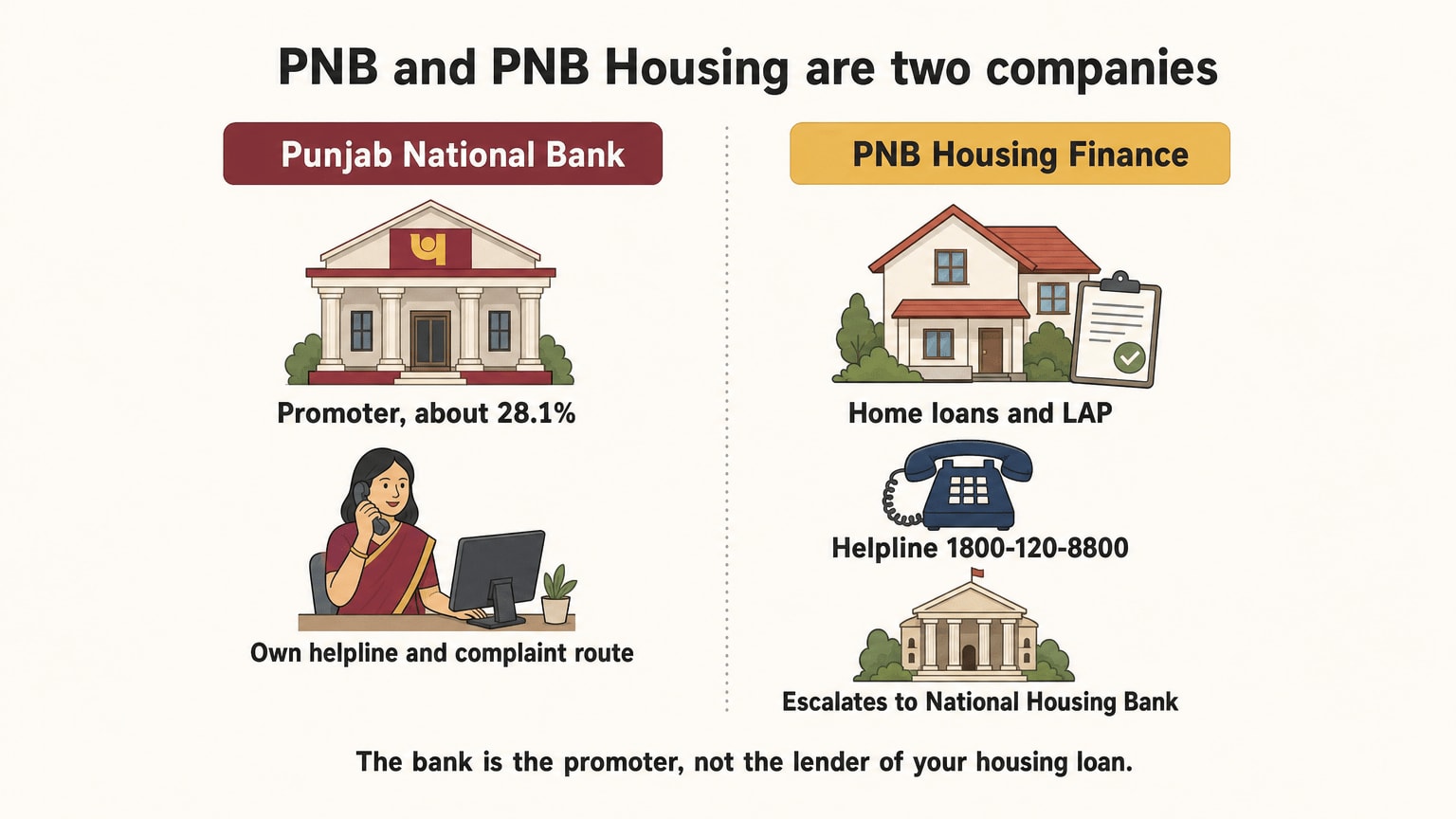
In short: PNB Housing Finance is a separate listed company, not Punjab National Bank. The bank is its promoter, with about 28%. Its home loan page says rates start as low as 7.50%*, read on 4 November 2026.
Type "PNB" into a search box and you get two companies mixed together. Punjab National Bank is a bank. PNB Housing Finance is a housing finance company, a lender that does home loans and little else. Their phone lines, complaint routes and rate pages are different, and a lot of pages that rank for this name quietly blur the two. That's how people end up ringing the bank's helpline about a housing loan.
The two companies side by side, as this post describes them
| Punjab National Bank | PNB Housing Finance | |
|---|---|---|
| What it is | A bank | A housing finance company, listed on the NSE and BSE |
| What it lends | Not covered in this post | Home loans and little else (plus loan against property) |
| Ownership | The promoter, with about 28% | A separate company with its own books |
| Customer care | Its own lines, different from PNB Housing's | 1800-120-8800 |
| Where a complaint ends | Its own route | The National Housing Bank, after the company's four levels |
If you want to see which lenders would take your profile before you apply anywhere, the eligibility check shows offers from 40+ lenders in about 2 minutes without a hard inquiry. Butter Money is not a lender, so PNB Housing's rate, sanction and timeline stay with PNB Housing.
Below: who owns it, what it lends, the rate and fee it publishes (with the date I read them), what it asks you to bring, how to complain, and a short note on its deposits and its shares. I read the company's own pages on 4 November 2026. Its home page sat behind a CAPTCHA for me, so I could not click through the customer portal and I won't describe screens I haven't seen. Where the company's pages disagree with each other, I say so.
Who owns PNB Housing Finance
It started as a subsidiary of the bank. Wikipedia says it began operations on 11 November 1988 as a wholly owned subsidiary of Punjab National Bank, and is headquartered in New Delhi. Its shares have traded on the NSE and BSE since November 2016.
Is it a government company, then? Not in the way the bank is. Punjab National Bank is the promoter, and its stake is about 28.1% (as per wikipedia). A shareholding tracker, Upstox, shows the promoter at 28.01% for the September 2026 quarter, on a page dated 4 November 2026. The same page shows foreign institutional investors at 14.19% and the public at 8.51%. So the bank is the largest named holder, but it does not hold most of the company.
The history has had other owners in it. Wikipedia says the Carlyle Group's Quality Investments Holdings bought a 49% holding in February 2015, and later sold it. I couldn't read the company's own shareholding filing, because the PDF came back as unreadable text, so treat the 28% as "about 28%", and check the latest quarterly filing on the NSE or BSE if the exact figure matters to you.
One thing follows from this, and it's worth saying plainly. Having a bank as promoter is not the same as a bank guaranteeing your loan or your deposit. PNB Housing is a company with its own books, its own ratings and its own regulator. For housing finance companies, the grievance route in the company's own procedure ends at the National Housing Bank, not at the bank's customer care.
What PNB Housing Finance lends
The loan page lists these under its housing loan headings: Home Loan, Plot Loan and Home Construction Loan. Under "other home loans" it lists Home Extension Loan, Home Improvement Loan and a home loan for NRIs. It also lists Loan Against Property, and two "Roshni" loans: a Roshni Home Loan and Pradhan Mantri Awas Yojana 2.0.
For most readers the plain home loan and the loan against property (LAP) are the two that matter. A home loan is for buying or building. LAP lends against a property you already own, so the money isn't tied to buying one. Butter Money has its own page on loan against property, which says LAP goes up to ₹5 crore. That is Butter's figure, not PNB Housing's limit. I didn't find PNB Housing's LAP limit on a page I could read.
The company also lists products for developers and commercial borrowers. I'm leaving those out. This site covers home loans, balance transfers, top-ups and LAP, and that is the part I can speak to.
How much will it fund? The loan page says PNB Housing "can sanction and finance up to 90% of the house value", and adds that the percentage depends on the loan amount. So 90% is a ceiling, not a promise. As an illustration only: on a flat valued at ₹100 lakh, the most it could finance at that ceiling is ₹90 lakh, and you'd bring the other ₹10 lakh. A bigger loan usually gets a lower percentage, so don't plan around the ceiling.
Tenure is up to 30 years, with repayment to finish by age 70, per the same page. If you want to see what that does to the monthly figure, the post on 20, 25 and 30 year EMIs runs the same loan at three tenures. Those numbers are illustrative.
PNB Housing Finance home loan interest rate and fees
This is the number most people came for, and it's the one I'd trust least without a date. So here is what the company's own pages say, and when I read them.
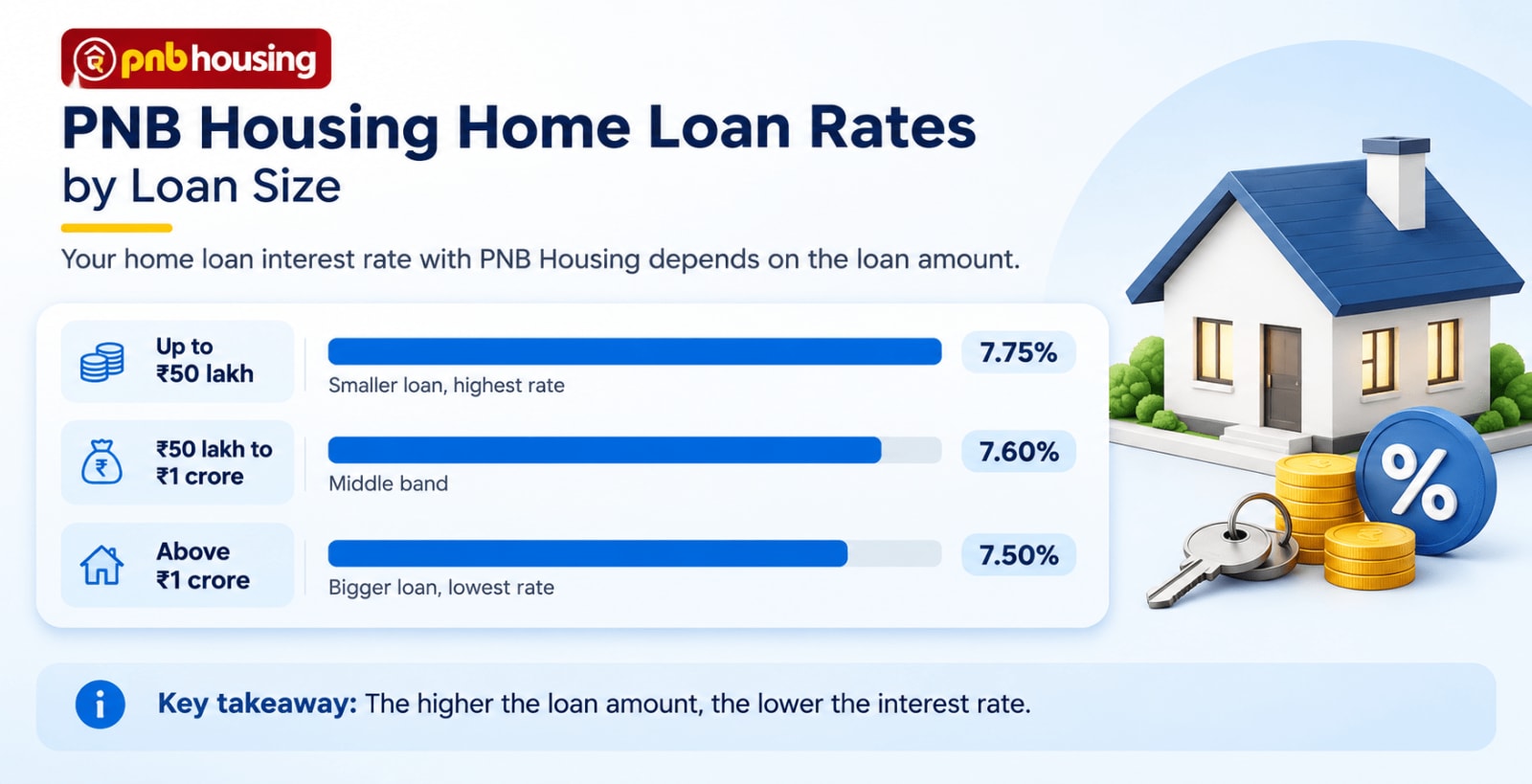
PNB Housing's home loan rate table, floating rates, read 4 November 2026
| Loan amount | Rate on the page |
|---|---|
| Up to ₹50 lakh | 7.75% |
| ₹50 lakh to ₹1 crore | 7.60% |
| Above ₹1 crore | 7.50% |
Source: PNB Housing home loan page, read 4 November 2026. The page carries no effective date.
The headline on that page says rates "start as low as 7.50%*". The asterisk matters, and so does "start": it's where the range begins, not what you'll be offered. Your rate depends on your profile, and PNB Housing sets it.
Now the part I can't resolve for you. The same page has an FAQ that quotes "7.90%" for salaried applicants and "8.10%" for self-employed ones. That doesn't match the table above it. The page has a blank "last update" field, so I can't tell which is newer. If two numbers on one lender's page disagree, the sanction letter is the only one that counts. Ask for the rate in writing, with the benchmark and the reset date.
Why it moves. Home loans like this are floating. On 7 October 2026, according to a PSU Connect report of the Monetary Policy Committee's decision, the RBI raised the policy repo rate by 25 basis points to 5.50 per cent and moved its stance from neutral to calibrated tightening. I couldn't reach the RBI's own statement, so that rests on the news report. I also can't tell you whether PNB Housing's page was updated after the move. When your benchmark resets, your EMI or your tenure can change, and the repo rate post explains which one and how to find your reset date.
The processing fee
PNB Housing's loan page says only that it charges "a low processing fee that is competitive in the market". No number. The company's own blog on processing fees says the fee is "up to 1% for Home Loan", that it is generally non-refundable, and that fees, charges and rates are subject to change at the company's discretion. That page has no date either.
So the honest answer is "up to 1%, plus whatever else applies", and I can't say whether GST is on top, because that page doesn't mention it. Third-party sites quote flat amounts and other percentages. They disagree with each other, so I'm not repeating them. Ask the branch for the fee schedule for your loan, in writing, before you pay anything.
Prepayment is the other one to check. The company's blog says in one place that a lender "may levy a prepayment penalty", and advertises "No Prepayment or Foreclosure charges*" in another, with the conditions not shown. Under the RBI's directions, lenders can't levy prepayment charges on loans to individuals for non-business purposes that are sanctioned or renewed on or after 1 January 2026, as the EMI tenure post explains. Older loans can differ. Check your own agreement.
If you'd like to see how this lender's published rate sits among others, Butter Money's lenders page lists rates and fees "onwards" for the lenders it works with. They're site-published figures and they move.
Eligibility and documents
What I could read on the home loan page, as a table.
What PNB Housing's loan page asks for, read 4 November 2026
| Item | What the page says |
|---|---|
| Age | 21 years or above at application, and not over 70 at maturity |
| Monthly income | ₹15,000 and above |
| Credit score | Minimum 611 CIBIL |
| Work history, salaried | 3+ years |
| Business continuity, self-employed | 3+ years |
Source: PNB Housing home loan page, read 4 November 2026.
Read that 611 as the company's published floor, not a guarantee that a 611 gets a loan. A minimum is the point below which the answer is no. Above it, your income, your other EMIs, your credit history and the property decide the rest, and a lower score usually pushes the rate up. If you don't know your own number yet, the post on a free CIBIL score check walks through pulling it, and how to improve your credit score covers what to fix first.
Documents
The page lists two sets.
Salaried: the application form, age and residence proof, your last 3 months' salary slips, Form 16 for 2 years, your last 6 months' bank statement, and the property documents.
Self-employed: the application form, age and residence proof, business income proof and ITR, proof that the business exists, your last 3 years' ITRs, balance sheets certified by an accountant, 12 months of bank statements, and the property documents.
The salaried list is shorter and the self-employed list is heavier, and the bank statement period alone differs by half a year. If you're self-employed, start collecting the ITRs and the certified balance sheets first. They take the longest.
The property papers are where most delays come from, and they have nothing to do with you. A mismatched name or a gap in the chain of ownership slows any lender. If you're buying in West Bengal, Bihar or Odisha, the guides to Banglarbhumi, Bihar Bhumi and Bhulekh Odisha show where each record lives.

How to apply and what to do about the portal
I'd rather tell you what I couldn't do than invent a login path. The company's home page returned a security check to my tools, so I haven't seen the customer portal or any app, and I'm not going to name one.
What I can stand behind is the order of things, which holds for any lender:
- Pull your credit report and fix errors before anyone else sees it.
- Pick the EMI you could pay in a bad month, and the tenure that gives it.
- Gather the documents above.
- Apply through the lender's own site or a branch, and ask for the sanction letter in writing.
- Read the letter for the rate, the benchmark, the reset date and every fee.
Each application to a lender can add a hard inquiry to your report, which is why people check what they'd be offered first. Butter Money's eligibility check is the one step it describes as not touching your credit score. The application itself is a different matter.
The company's loan page also gives a "Talk to an Expert" number and a text option: call 1800-120-8800, or send "PNBHFL" by SMS to 56161. Both are on the page I read on 4 November 2026.
Customer care and how to complain
The number is the same one: 1800-120-8800. That's PNB Housing's, not the bank's. The bank's lines are different, and it's the mistake I'd most want you to avoid. If your loan is with PNB Housing, a call to Punjab National Bank's helpline gets you nowhere.
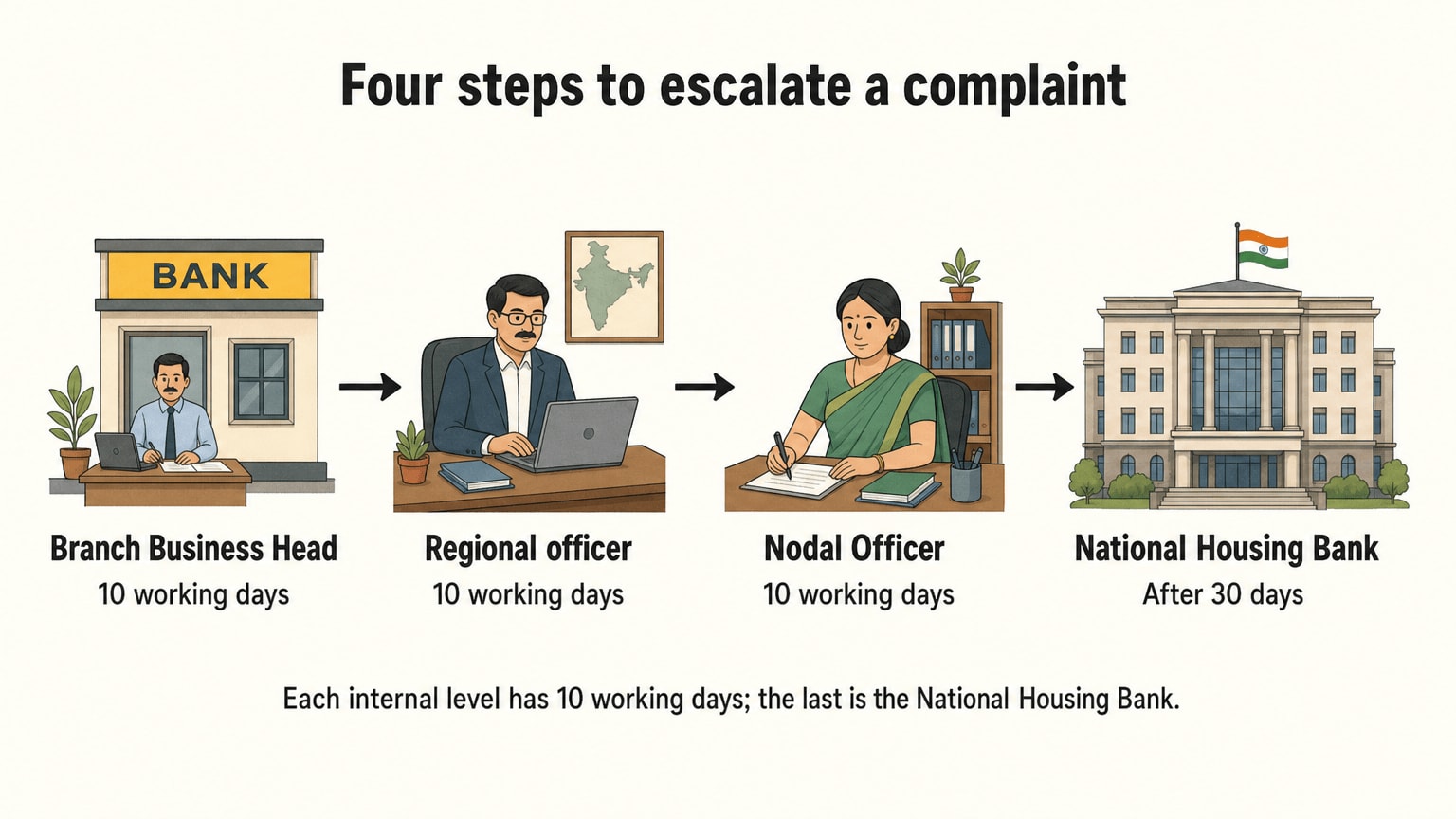
The company's grievance page sets out four levels. I've kept its time limits as written.
PNB Housing's complaint route, as its grievance page describes it
| Level | Who | Time limit |
|---|---|---|
| 1 | Branch Business Head of your loan's service branch | Final response within 10 working days |
| 2 | Regional Grievance Redressal Officer | 10 working days |
| 3 | Nodal Officer | 10 working days |
| 4 | National Housing Bank | If unresolved within 30 days of the above |
Source: PNB Housing grievance procedure, read 4 November 2026.
Level 1 takes walk-ins, email (customercare@pnbhousing.com), phone or a letter. Level 3, the nodal officer, is reachable at nodalofficer@pnbhousing.com or 0120-6239100, or by post at PNB Housing Finance Ltd., 9th Floor, Antriksh Bhawan, 22 Kasturba Gandhi Marg, New Delhi 110001, with "Grievance Redressal" written on the envelope. The page lists no office hours for any level. Level 4 is the National Housing Bank's Grievance Redressal Department in New Delhi, with an online portal named on the company's page.
Two habits help. Write the complaint down and keep the date, even if you also phone. And say what you want: a corrected statement, a refund of a charge, a document. A complaint that names the fix gets a clear answer faster than one that describes the mood.
The page doesn't mention the RBI at all, only the National Housing Bank. I'd go by what the company publishes and what your sanction letter says. For anything legal, a lawyer is the right person.
PNB Housing fixed deposits
Most people searching this name want a loan. But the company also takes public deposits, and that is a gap on most pages that rank.
What its FD page says, read 4 November 2026: rates "up to 7.40% P.A" for 60 months tenure only, with a limited-period offer shown at 7.10%. The minimum tenure is twelve months, and 60 months is the longest listed. There's a lock-in of 3 months for premature withdrawal. Senior citizens above 60 get an extra 0.25% a year. Corporate deposits start at ₹25,000, and the page gives no minimum for individuals.
I couldn't find the full rate table by tenure, because the page links to it separately, and the page has no effective date. So treat 7.40% as the top of the range, not what a 12-month deposit pays.
On safety: the company's credit ratings page lists its fixed deposits as rated AAA (Stable) by CARE and by CRISIL. It records CRISIL's upgrade to AAA/Stable on 7 October 2026 and CARE's upgrade from AA+/Stable on 7 May 2026. The FD page also carries a banner reading "AAA/Positive" for CRISIL, which doesn't match, so I'd go by the ratings page, which is dated.
A rating is an agency's opinion of how likely the company is to pay. It isn't a guarantee, and a deposit with a housing finance company isn't the same as a bank deposit. Whether an FD suits you is a question for your own situation and, for edge cases, an adviser.
The stock, briefly
PNB Housing is listed on the NSE and BSE. I'm not going to give you a share price, a P/E or a dividend history. I couldn't read a primary page for any of them: the company's factsheet came back as unreadable text, and the stock pages that rank either blocked me or didn't show where their numbers came from. A figure I can't trace doesn't go in.
What I can say is what the ownership above tells you: a promoter near 28%, foreign institutions at 14.19%, the public at 8.51%. For a live price and the latest filings, use the exchanges. Whether to buy is advice I can't give, and a SEBI-registered adviser can.
NSE's own page for the company opens the live quote and the filings it has published.
Frequently asked questions
Is PNB Housing Finance the same as Punjab National Bank?
No. PNB Housing Finance is a separate company that does housing loans. Punjab National Bank is its promoter, with about 28%, per Wikipedia and a shareholding tracker. The two have different customer care lines and complaint routes. PNB Housing's number is 1800-120-8800.
Is PNB Housing Finance a government company?
Not directly. It began in 1988 as a wholly owned subsidiary of Punjab National Bank, and the bank is still its promoter. But the bank holds about 28%, not a majority, and the company's shares trade on the NSE and BSE.
What is the PNB Housing Finance home loan interest rate?
PNB Housing's loan page says rates start as low as 7.50%*, with a table showing 7.75% up to ₹50 lakh, 7.60% for ₹50 lakh to ₹1 crore and 7.50% above ₹1 crore, read on 4 November 2026. The page is undated and its FAQ quotes 7.90% and 8.10%. Your rate is the lender's call.
What is the PNB Housing Finance customer care number?
1800-120-8800, listed on the company's loan page and grievance page. You can also SMS "PNBHFL" to 56161. For complaints, escalate from the branch to the regional officer, the nodal officer, then the National Housing Bank.
What is the minimum CIBIL score for a PNB Housing loan?
The loan page lists a minimum of 611. That's a published floor, not a promise. Income, existing EMIs and the property also decide the outcome, and the lender sets the final rate.
Does PNB Housing Finance offer loan against property?
Yes, its loan page lists Loan Against Property among its products. I couldn't find its LAP rate or limit on a page I could read, so ask the company, or see Butter Money's page on loan against property for how LAP works across lenders.
What is the processing fee on a PNB Housing home loan?
The company's blog says up to 1% for a home loan, generally non-refundable, and subject to change. The loan page gives no figure. Ask for the fee schedule in writing.
Does PNB Housing take fixed deposits?
Yes. Its FD page shows up to 7.40% p.a. for 60 months, a twelve-month minimum tenure and an extra 0.25% for senior citizens, undated. Its ratings page lists the FDs as AAA (Stable) by CARE and CRISIL.


