

Home Loan Overdraft: How It Works, Who It Suits and What to Ask First
You have ₹5 lakh sitting in a fixed deposit and an ₹80 lakh home loan charging more than the deposit earns. A home loan overdraft lets you park that money in the loan account. It cuts your interest while you can still withdraw it.
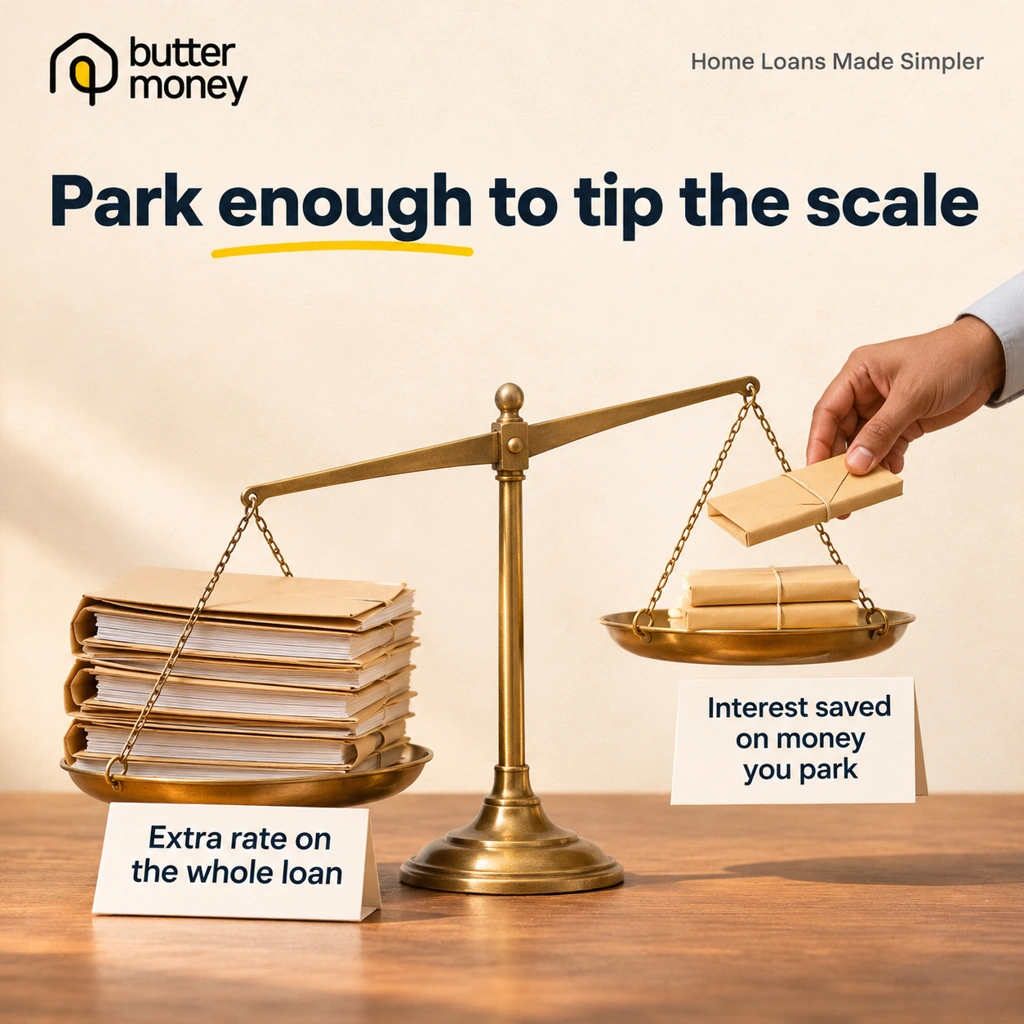
The catch is the rate. Lenders usually charge a little more on an overdraft loan, and that extra applies to the whole loan, not only the part you offset.
This guide shows how the overdraft works and how much you need to park to come out ahead. It also covers who it suits and what to ask before you sign.
Have a rough surplus figure in mind? Run it through the overdraft calculator and see the interest it could save. Free, no sign-up, and nothing goes to any lender. Open the overdraft calculator
Key takeaways
- A home loan overdraft charges interest on your loan minus the money you park, and you can withdraw the parked money later.
- The overdraft rate is usually a little higher, and that extra applies to the whole loan.
- With a 0.40% higher rate, you need to keep roughly a ninth of the loan parked before it beats a regular loan plus an FD.
- Prepaying a regular loan saves the most interest, but the money is gone. The overdraft trades some of that saving for access.
- Parked money doesn’t count as principal repaid, so it earns no principal deduction under the old tax regime.
What is a home loan overdraft?
A home loan overdraft is a home loan run like a current account. You still pay a fixed EMI. Any extra money you deposit lowers the balance the bank charges interest on, and you can take it back out when you need it.
The lender approves the loan as an overdraft limit. At SBI, whose overdraft home loan is called MaxGain, the limit you can draw falls each month by the principal part of your EMI. The account is cleared by the end of the loan’s tenure.
How the interest is worked out
Lenders typically charge interest on the daily balance: the loan outstanding minus whatever you’ve parked that day. Step by step:
- You park money. Say ₹5 lakh goes in on the 1st.
- Interest drops from that day. On an ₹80 lakh loan, you pay interest on ₹75 lakh.
- Your EMI stays the same. Less of it goes to interest, so more goes to principal.
- You withdraw if you need it. Interest rises again on the amount you take out.
What kinds of overdraft home loans are there?
There are three main kinds, and they solve different problems. Ask the lender which one you’re being offered, because the same word covers all three.
| Kind | How it works | Example, as described on the lender’s site |
|---|---|---|
| Overdraft loan account | The loan itself is an overdraft. Surplus parked in it lowers interest, and you can withdraw it | SBI MaxGain, which also comes as a Hybrid with at least 60% as a term loan. PNB Max-Saver, for loans from ₹10 lakh |
| Linked savings account | A regular home loan with a linked savings account. The savings balance at the end of each day reduces the interest | Bank of Baroda Home Loan Advantage |
| Overdraft top-up | A credit line on top of your home loan. You pay interest only on what you use | ICICI Bank Home Overdraft |
The first two are about parking surplus. The third is about borrowing more, so the maths in this guide doesn’t apply to it.
Home loan overdraft vs regular home loan vs prepayment
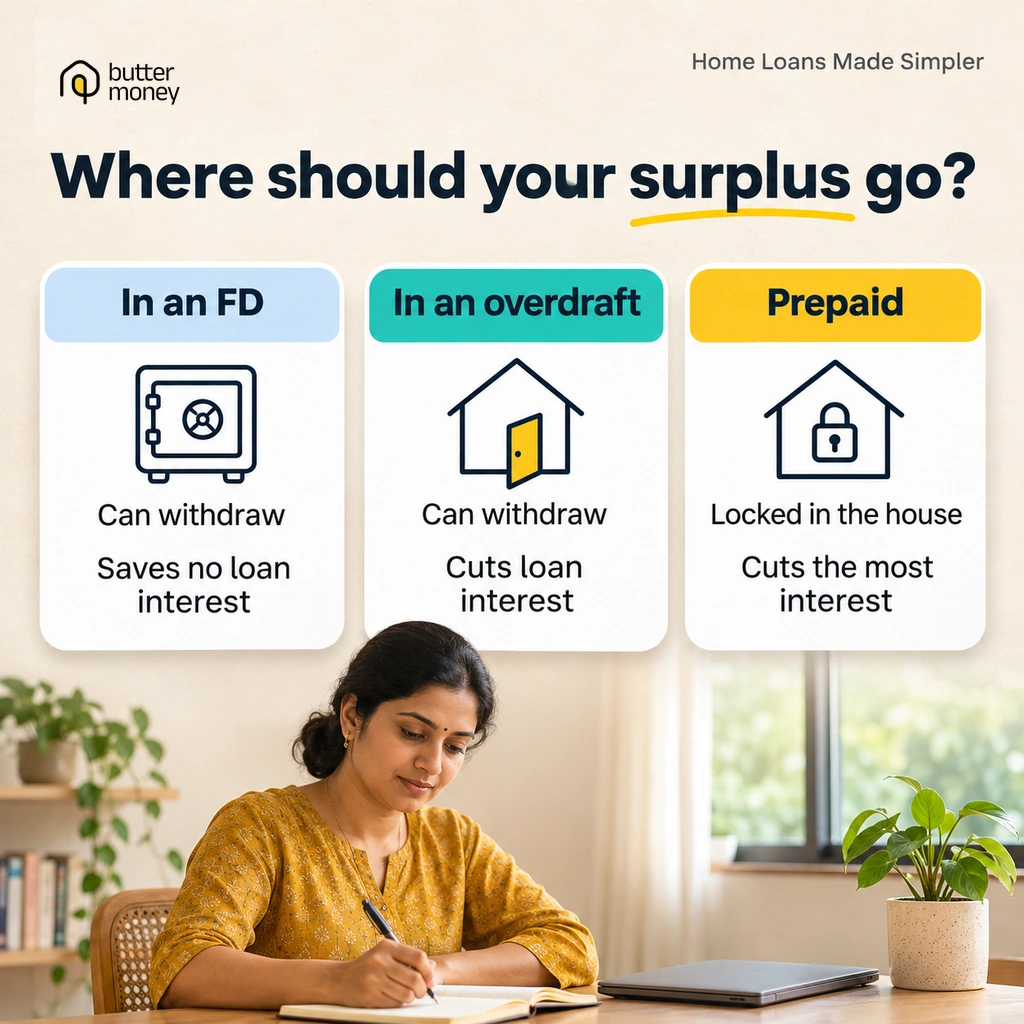
An overdraft saves less interest than prepaying the same money, but it keeps the money within reach. A regular loan with your surplus in an FD keeps the money reachable too, but saves nothing on the loan.
| Comparison Factor | Regular loan, surplus in FD | Overdraft home loan | Regular loan, surplus prepaid |
|---|---|---|---|
| Interest rate | Lender’s regular rate | Usually a little higher | Lender’s regular rate |
| Interest charged on | Full loan outstanding | Loan minus money parked | Loan after prepayment |
| Your surplus | Earns FD interest, which is taxed | Saves loan interest, which isn’t taxed | Saves loan interest |
| Can you get the money back? | Yes, by breaking the FD | Yes, withdraw any time | No, unless you take a top-up loan |
| Principal tax deduction (old regime) | On principal paid | Not on money parked | On principal paid, including prepayment |
| Prepayment charges | Not relevant | Not relevant | None on floating-rate loans to individuals sanctioned or renewed from 1 January 2026 |
The prepayment rule comes from the RBI’s Pre-payment Charges on Loans Directions, 2025. It covers floating-rate loans to individuals for non-business purposes. Older loans follow their sanction letter, so check yours. That removes one of the old selling points of overdraft loans.
How much surplus do you need to park?
With a 0.40% higher rate, keep about a ninth of your loan parked on average. That’s the point where it beats keeping the money in an FD. Below that, the extra rate on the whole loan costs more than the parked money saves.
The rule works like this. Divide the rate premium by the gap between the overdraft rate and what your money earns elsewhere after tax:
- Against an FD: at an 8.15% overdraft rate and an FD paying 6.5% before tax, someone in the 30% slab keeps 4.55%. That gives 0.40 ÷ 3.60, or about 11% of the loan.
- Against a savings account: at 2.5% before tax, you keep 1.75%. The bar drops to about 6% of the loan.
On an ₹80 lakh loan, that’s about ₹8.9 lakh parked against an FD, or ₹5 lakh against a savings account. Because the loan shrinks every year and your surplus usually grows, the same money clears the bar more easily later on.
The rate gap decides your break-even point, and advertised rates go to the strongest profiles. See which lenders would offer you an overdraft, and at what rate. One check across 40+ lenders, no CIBIL impact. Check your eligibility
Worked example: an ₹80 lakh loan with and without an overdraft
Illustrative figures. Rohan, 38, is a product manager in Bellandur taking home ₹2.4 lakh a month. He’s borrowing ₹80 lakh for 20 years. He has ₹5 lakh set aside and can add ₹15,000 a month.
His lender quotes 7.75% on a regular loan and 8.15% on the overdraft version. The overdraft EMI is ₹67,664 against ₹65,676. To compare fairly, the ₹1,988 difference goes into his savings or prepayment in the other two options.
| After | Regular loan, surplus in FD | Overdraft home loan | Regular loan, surplus prepaid |
|---|---|---|---|
| 1 year: still owed after counting savings | ₹70.94 lakh | ₹71.05 lakh | ₹70.74 lakh |
| Cash he can reach | ₹7.31 lakh | ₹6.80 lakh | Nil |
| 5 years: still owed after counting savings | ₹52.08 lakh | ₹51.60 lakh | ₹50.01 lakh |
| Cash he can reach | ₹17.70 lakh | ₹14.00 lakh | Nil |
| 10 years: still owed after counting savings | ₹21.10 lakh | ₹16.47 lakh | ₹13.25 lakh |
| Cash he can reach | ₹33.63 lakh | ₹23.00 lakh | Nil |
| Effectively debt-free after | 12 years 9 months | 11 years 10 months | 11 years 5 months |
Assumes rates stay the same, an FD at 6.5% before tax, the 30% slab and the new tax regime. “Effectively debt-free” means savings or parked money cover what’s left.
In the first year, the overdraft leaves Rohan about ₹10,000 behind the FD route, because the extra rate applies to all ₹80 lakh. By year five he’s about ₹48,000 ahead. By year ten he’s about ₹4.6 lakh ahead, with ₹23 lakh he can still reach.
Prepaying beats both on interest, by about ₹3.2 lakh over the overdraft at ten years. The cost is that none of that money is reachable without a new loan.
What if the surplus is small?
Run the same loan with ₹1 lakh parked and ₹3,000 a month. The overdraft stays behind the FD route at every point. After ten years, Rohan would be about ₹2 lakh worse off than on a regular loan with the same money in an FD.
Figures are indicative of typical market practice as of November 2026 and vary by lender, borrower profile, and over time.
Want to see what prepaying the same money would do instead? Compare it in the prepayment calculator. Free, instant, and nothing is shared with any lender. Open the prepayment calculator
Who does a home loan overdraft suit?
It suits borrowers who keep a large cash balance for months at a time but want to reach it quickly. It doesn’t suit borrowers whose surplus is small, or who would spend money that’s easy to withdraw.
It usually suits you if:
- You get large, irregular income, such as bonuses, business profits or project fees
- You’re self-employed and hold a cash buffer for slow months
- You’re saving towards a known cost a few years away, such as school fees or a renovation
- You’d otherwise keep a large emergency fund in a savings account or FD
It usually doesn’t suit you if:
- Your surplus is a few thousand a month, or comes and goes within weeks
- You’re likely to dip into the parked money for everyday spending
- You don’t need the money back. Prepaying a regular loan then saves more
- You need the money to earn more than your loan rate after tax
For self-employed buyers, the overdraft can sit alongside the business’s cash needs. Our guide to home loans for the self-employed covers how lenders read that income.
What does an overdraft do to your tax benefits?
Under the new tax regime, nothing changes. It doesn’t allow either home loan deduction on a self-occupied home. Under the old regime, the overdraft can cut both deductions, so check your numbers.
- Principal deduction: money you park is a deposit, not a repayment, so it doesn’t count. Only the principal paid through your EMI does.
- Interest deduction: the Income-tax Act, 2025 allows up to ₹2 lakh a year on interest for a self-occupied home. Parking money lowers your interest. On a large loan, yearly interest often stays above ₹2 lakh for years, so you may lose nothing early on.
Ask your chartered accountant to check your own case before you choose.
What to ask the lender before you sign
Get the answers to these in writing, ideally in the sanction letter, before you pay a processing fee:
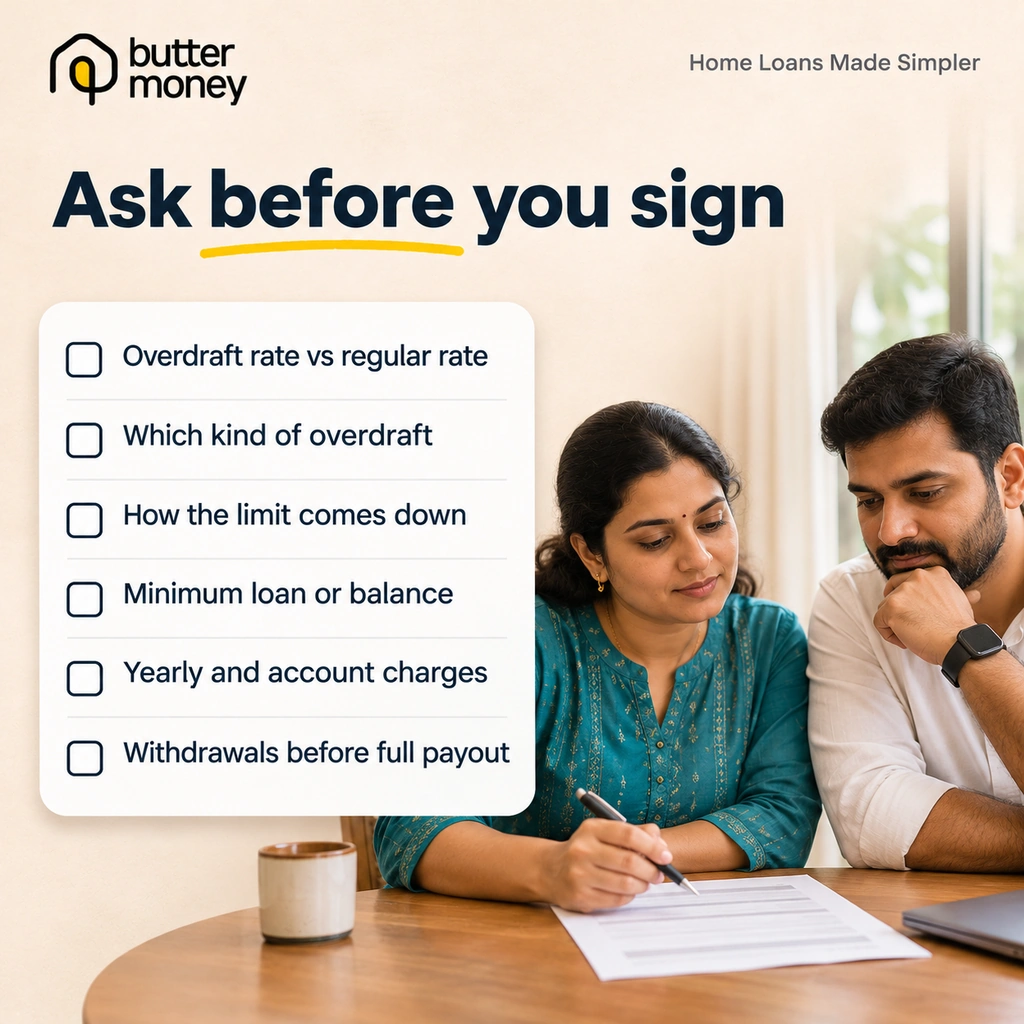
- What’s the overdraft rate today, and what’s the regular rate? Lenders rarely show the overdraft rate on their rate pages. Older press reports put the gap at about 0.20% to 0.50%.
- Which kind of overdraft is this? A parking account, a linked savings account or a top-up credit line work differently.
- How does the limit come down? At SBI and PNB it falls monthly by the principal part of your EMI. Ask whether you can withdraw everything above your balance.
- Is there a minimum loan size or a minimum balance? PNB, for example, offers Max-Saver on loans of ₹10 lakh and above.
- What does it cost to run? Ask about yearly renewal, account maintenance and debit card charges.
- Can you withdraw before the loan is fully paid out? On an under-construction home, some lenders hold the surplus until the full loan is released.
- Is the rate linked to the repo rate or the MCLR? That decides how fast rate changes reach you. Our guide to MCLR vs EBLR explains the difference.
Overdraft terms differ a lot between lenders, and they’re rarely on a rate page. Butter Money compares your profile across 40+ lenders and shows which ones offer an overdraft you’d qualify for, before any lender pulls your credit report.
Not sure the overdraft quote you’ve got is a fair one? Send it to a Butter Money advisor on WhatsApp and get the rate gap and charges checked. Free, no obligation, and no credit check at this stage. Chat with an advisor
Can you switch an existing home loan to an overdraft?
Sometimes. Ask your current lender first, because some will convert a loan for a fee. If yours doesn’t offer an overdraft, you can move the loan to a lender that does, through a balance transfer.
A transfer brings a fresh processing fee, legal and valuation charges, and paperwork. For floating-rate loans to individuals sanctioned or renewed from 1 January 2026, the old lender can’t charge a prepayment fee. Our guide to top-up loans and balance transfers covers the costs in detail.
FAQs
Is a home loan overdraft worth it?
It’s worth it if you keep a large surplus parked for long periods. With a 0.40% higher rate, that means roughly a ninth of the loan, on average, compared with keeping the money in an FD. With a small or short-lived surplus, a regular loan usually costs less.
Is the interest rate higher on an overdraft home loan?
Usually, yes. Lenders charge a little more because you get to withdraw the money. The gap varies by lender and isn’t always published, so ask for both rates in writing before you choose.
Does money parked in a home loan overdraft count as prepayment?
No. It lowers the balance you pay interest on, but it stays your money and you can withdraw it. For tax, it doesn’t count as principal repaid, so it earns no principal deduction under the old regime.
Which banks offer a home loan with an overdraft facility?
Several do, under different names. SBI offers MaxGain, PNB offers Max-Saver, Bank of Baroda links a savings account to the loan, and ICICI Bank offers an overdraft top-up. Terms and eligibility change, so check the current details before you apply.
Before you choose the loan type
Work out how much surplus you’ll keep parked, on average, for the next few years. If it’s well above a ninth of the loan, ask for an overdraft quote. If it’s smaller, take the regular loan and prepay or save on the side.
Already paying a regular home loan and thinking of switching to an overdraft? See what moving lenders could save you first. Free, and nothing is shared with any lender. Check your switching savings
Explore more:


